New Products
Winchester Systems announced the release of FlashDisk OpenRAID, a data storage array capable of supporting up to five heterogeneous servers. The servers share a storage pool by way of the U160 SCSI protocol, capable of scaling to 2.3TB. With the addition of an expansion chassis, FlashDisk OpenRAID can scale to 4.6TB, supporting up to three hosts. It supports dual redundant 64-bit RAID controllers and can be used for various disk-intensive tasks, such as database, multimedia, e-mail or Web server work. The SC-4400 is compatible with any server or OS and has no host software driver requirements.
Winchester Systems, 149 Middlesex Turnpike, Burlington, Massachusetts 01803, 800-325-3700, www.winsys.com.
The Red Hat Application Server is an open-source middleware platform for Java 2 Enterprise Edition (J2EE) applications. The server includes a runtime system and development libraries and is tested and supported on all major Java Virtual Machines, including Sun SDK, BEA WebLogic JRockit and IBM JDK. It also is certified with databases, including Oracle Database, IBM DB2, Sybase, PostgreSQL and MySQL. Red Hat Application Server includes JOnAS, Tomcat, Struts, supporting modules for file uploads and tutorials.
Red Hat, 1801 Varsity Drive, Raleigh, North Carolina 27606, 888-733-4281, www.redhat.com.

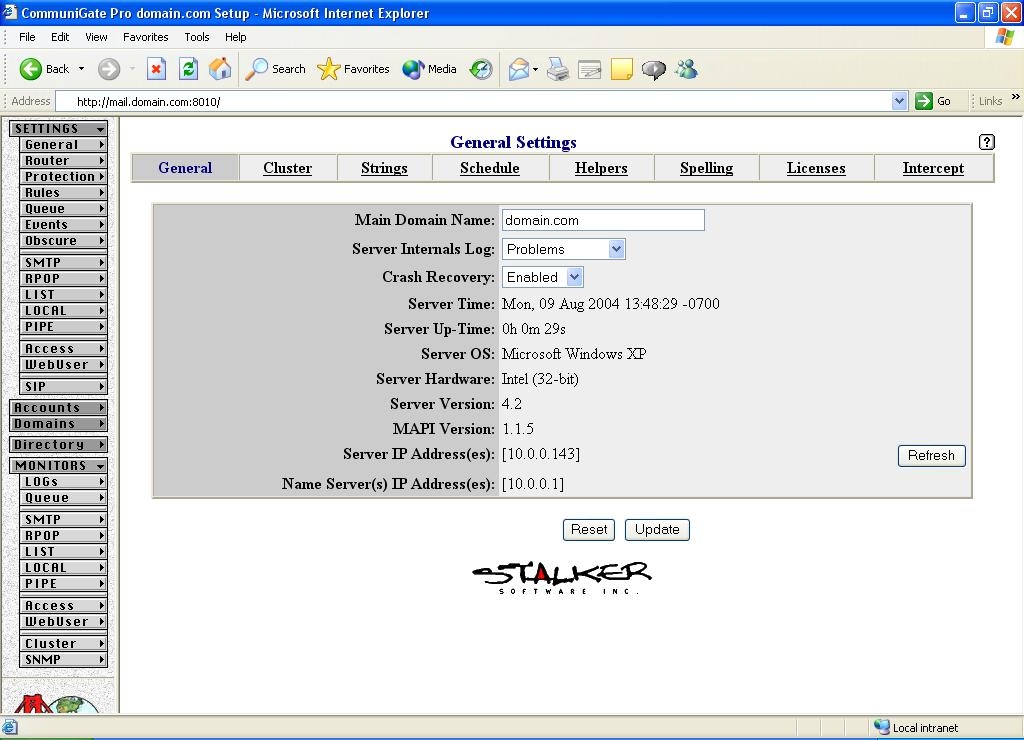
With the release of version 4.2, CommuniGate Pro Real-Time Communications now offers secure instant messaging, VoIP, video conferencing, whiteboard sharing and desktop and application sharing capabilities. Using a standards-based, cross-platform design enables CommuniGate Pro 4.2 to be utilized by any client, whether in office or remote, using session initiation protocol (SIP) on UNIX, Linux, Mac OS X or Windows. Also new for v4.2 is the choice of a fully customizable or preconfigured Web interface for Web-based mail and calendaring functions. In addition, CommuniGate Pro 4.2 offers remote administrative control features for troubleshooting, maintenance and updating duties.
Stalker Software, Inc., 655 Redwood Highway, Suite 275, Mill Valley, California 94941, 800-262-4722, www.stalker.com.
Unisys announced a new server line, ES7000 Servers for Linux, available in both 32-bit and 64-bit configurations. The ES7000 servers can include 4 to 32 Intel Xeon MP or Itanium 2 processors, 4 to 512GB of memory, 16 to 256MB of shared cache and 8 to 160 I/O slots, both PCI and PCI-X. Servers can be run as one single-image system, or they can be configured with as many as 12 logical partitions running several different OSes concurrently. ES7000 Servers are certified to run SuSE Linux Enterprise Server, Red Hat Enterprise Linux AS or both.
Unisys Corporation, Unisys Way, Blue Bell, Pennsylvania 19424, 215-986-4011, www.unisys.com.
The Wyse Winterm 5150SE is a thin client powered by the Wyse Linux V6 operating system and running on an AMD Geode GX 533 processor. Wyse Linux V6 is based on the 2.6 Linux kernel and offers customization for specific needs across a wide variety of platforms, including Windows, UNIX, Linux, IBM, X-Windows and Java. The Winterm 5150SE offers free seating capabilities so users can log in to different clients without losing their specific configurations. The modular design of the 5150SE allows features to be added and removed as needed. The thin client features a read-only filesystem, no moving parts and a compact chassis with USB and legacy I/O ports.
Wyse Technology, 3471 North First Street, San Jose, California 95134, 408-473-1200, www.wyse.com.
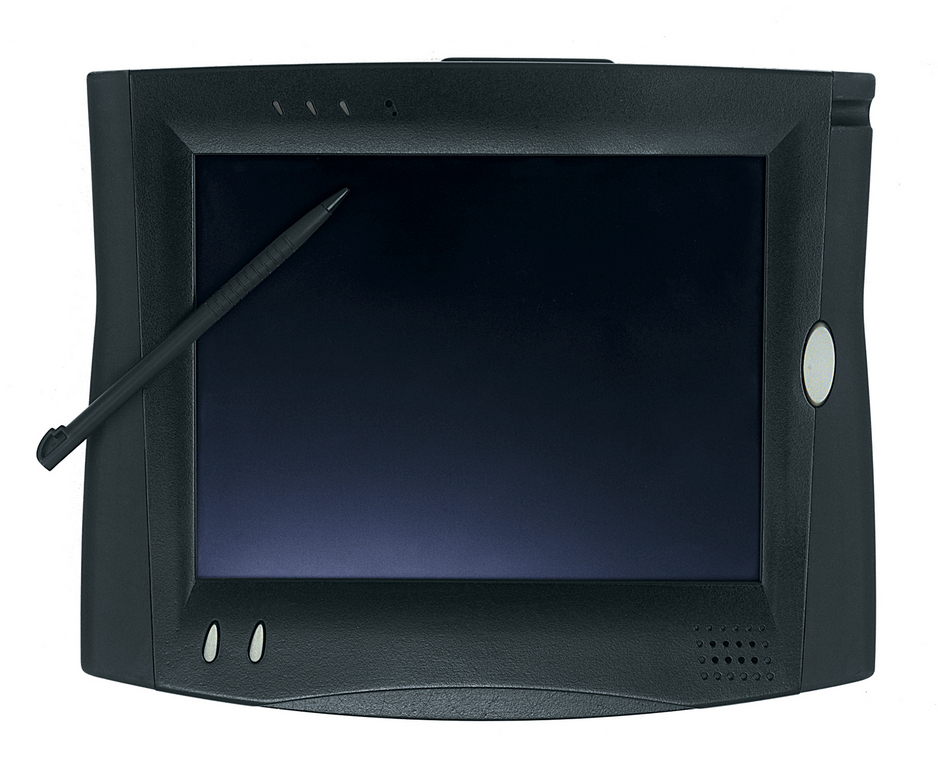
Xybernaut announced that its Atigo line of wireless panel computers now are available with Linux. Atigos can be used as wireless flat-panel display computers or standalone wireless-enabled mobile/wearable computers. Atigos support dual-use functions and are configured with built-in IEEE 802.11b WLAN wireless networking support through standard PC card and/or CompactFlash slots. Atigos with Linux also offer open-source tools for support, standard communication protocols, data management and system configuration. The Atigo T model uses a Crusoe TM5800 processor with a 1GHz CPU and offers 256MB of SDRAM and Flash memory configurations of 128, 256 and 512 MB or 1GB. All Atigos have internal rechargeable Lithium-ion batteries and optional hot-swappable external batteries. They all have 8.4-inch touchscreen-enabled 800 × 600 SVGA displays.
Xybernaut Corporation, 12701 Fair Lakes Circle, Suite 550, Fairfax, Virginia 22033, 703-631-6925, www.xybernaut.com.