
New Products
Octagon Systems released the XE-800, an SBC using the EPIC (embedded platform for industrial computing) form factor. Sized midway between the PC/104 and EBX form factors, the EPIC-based XE-800 is designed for embedded military, security, industrial and mobile applications. It can operate over a –40° to 75°C temperature range and features four USB 2.0 ports, two USB 1.1 ports, two eight-wire serial ports, 48 lines of digital I/O, 10/100 Base-T Ethernet, CRT and flat-panel video and PC/104 and PC/104-Plus expansion. A CompactFlash socket is available for bootable and removable memory, up to 2GB. Companion XE-800 OS Embedder kits, which include hardware and software for instant operation, are available for Linux 2.6 and QNX.
Octagon Systems, 6510 West 91st Avenue, Westminster, Colorado 80031, 303-430-1500, www.octagonsystems.com.

PathScale announced the availability of the EKO Compiler Suite for AMD Opteron and Athlon 64 systems. The EKO Suite offers C, C++ and Fortran 9X compilers and beta support for 32-bit x86 compilation. The PathScale compilers provide binary compatibility, with the ability to mix and match the linking of GNU GCC and PathScale compiled libraries and objects. The front ends are source-compatible with the GNU compiler suite for C/C++. The Fortran 95 compiler provides support for the most common Cray/SGI extensions, and in-line AMD64 assembly code also can be issued. The PathScale Compiler is available in installable Linux RPM format and is tested on SuSE, Red Hat and Fedora. The compilers can be purchased as subscriptions to the full EKO suite or to separate languages.
PathScale, Inc., 477 North Mathilda Avenue, Sunnyvale, California 94085, 408-746-9100, www.pathscale.com.
gumstix, Inc., introduced a new line of tiny Linux single-board processors (SBCs) and peripherals. Based on Intel's PXA255 processor with XScale technology, gumstix tiny boards measure 20mm × 80mm × 8mm. The line includes two gumxstix boards and two waysmall computers. The gumstix 200x and 400x boards feature 200MHz and 400MHz Intel PXA255, respectively; both offer 64MB of SDRAM, 4MB of Flash, an OS, an MMC.SDT slot and multiple I/Os. The waysmall 200x offers a gumstix 200x in a gumstix box, and the waysmall 400x offers a gumstix 400x. Both gumstix boxes feature two mini-DIN8 serial ports, one USB mini-B client port, a case and a power supply. The boards are stackable and draw less than 250mA at 400MHz. A GCC toolchain offers access to open-source software for porting. The boards ship with 4MB of Flash, containing u-boot-1.0.0, kernel 2.6.4 and a root filesystem. The computers include a BusyBox implementation with a Web server, a complete Linux kernel and a cross-compiler.
gumstix, Inc., www.gumstix.com.

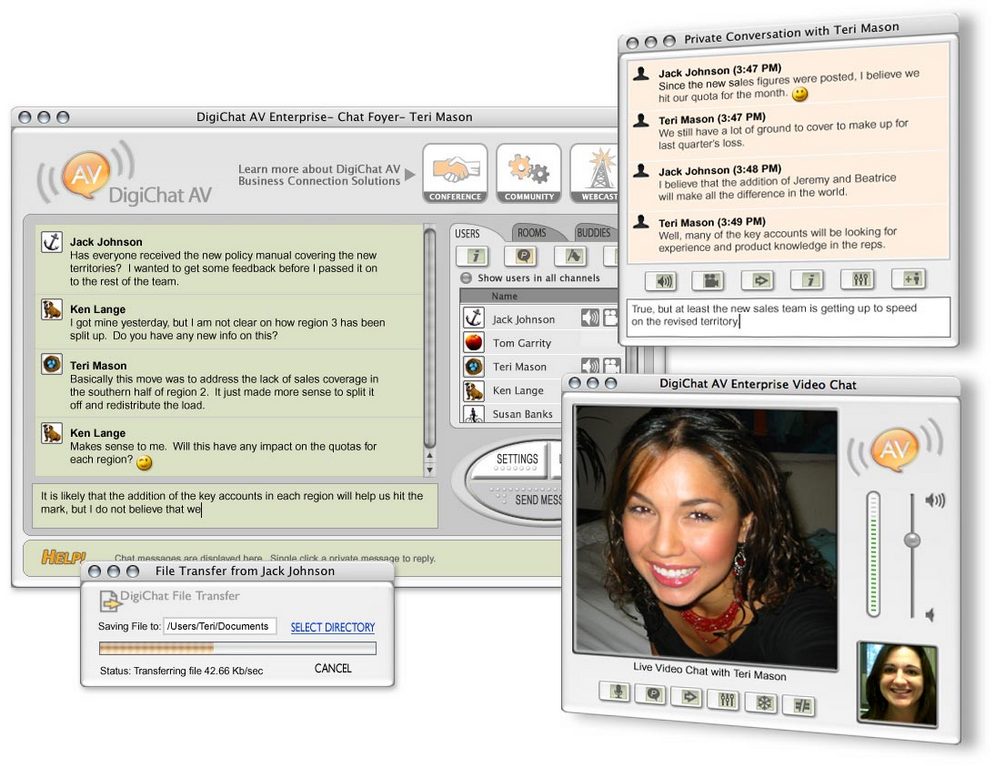
DigiChat AV Enterprise 5.0 is Java software that enables Web-based chatting, on-line collaboration, e-learning and moderated Webcasts. Features of version 5.0 include voice chat (VoIP), video chat (P2P), Web-based instant messaging support, a GUI with skinnable interfaces, a high-performance text messaging engine, HTTP tunneling support, scriptable BOTs support and scriptable command-line and Java APIs. The new client-side plugin architecture allows users to extend and create new programs within DigiChat. Version 5.0 also offers an integrated IM application that can be installed locally. Users can share text documents, PDFs, images, sounds and video directly through DigiChat. DigiChat supports UNIX/Linux, Windows 9x/NT/2000/XP, Mac OS/OS X and Solaris.
Digi-Net Technologies, Inc., 1034 Northwest 57th Street, Gainesville, Florida 32605, 877-404-2428, www.digi-net.com.
Version 9 of Visual SlickEdit, a development tool with a high-level code editor, offers ten C++ refactorings to enable developers to improve the structure of source code for better performance. Other new features in version 9 include a Java GUI builder, full-screen editing and dual-monitor support, a backup history that stores changes locally, CodeWright emulation and a new HTML Help and tutorial assistant. To simplify builds, Visual SlickEdit offers a C/C++ auto-build system as well as support for Ant. Visual SlickEdit includes integrated C/C++ and Java debuggers. The advanced code editor features Context Tagging, which offers language-specific coding assistance for a multitude of languages. The DIFFzilla differencing system, which provides side-by-side file and directory difference editing, works with three-way merge to support version control.
SlickEdit, Inc., 3000 Aerial Center Parkway, Suite 120, Morrisville, North Carolina 27560, 800-934-3348, www.slickedit.com.
