New Products
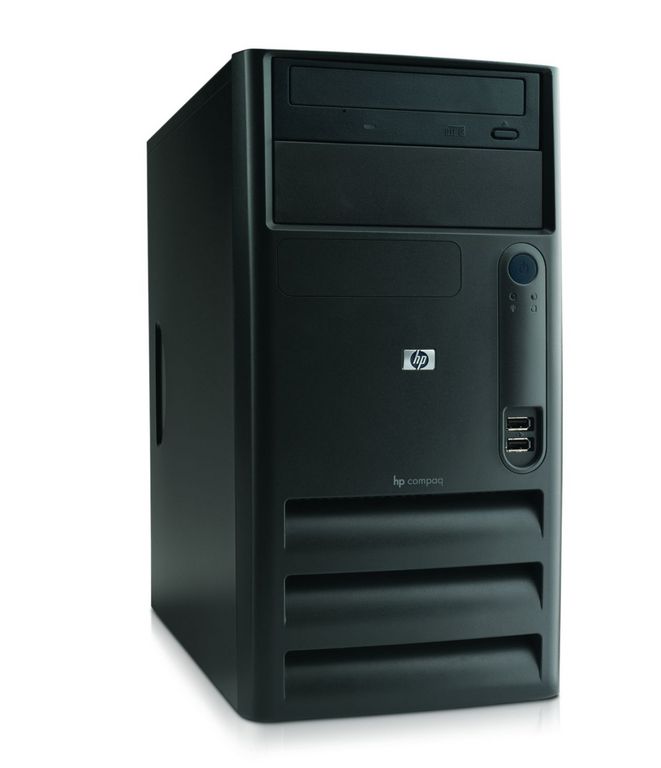
HP announced a new line of business desktop PCs, available in three categories: the Compaq 2000, 5000 and 7000 series. The dx2000 features four DIMM slots for single or dual-channel memory configurations, plus eight USB 2.0 ports. It can be preconfigured or customized with Celeron or HyperThread-enabled Pentium 4 processors with speeds up to 3.0GHz, up to 80GB hard drives, up to 1GB of DDR SDRAM and a choice of optical drives. The dc5000 is available in a small form factor or microtower design, both designs have tool-less access to internal components and drives. It can be customized with Celeron or Pentium 4 processors with speeds up to 3.0GHz, up to 160GB hard drives and up to 4GB of DDR SDRAM. The 7000 series offers the most advanced features for high-end environments and applications. All systems run Mandrake Linux.
Hewlett-Packard Company, 3000 Hanover Street, Palo Alto, California 94304, 800-752-0900, www.hp.com/products/desktops.
The GForge Group now is offering fully configured GForge System Servers. GForge is a collaborative development environment that allows large software projects to be managed and tracked through a single interface. With Collaboration Station I, Collaboration Station II, GForge Rackmount I and GForge Rackmount II, GForge offers four plug-and-play, out-of-the-box server solutions. GForge collaborative development and management software, plus Debian, come pre-installed and configured on a server appliance built to the client's specifications. Sites are customizable and come with one-year hardware and software support.
The GForge Group, 512 129th Street, Urbandale, Iowa 50323, 408-907-2744, www.gforgegroup.com.

Embedded Planet has three new EPC Class 1-compliant RFID reader development kits available, all based on Alien Technology's ALR-9932-A reader/programmer OEM module. The development kits can be used in applications for industry, retail, military, aerospace and more. The kits enable RFID system integrators and hardware manufacturers to integrate read/write RFID capabilities into products. The EP RFID Reader Development Kit provides OEMs with 32-bit processor solutions for PowerPC, ARM and MIPS using the OEM's reader engine. The EP RFID Reader/Concentrator Development Kit includes a PowerPC single-board computer and up to ten ALR-9932-A RFID readers. The EP RFID Reader/802.11 Development Kit includes the ALR-9932-A engine and a Wi-Fi (802.11a/b/g) system with a PowerPC processor.
Embedded Planet, 749 Miner Road, Cleveland, Ohio 44143, 440-646-0077, www.embeddedplanet.com.
Linux Development Kits (LDKs) built on the 2.6 kernel now are available from TimeSys for the PowerPC architecture. TimeStorm LDKs include the Eclipse-powered TimeStorm IDE and a complete embedded Linux distribution based on the 2.6 kernel, cross-platform GNU toolchains and device drivers for supported hardware platforms. These tools and the 2.6 kernel combined offer developers better performance, improved device driver framework, expanded connectivity support, support for headless systems and real-time responsiveness. Initial LDKs are for the Motorola PowerPC 8260 processor and the Intel IA32 processors, with support for additional processors and architectures coming soon.
TimeSys, 925 Liberty Avenue, 6th Floor, Pittsburgh, Pennsylvania 15222, 888-432-8463, www.timesys.com.

The USB DUX is a data acquisition unit for real-time monitoring and control. The board takes advantage of the real-time speed and power of the USB port and is designed to work under Linux in both embedded and desktop designs. The driver is part of the COMEDI framework, so it works directly with Labview. Two versions of the USB DUX are available, one with a standard D connector and one with 14 additional BNC connectors and two K-type thermocouples. Both the driver and the firmware are licensed under the GPL. USB 1.1 is supported under both 2.4 and 2.6 series kernels, and high-speed USB 2.0 is supported with kernel versions 2.6.4 and higher.
INCITE, University of Stirling, Stirling, UK, FK9 4LA, tech@linux-usb-daq.co.uk, www.linux-usb-daq.co.uk.

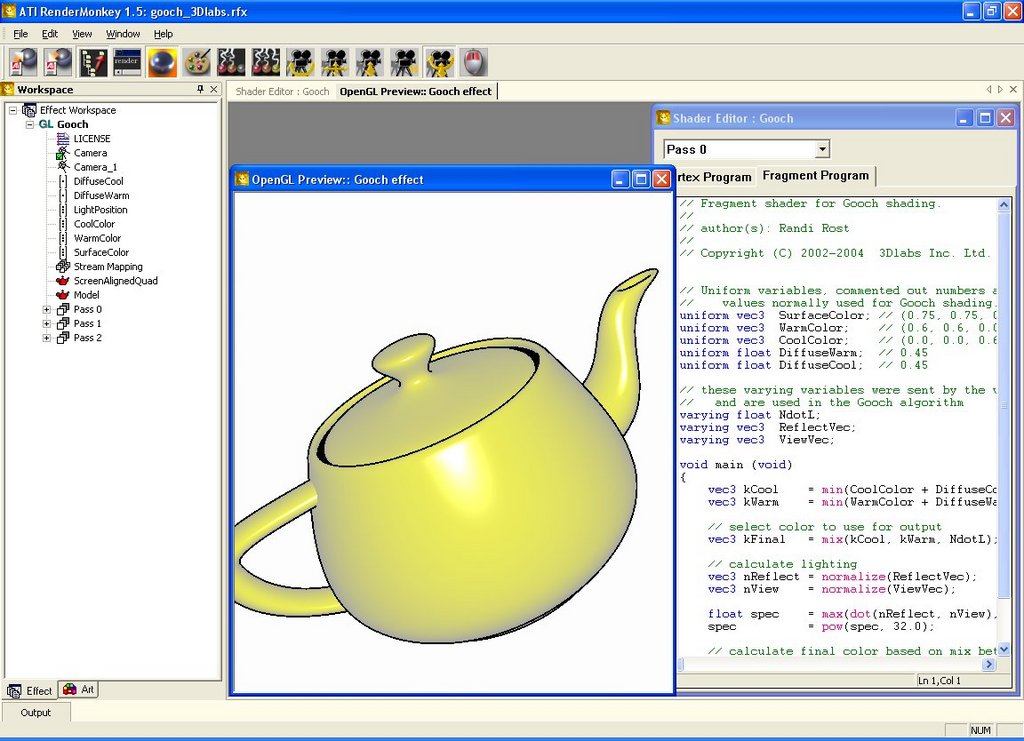
RenderMonkey 1.5 is an integrated, real-time OpenGL Shading Language development environment with a graphical user interface used to write and adjust shader attributes, such as the definition of color, textures, graphics states, scalars, vectors and matrices. It eliminates the need for handwritten OpenGL Shading Language programs for many visual effects. The shader development tool supports a plugin architecture that enables developers to create new, customized components as needed. RenderMonkey works with a number of shading languages, including OpenGL's, HLSL and assembly-level languages. Shaders and their attributes are stored in XML files for interchange with other applications.
3Dlabs US, 9668 Madison Boulevard, Madison, Alabama 35758, 877-286-1185, www.3dlabs.com.