UpFront
UpFront
- LJ Index—May 2004
- They Said It
- packetbl:
- diff -u: What's New in Kernel Development
- World-Record Distributed Chess Project
- Customer Request Tracking System:
LJ Index—May 2004
1. Percentage of surveyed enterprises that say they will increase Linux spending next year: 60
2. Percent surveyed that say they will increase Linux spending by 6% to 10%: 17
3. Percent surveyed that say they will increase Linux spending next year by 10% more than last year: 43
4. Percent surveyed that say their top spending on Linux will be in upgrading the OS: 35
5. Percent surveyed that say their top spending on Linux will go to server hardware upgrades: 30.5
6. Percent surveyed that say their top spending on Linux will go to data center migrations: 29.5
7. Projected increase factor in hardware spending at UAL Loyalty Services: 10
8. Percent surveyed that say data center migration is top priority among Linux-related projects for 2004: 30
9. Percentage of above who say they'll be spending up to $99,000 US on that migration: 13
10. Percentage of above who say they'll be spending between $100,000 and $499,000 US: 52.7
11. Number of months it takes IT to get an internal application to full deployment: 9
12. Thousands of PCs in a French study toward the possible replacement of Microsoft Windows with Linux: 17
13. Hundreds of applications in the same study: 6
14. Hundreds of servers in the same study: 4
15. Thousands of police computers switched to Linux from Windows in Lower Saxony, Germany: 11
16. Percentage of all European computers that now run Linux: 15
17. Percentage that said “Wait” in response to the eWeek survey of respondents' willingness to wait until 2006 for Microsoft's Longhorn OS: 35
18. Percentage that said “Switch to Linux desktop” in response to the eWeek survey of respondents' willingness to wait until 2006 for Microsoft's Longhorn OS: 40
19. Popularity position of Red Hat among all Linux distributions, according to Netcraft: 1
20. Fastest growth position of Debian among all Linux distributions, according to Netcraft: 1
1–10: SearchEnterpriseLinux.com
11: IDC
12–16: ZDnet
17, 18: eWeek
19, 20: Netcraft
They Said It
How are you going to write software that is useful for people if you don't know if or how they're using your features? Answer these questions: What percentage of bug reports to open-source projects are submitted by employees of financial services firms? Which industries have the highest patch submission to running copies ratio?
—Robert Lefkowitz, from his talk at OSCON
There's a fine line between participation and mockery.
—Scott Adams (www.photodude.com/index.shtml)
One way to fix this is to “increase the dimensionality of the discrimination hyperspace” (no, I am not making that phrase up).
—Bill Yerazunis, CRM114 & Mailfilter HOWTO
packetbl:
This is a real-time blacklist module for iptables/Netfilter. If you run one or more mail servers, you can save processing time by running this module on your Linux router. The module can check incoming port 25 connections against the spam blacklists and drop those packets before your mail servers even see them. Requires: libdotconf and glibc.
diff -u: What's New in Kernel Development
The FAT filesystem still is being maintained, and, in fact, Frodo Looijaard recently has added Linux support for some obscure FAT implementations that required unusual characters to delineate the directory index. One problem with FAT maintenance is the proliferation of implementations that should be supported under Linux. Another is that the MS-DOS version may not always clearly obey the official specification itself; in which case, as H. Peter Anvin has put it, the rule always should be to follow the WWDD rule (What Would DOS Do). The question of when to adhere to standards and when to slough them off in favor of something better is a perennial one in the free software world.
Michael A. Halcrow has begun work on an encrypted filesystem. According to his initial research, the best method will be to create an entirely seamless encryption layer above the root filesystem, with files marked as either encrypted or clear. Encryption keys associate with files as opposed to directories or block devices and so forth, but a directory can be tagged encrypted only, in which case all files within it are encrypted by default. Key and other metadata will be stored inside Extended Attributes. Standard file data, such as file size and permissions, will be encrypted, as far as is possible. Deleted files will be wiped from the disk as thoroughly as they can to reduce the possibility of recovery. A number of other interesting features appear to be in the offing as well.
Vojtech Pavlik has produced an FAQ for problems encountered with Input drivers. It covers such issues as how to get a list of Input drivers on the system, how to deal with mouse or keyboard misbehavior and many others. This is the first time these problems have been documented since the Input layer was rewritten during 2.5 development, and a lot of folks are overjoyed to have a central repository where their questions can be answered.
Ever since the IDE driver was rewritten, amid much turmoil and upheaval in the 2.5 development tree, efforts to fix its ability to be loaded as an external module have been put off until the rest of its code could stabilize. Alan Cox in particular rejected various patches from various developers attempting to make IDE loadable as a module. A recent attempt by Witold Krecicki seemed like a good attempt, but it looks like Bartlomiej Zolnierkiewicz's patch is more likely to get into the 2.6 tree in the near future. Having worked intensively on the IDE driver during the 2.5 cycle, he's apparently been developing the loadable module patch for some time, and feels it adequately covers all the corner- and edge-cases.
It turns out that some of the mailing lists listed in the MAINTAINERS file as being the proper place to submit bug reports on various features actually require that users subscribe to the lists before posting their reports. This is not uncommon in the realm of mailing lists, but for Linux kernel development, it has been decided that all bug-receiving lists listed in the MAINTAINERS file must receive posts from anyone. This is the best way to welcome regular users to submit their bug reports. One of the main reasons to require subscription before posting has been the proliferation of spam and the attempt to keep it out of a development mailing list. Although there are various ways of dealing with that problem, it also has been decided that not all mailing lists in MAINTAINERS must be completely open, as long as they have a secondary list that does remain open to all bug reports.
A new port of the Linux kernel, called Cooperative Linux, has sprung up. Similar to User-Mode Linux (UML), Cooperative Linux is not a port to any particular hardware architecture but is intended to create a running Linux system on top of an existing system. Cooperative Linux already has run on an instance of Windows 2000 and Windows XP successfully. The Cooperative Linux developers hope this will allow many users of other OSes to try Linux without the burden of having to replace their existing systems with complete Linux installations. Apparently, multiple instances of Cooperative Linux can run in parallel on a single system, and efforts toward running Cooperative Linux on top of Linux itself already are underway.
World-Record Distributed Chess Project
On January 30, 2004, one of the world's top chess players, International Grandmaster Peter Nielsen, faced a distributed computing cluster called ChessBrain in an unprecedented man-vs-machine event. ChessBrain fought back as it navigated well-placed traps in a game that resulted in a draw.
The ChessBrain Project plays live chess games in real time, using distributed computing techniques similar to SETI@home and distributed.net. A central Linux-based server called a SuperNode coordinates thousands of distributed machines called PeerNodes.
Interest in the event was significantly greater than anticipated. As a result, a large number of PeerNodes descended on the SuperNode in a situation that resembled a denial-of-service attack. To address this potentially fatal situation, ChessBrain member Gavin Roy tweaked /proc filesystem entries to modify the TCP/IP stack's behavior. We also stopped the SuperNode from Denmark and modified the SuperNode source code to instruct remote PeerNodes to change the frequency of their connection attempts. We were able to address the situation in real time without rebooting a single machine.
ChessBrain's official Guinness World Record attempt was hosted by the Danish UNIX Users Group (DKUUG) at the Symbion Science Park in Copenhagen, Denmark, and supported by the US-based Distributed Computing Foundation. With a new record involving 2,070 computers from 56 different countries, ChessBrain has become the first distributed network to play a game against a single human opponent. This gives new meaning to “Powered by Linux!”
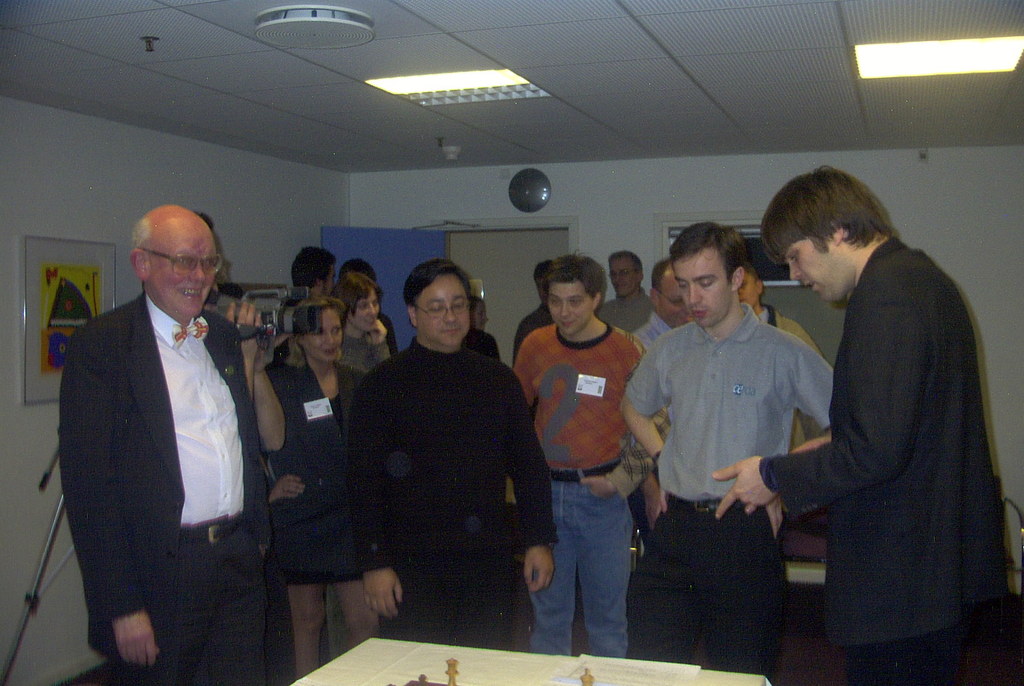
The ChessBrain team swaps notes with GM Peter Nielsen (right) after the game.
Carlos Justiniano is the founder of ChessBrain.net. His article “ChessBrain: a Linux-Based Distributed Computing Experiment” appeared in the September 2003 issue of Linux Journal.
Customer Request Tracking System:
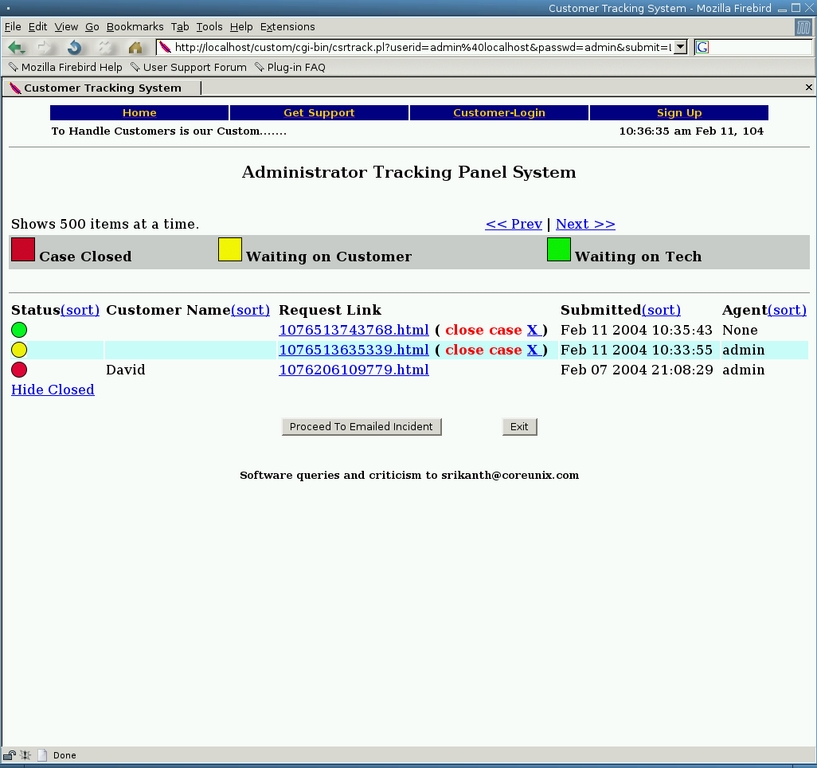
Have you tried other ticket tracking systems and found that they're too complex or that they don't keep you and your customers in contact well enough? This ticket tracking system is simple to use for both customers and technicians, and it e-mails responses to customers so they know immediately when their request was processed. If you need a simple, easy-to-use tracking system, this might be the one for you. Requires: Web server; Perl; Perl modules CGI, DBI, Net::SMTP, Socket, File::Copy; and PostgreSQL.