
Getting the Most from XMMS with Plugins
XMMS (the X MultiMedia System) is a feature-rich multimedia player that has won the Linux Journal's Readers' Choice Award for Favorite Audio Tool for the past four years. I assume, then, that the program needs little introduction here.
Most users of the program probably use it to play MP3s, but its default range of supported file formats also includes OGG, WAV, CD audio and all formats supported by the MikMod music module player. Thanks to various third-party input plugins, XMMS also can play almost every available audio and video format, as we soon shall see. Supported audio output formats include ALSA, OSS, esd and aRts. It also has a driver for writing audio output to disk in the WAV sound file format, which is quite handy for converting sound files for burning to an audio CD.
But, XMMS is more than a versatile player. This brief article dives a little deeper into the program to expose some of its extended features, such as its equalizer and playlist capabilities, as well as some interesting and useful third-party plugins.
XMMS is divided into three panels: the player, a graphic equalizer and a playlist window. The player contains the expected transport controls as well as sliders for volume and balance, or pan position. Another larger slider controls a pointer for random access into the file being played. Toggles are provided for the other panels, and switches control song looping and random playback.
The graphic equalizer (EQ) presents 11 sliders, one for preamp gain (+/– 20db), the others for boosting or cutting audio frequencies in ten bands (channels). Ten channels provide decent basic equalization, with starting frequencies at 60, 170, 310, 600, 1k, 3k, 6k, 12k, 14k and 16k Hertz. These numbers indicate the throw (movement range), for each slider ranges from 100 up to 6,000 Hertz, which is rather coarse-grained, but the sliders are nicely responsive with smooth real-time audio updating. The default equalizer is fine for most desktop audio listening, but for finer resolution you can try Felipe Rivera's graphic EQ plugin that can be configured for 10, 15, 25 or 31 bands (see this article's Resources for links to all software discussed).
The playlist panel displays the files to be played and provides a number of useful file controls. The buttons on the lower left add and delete files from the list, make and sort selections and open an ID3 editor for the information tag attached to an MP3. The playlist window also includes a set of transport controls identical to those in the player panel, along with indicators for elapsed time during file play and for total time of the playlist. Finally, the List button on the lower right lets you load a new playlist, blank out the current list or save the contents of the playlist to a new file. Playlists are plain-text files in the common M3U playlist format, meaning the entries are simply paths to the included files. The playlist is quite flexible and accommodates any file type supported by XMMS and its plugins.
Let's take a peek at some of these plugins. XMMS utilizes plugins for file I/O, special effects, visualization and a general category. For the purpose of this article, I focus on only a few I/O and effects plugins.
Erik de Castro Lopo's libsndfile has taken its place as the preferred sound file I/O library for such projects as the Ardour digital audio workstation and the MusE audio/MIDI sequencer. Erik's libxmms_sndfile plugin expands XMMS' sound file support to a wider variety of sound file types, including AIFF, AU/SND, IRCAM SF and many others. Nandan Dixit's libxmmsmplayer plugin adds the ability to play any video file format supported by the MPlayer video playback engine, extending XMMS' file support to MPEG, ASF, AVI, MOV and other video formats. Nick Lamb's ladspa.so is in fact a plugin to host plugins. LADSPA (the Linux Audio Developers Simple Plugin API) is an interface designed for creating simple but powerful audio processing plugins. Ladspa.so brings dozens of interesting effects to XMMS, all usable during real-time playback. Figure 1 shows off XMMS with a playlist containing sound files in five formats (AIFF, AU, MP3, OGG and WAV); movies in MPEG, AVI and RM formats (yes, the MPlayer plugin handles RealVideo too); and the LADSPA plugin at work lending its plate reverb and retro flanger to the XMMS audio processing functions.
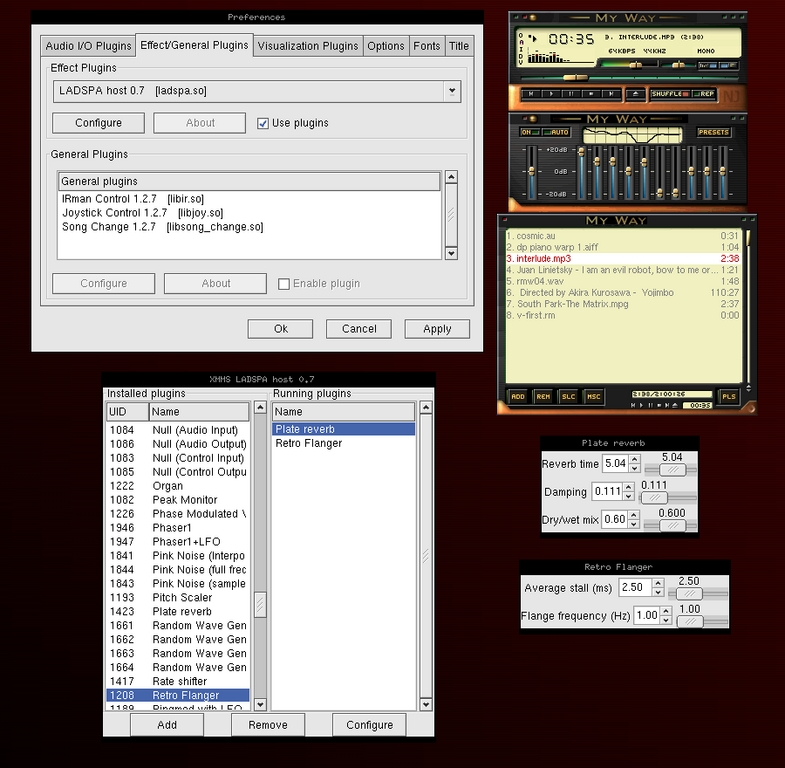
Figure 1. XMMS Showing a Playlist Containing Sound Files in Five Formats
That's all for this preview of some of XMMS' advanced features. Big thanks to the main development team for creating and maintaining XMMS, to the whole crew of third-party plugin developers for their wonderful expansions and to 4Front Technologies for its support of this most excellent Linux multimedia software.
Resources
Felipe Rivera's Equalizer Plugin: equ.sourceforge.net
The LADSPA Plugin: www.ecs.soton.ac.uk/~njl98r/code/ladspa
The libsndfile Plugin: www.zipworld.com.au/~erikd/XMMS
The MPlayer Plugin: xmmsmplayer.sourceforge.net
XMMS: www.xmms.org
Dave Phillips is a musician, teacher and writer living in Findlay, Ohio. He has been an active member of the Linux audio community since his first contact with Linux in 1995. He is the author of The Book of Linux Music & Sound, as well as numerous articles in Linux Journal.

