
LAMP Development at Public Sector Web Sites
Linux runs right under the radar, not exactly in stealth mode, at many high-profile government agencies, including the Departments of Defense, State and Labor; the General Services Administration; the Census Bureau; and USAID. At the heart of these applications lies the LAMP framework, which stands for Linux, Apache, MySQL and PHP, Perl or Python. Tom Walker, former Lt. Commander of Navy Special Operations and adamant proponent of open-source technologies, said, “The next computing revolution, like that of the Internet, will emerge from unexpected and perhaps even modest sources...the next great leap in computing and software technology will come from small firms who have the creativity and strength to stand up...by offering advanced solutions using Open Source technologies.” Firms like Walker's group and a few others have led the charge on Capitol Hill and elsewhere with open-source software (OSS).
Lack of an integrated response within the US intelligence community prior to the attacks of September 11, 2001 has heightened government awareness of the disconnected databases in use throughout the country. As the Congressional Report on Intelligence Actions and the September 11 attacks revealed, “The intelligence community continues to be fragmented.” In response to this situation, Peter Gallagher and Martin Hudson of devIS state, “The need for governments to share information and solutions is fueling a new framework for eGovernment problem solving.” Gallagher explains how Linux has made its way into the public sector:
Early on we were able to use OSS only because the applications were outsourced. We could not talk about Linux, for instance. Now our clients really are considering how OSS might improve their internal environments—they want to talk to us about it. This is a big change. It always is a pleasure to see the look on a customer's face when they come to us asking about how to take advantage of OSS and then we remind them that together we have been for years!
We have shown that it works rather than just talking about it. I expect that in a few years there won't be interest in OSS for eGov per se, it will be just another option—we think the winning option.
John Weathersby sits in his office at the University of Southern Mississippi pulling together geographically diverse groups of people with a mission. He runs the Open-Source Software Institute (OSSI), a nonprofit organization comprised of corporate, government and academic representatives. OSSI exists to serve as an advocate and as a collective resource and venue for the promotion, development and implementation of open-source software solutions between corporate, government and academic entities. Additionally, OSSI serves as a forum for working committees to address open-source issues in regards to government/industry standards, academic research, economic/market and legislative policy.
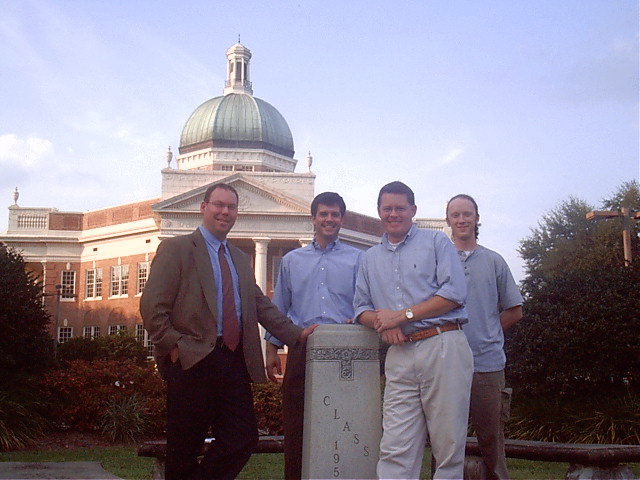
OSSI members John Weathersby (front) and Richard Kuebler (middle) pause with Mark Goodman (left) and Matthew Schick (right) from the University of Southern Mississippi as they tour campus. The Administration building stands in the background.
Shortly after inception of the Web site Government Forge (governmentforge.org), Weathersby reached out and began supporting Project Leopard, a framework for developing LAMP applications in government. Within two weeks, he pulled together open-source developers to facilitate building a common infrastructure. He next found an immediate application need within the judiciary branch.
Other recent wins include a Cooperative Research and Development Agreement (CRADA) with the Naval Oceanographic Office delivered in August 2003. The Institute also serves as the coordination body securing government certification for OpenSSL under FIPS 140-2 approved cryptography. In addition, Weathersby has coordinated an effort in which the North Mississippi Education Consortium (NMEC) will lead a pilot program designed to provide free and open-source software to Mississippi's public school system. The program, called Freedom to Learn, is part of a PhD-level study exploring alternative technologies and methods of reducing costs while increasing efficiency and student productivity within public school systems.
Peter Gallagher and Martin Hudson direct traffic from the second floor of the historic Underwood Building in Arlington, Virginia. Gallagher, a former Peace Corps volunteer in Senegal, West Africa, saw the need for more appropriate technology solutions in developing countries. Hudson had a deep interest in making computers more useful and was pushing desktop applications. They met as consultants, worked together at two different firms and then decided to start their own company, Development Info Structure (devIS).
Using LAMP became Gallager and Hudson's stock and trade. As Peter explains:
The opportunity to develop a public info structure with less redundancy, lower costs, greater flexibility and better service is the eGovernment challenge in this new world. devIS anticipates further expansion in the coming years based on accelerating interest in open standards, eGovernment and efficient use of open-source software solutions. devIS has capabilities in software development and outsourcing that are unique for a small business, and projections indicate rising demand and associated revenues. State and local governments are showing increased interest in open systems. devIS has begun actively soliciting partnerships with these groups. Recent changes to federal procurement rules now allow state and local governments to purchase services from federal GSA contracts, providing standard access to any governmental agency at various levels.
OSS was essential to devIS as a small business competing against mega-corporations for federal work. Some of the high-end proprietary tools are so expensive to get started with—you pay for partner licensing and all types of required training, including marketing...just to try the product.
The next big thing, now that we all know we need to share data using XML standards and Web services, will be to share components. I know it will be hard, but it has to happen—eGovernment is accelerating and the logic of public infostructure is too compelling—the necessary standards and architectural boundaries are becoming understood. Shared OSS components will move eGovernment ahead quickly.
Martin Hudson adds:
The Government's adherence to published standards, at multiple levels, is making the market more competitive, making it possible for small companies like devIS to compete on larger, mission-critical, applications. When we formed devIS the higher order systems looked more like fiefdoms for large integrators—small business could not get in the door.
Our ability to implement inter-networking applications fully—we host data servers for state, USAID, GSA and labor—makes us different from most of the small businesses in our sector. And we are able to do that largely because of our roots in open source.
Gallager and Hudson's recent wins include the US Department of Labor's Workforce Connections program. They elaborate:
This just-in-time dynamic content publishing environment powers over 50 federal Web sites, including DisabilityInfo.gov, the official portal for US government information on people with disabilities. The Workforce Connections application environment also publishes structured learning content, including question and answer interactions, all using the same object-oriented engine.
The tool exceeds federal specifications for Section 508, which is the federal implementation of the W3C Accessibility Guidelines. IT contractors now are legally liable to meet these requirements just as a construction projects must provide handicapped access. The system also meets another standard important to the federal government called SCORM, shareable content object reference model.
SCORM is an XML standard that makes it possible to share and re-use learning objects independent of proprietary authoring/presentation systems. Workforce Connections allows for distributed maintenance and instantaneous publishing by government content experts through a secure administration interface. The software was created in Python using the Zope content application server and runs on GNU/Linux Debian with the Apache Web server. Many of the sites are private. devIS currently is working with the DoL to release the product under an open-source license.
devIS also is doing work for the US Agency for International Development's TraiNet Project. Gallagher and Hudson describe TraiNet as:
...a secure, Internet-enabled visa application pre-processor [that allows] worldwide staff to comply with new security rules for training foreign nationals in the US. A Web-based work-flow interface, connected to a federated system architecture that relies on XML messaging to compensate for inconsistencies in connectivity among developing countries, provides a robust environment.
The system is in use at over 300 locations around the world to monitor training programs worth hundreds of millions USD for thousands of students. The visa processor has a secure machine-to-machine link with Department of Homeland Security systems to facilitate centralized production of the special student visas used for government-funded programs. OSS technologies used include GNU/Linux Debian, Apache, PostgreSQL and XML Blaster. Server-side applications are written in Python. devIS built, hosts and manages this application, including help desk and other operational support.
As a career Naval Officer, Tom Walker gained extensive experience in programming and Web enabling computer systems that support international military and special forces operations. After leaving the service, he used his leadership abilities to build a client list for gOSapps LLC of more than 400 customers. To date, his organization has installed more than 500 LAMP applications.
Walker's enthusiasm for open-source software is evident. He recently spoke at a Department of Defense staff briefing on the security, reliability and performance of open-source software. He told his audience:
The DOD decision [to use open-source software] will result in widespread changes in software development and acquisition throughout the federal government and with government contractors. The challenge for many departments is that right now the new policy has raised more questions than answers in a fast growing segment of the technology industry.
One of gOSapps LLC's projects is the Open Source Initiate Review (OSIR). OSIR provides formal expert analysis of existing system architectures and applications to help government agencies reach a high level of preparedness for open-source transition.
Recent wins for Walker include the US Navy's Technical Support Group Summary. Walker writes:
We provided the architecture, design and deployment of secure Web and CD-based training programs. The Technical Support Group (TSG) required a reliable method to deliver training on secure advanced communications system to remote locations. This training required delivery by a variety of transfer methods.
Additionally, due to ever-changing technological changes, the data had to be updated easily, minimizing the costs for program changes. We deployed special strategies and created a multimedia training system that was both informative and entertaining. The data is transferable on CD or over secure communication links.
Additionally, by allowing last minute compilation of data from a secure database, the training is always up to date. This data compilation is performed automatically, minimizing the training costs and time requirements for the technical support staff. An internal object-oriented framework utilized results in lower development time and costs, far fewer pre-QA defects and a richer feature set. The MySQL relational database allowed us to use complex data-driven applications, coupled with reliability and speed. We had a direct role in all aspects of the development cycle, coupled with close communication and feedback from the client, resulting in an advanced yet intuitive interface to meet client needs.
Walker's team also developed an on-line LAMP application to manage the database of storm water facilities and their ratings for James County, Virginia. Walker explains:
We developed the front-end interface for searching and viewing facility information. We also developed complete functional design specifications, carried through to development and deployment of multi-tiered relational database-driven Web applications.
The system is designed to meet the county's specific need to post and broadcast notifications of watershed quality results. The entire application is maintained through an intranet system, all managed by a unified administrative application.
James E. McMillan, employed at the National Center for State Courts has fashioned a Web site that says, “If you have ever wanted to try out court E-filing, now you can. Just click on the E-File a Document link above or the button below and fill in the forms.” The Web site also states, “You will be sent a password (you must have a working e-mail address) and attach your document. Or, you can fill out our demonstration complaint form.” James directs the Court Technology Laborartory (CTL, ctl.ncsc.dni.us/about_jim_mcmillan.htm).
McMillan has made his LAMP Project available to all the courts in the world. The inCounter Web site provides the downloadable source code to the inCounter Electronic Filing Manager Project. Look for a link that says “inCounter Open Source E-filing System” on James' Web page mentioned above. The link will take you to the current location of his OSS project.
Why are we doing this? To help the courts and legal system adopt electronic communication. Specifically, the inCounter Electronic Filing Manager Project is an effort to build the core functionality of an electronic filing inbox that has the following initial goals:
Demonstrate electronic court document filing.
Demonstrate a simple-to-use system (limited initial scope).
Create an expandable and customizable system through use of open-source code.
Demonstrate support for CourtXML/OASIS LegalXML filing standards.
Demonstrate support of the W3C SOAP XML communications standard (to connect commercial and advanced systems).
Demonstrate the use of free Linux, Apache, Perl and MySQL software in a court application.
McMillan joined the National Center for State Courts in October 1990. Since then, more than 1,000 visits from courts in 50 states and more than 70 foreign nations have been held in the CTL. Over 10,000 people have viewed remote CTL presentations. In November 2000, the TIES-CTL Project received the State Justice Institute's Howell Heflin Outstanding Project award.
With credentials comes credibility and McMillan has plenty. He previously held positions with the US Department of Justice and the Los Angeles Superior Court. He was a keynote speaker at the Fifth National Court Technology Conference and a lecturer at the National Judicial College, University of Southern California Judicial Administration Program, Smithsonian Associates, and many other national and international court, law and technology interest groups.
Tom Adelstein works as a Linux consultant in Dallas, Texas. His current interest lies in the field of eGovernment applications. Tom is involved in the launch of Government Forge, a Web site devoted to state and local governments interested in Linux and open source. He also is a member of the Open-Source Software Institute.
