
The Official Samba-3 HOWTO and Reference Guide, John H. Terpstra and Jelmer R. Vernooij, Editors
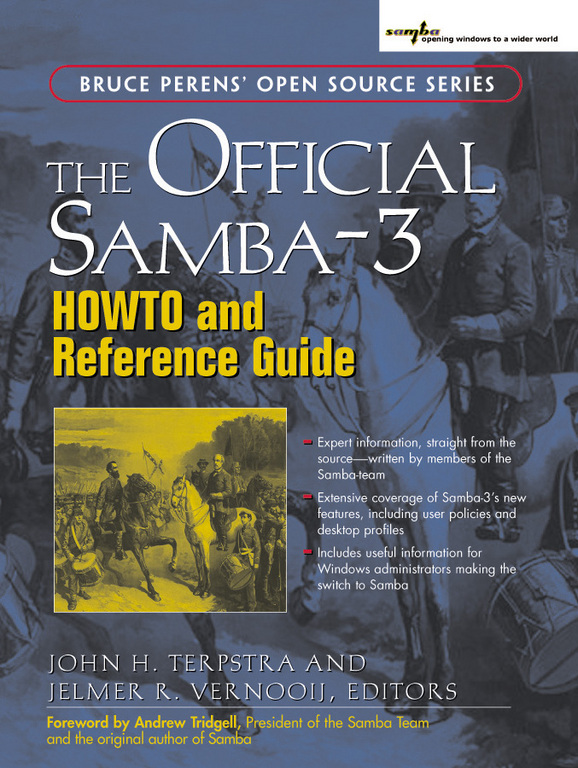
As Linux makes its way into previously Microsoft-only environments, whether in a server or desktop capacity, it is likely that Samba becomes involved in the process of integrating the systems. Hot on the heels of the September 2003 release of Samba 3.0 comes The Official Samba-3 HOWTO and Reference Guide, edited by John H. Terpstra and Jelmer R. Vernooij, two of the cofounders of the Samba team.
The sheer amount of information in the book is impressive; the important topics of file sharing, domain control, domain membership and WINS are covered thoroughly. Beyond this, the book goes into considerable detail on issues such as security, trust relationships, access controls and system policies.
A nice touch is the presence of a number of ready-to-run sample Samba configurations in an early chapter. These range from a simple file server to a large domain controller with a directory server back end, and they are useful for anyone who quickly needs to set up a server for one of a number of common tasks, without first having to wade through hundreds of pages of documentation.
Also useful are the Common Errors sections at the end of most chapters, where many of the questions that appear time and time again on the Samba mailing list are documented and answered. These sections are of particular benefit to people migrating from an older version of Samba, and they definitely are a worthwhile feature.
Due to the complexity of modern Samba installations, it isn't sufficient for a book to cover only the Samba software itself. A number of external software packages are needed to integrate a Samba server into a large network. Fortunately, the book does not let us down. The use of OpenLDAP, PAM, ISC BIND and DHCP in conjunction with Samba are all touched on in varying degrees. A detailed chapter on using Samba with the CUPS printing system also is provided.
One minor problem concerns the chapter on configuring Windows systems, where the authors notably have omitted any explanation on joining a Windows NT 4 system to a domain, concentrating instead on later versions of Windows. NT 4 still has some corporate deployment despite Microsoft's lack of support, and potential Samba administrators may have found such an explanation useful. Interestingly, though, the authors did discuss NT 4 in a later chapter in the context of roaming profiles.
The book is unashamedly for the more-advanced Samba user. It should be appreciated most by those people who already have some experience with earlier versions of Samba or who are at least are familiar with administering Linux or UNIX systems. Newcomers looking for a book to step them through their first installation may find this book tough going; they would be better off looking elsewhere before venturing into this one. For the advanced user, however, or for anyone planning on using Samba in a production environment, this book is invaluable.
Today’s modular x86 servers are compute-centric, designed as a least common denominator to support a wide range of IT workloads. Those generic, virtualized IT workloads have much different resource optimization requirements than hyperscale and cloud applications. They have resulted in a “one size fits all” enterprise IT architecture that is not optimized for a specific set of IT workloads, and especially not emerging hyperscale workloads, such as web applications, big data, and object storage. In this report, you will learn how shifting the focus from traditional compute-centric IT architectures to an innovative disaggregated fabric-based architecture can optimize and scale your data center.
Sponsored by AMD
Built-in forensics, incident response, and security with Red Hat Enterprise Linux 6
Every security policy provides guidance and requirements for ensuring adequate protection of information and data, as well as high-level technical and administrative security requirements for a system in a given environment. Traditionally, providing security for a system focuses on the confidentiality of the information on it. However, protecting the data integrity and system and data availability is just as important. For example, when processing United States intelligence information, there are three attributes that require protection: confidentiality, integrity, and availability.
Learn more about catching the bad guy in this free white paper.
Sponsored by DLT Solutions
| Making Linux and Android Get Along (It's Not as Hard as It Sounds) | May 16, 2013 |
| Drupal Is a Framework: Why Everyone Needs to Understand This | May 15, 2013 |
| Home, My Backup Data Center | May 13, 2013 |
| Non-Linux FOSS: Seashore | May 10, 2013 |
| Trying to Tame the Tablet | May 08, 2013 |
| Dart: a New Web Programming Experience | May 07, 2013 |
- RSS Feeds
- New Products
- Making Linux and Android Get Along (It's Not as Hard as It Sounds)
- Drupal Is a Framework: Why Everyone Needs to Understand This
- A Topic for Discussion - Open Source Feature-Richness?
- Home, My Backup Data Center
- Developer Poll
- Dart: a New Web Programming Experience
- What's the tweeting protocol?
- New Products
Enter to Win an Adafruit Prototyping Pi Plate Kit for Raspberry Pi

It's Raspberry Pi month at Linux Journal. Each week in May, Adafruit will be giving away a Pi-related prize to a lucky, randomly drawn LJ reader. Winners will be announced weekly.
Fill out the fields below to enter to win this week's prize-- a Prototyping Pi Plate Kit for Raspberry Pi.
Congratulations to our winners so far:
- 5-8-13, Pi Starter Pack: Jack Davis
- 5-15-13, Pi Model B 512MB RAM: Patrick Dunn
- Next winner announced on 5-21-13!
Free Webinar: Linux Backup and Recovery
Most companies incorporate backup procedures for critical data, which can be restored quickly if a loss occurs. However, fewer companies are prepared for catastrophic system failures, in which they lose all data, the entire operating system, applications, settings, patches and more, reducing their system(s) to “bare metal.” After all, before data can be restored to a system, there must be a system to restore it to.
In this one hour webinar, learn how to enhance your existing backup strategies for better disaster recovery preparedness using Storix System Backup Administrator (SBAdmin), a highly flexible bare-metal recovery solution for UNIX and Linux systems.


1 hour 13 min ago
3 hours 11 min ago
3 hours 28 min ago
3 hours 58 min ago
3 hours 58 min ago
3 hours 59 min ago
7 hours 3 sec ago
15 hours 26 min ago
15 hours 32 min ago
16 hours 1 min ago