
The Official Samba-3 HOWTO and Reference Guide, John H. Terpstra and Jelmer R. Vernooij, Editors
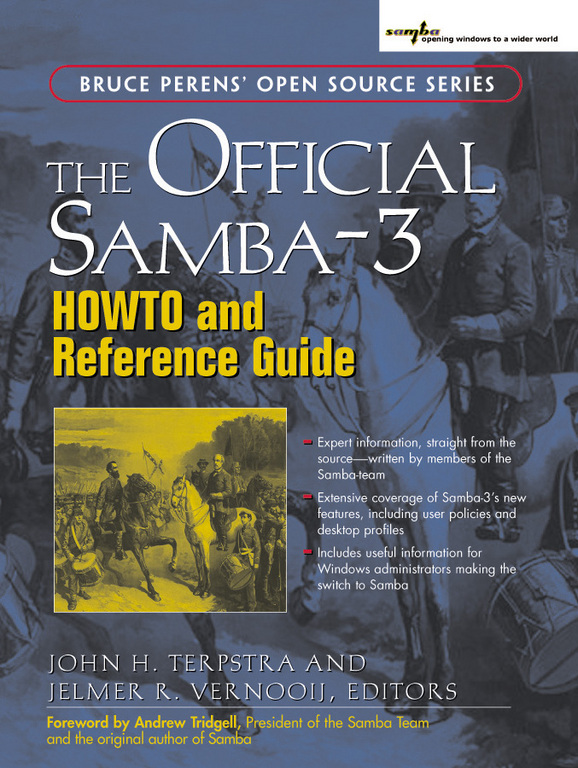
As Linux makes its way into previously Microsoft-only environments, whether in a server or desktop capacity, it is likely that Samba becomes involved in the process of integrating the systems. Hot on the heels of the September 2003 release of Samba 3.0 comes The Official Samba-3 HOWTO and Reference Guide, edited by John H. Terpstra and Jelmer R. Vernooij, two of the cofounders of the Samba team.
The sheer amount of information in the book is impressive; the important topics of file sharing, domain control, domain membership and WINS are covered thoroughly. Beyond this, the book goes into considerable detail on issues such as security, trust relationships, access controls and system policies.
A nice touch is the presence of a number of ready-to-run sample Samba configurations in an early chapter. These range from a simple file server to a large domain controller with a directory server back end, and they are useful for anyone who quickly needs to set up a server for one of a number of common tasks, without first having to wade through hundreds of pages of documentation.
Also useful are the Common Errors sections at the end of most chapters, where many of the questions that appear time and time again on the Samba mailing list are documented and answered. These sections are of particular benefit to people migrating from an older version of Samba, and they definitely are a worthwhile feature.
Due to the complexity of modern Samba installations, it isn't sufficient for a book to cover only the Samba software itself. A number of external software packages are needed to integrate a Samba server into a large network. Fortunately, the book does not let us down. The use of OpenLDAP, PAM, ISC BIND and DHCP in conjunction with Samba are all touched on in varying degrees. A detailed chapter on using Samba with the CUPS printing system also is provided.
One minor problem concerns the chapter on configuring Windows systems, where the authors notably have omitted any explanation on joining a Windows NT 4 system to a domain, concentrating instead on later versions of Windows. NT 4 still has some corporate deployment despite Microsoft's lack of support, and potential Samba administrators may have found such an explanation useful. Interestingly, though, the authors did discuss NT 4 in a later chapter in the context of roaming profiles.
The book is unashamedly for the more-advanced Samba user. It should be appreciated most by those people who already have some experience with earlier versions of Samba or who are at least are familiar with administering Linux or UNIX systems. Newcomers looking for a book to step them through their first installation may find this book tough going; they would be better off looking elsewhere before venturing into this one. For the advanced user, however, or for anyone planning on using Samba in a production environment, this book is invaluable.

Realizing the promise of Apache® Hadoop® requires the effective deployment of compute, memory, storage and networking to achieve optimal results. With its flexibility and multitude of options, it is easy to over or under provision the server infrastructure, resulting in poor performance and high TCO. Join us for an in depth, technical discussion with industry experts from leading Hadoop and server companies who will provide insights into the key considerations for designing and deploying an optimal Hadoop cluster.
Sponsored by AMD
If you already use virtualized infrastructure, you are well on your way to leveraging the power of the cloud. Virtualization offers the promise of limitless resources, but how do you manage that scalability when your DevOps team doesn’t scale? In today’s hypercompetitive markets, fast results can make a difference between leading the pack vs. obsolescence. Organizations need more benefits from cloud computing than just raw resources. They need agility, flexibility, convenience, ROI, and control.
Stackato private Platform-as-a-Service technology from ActiveState extends your private cloud infrastructure by creating a private PaaS to provide on-demand availability, flexibility, control, and ultimately, faster time-to-market for your enterprise.
Sponsored by ActiveState
| Speed Up Your Web Site with Varnish | Jun 19, 2013 |
| Non-Linux FOSS: libnotify, OS X Style | Jun 18, 2013 |
| Containers—Not Virtual Machines—Are the Future Cloud | Jun 17, 2013 |
| Lock-Free Multi-Producer Multi-Consumer Queue on Ring Buffer | Jun 12, 2013 |
| Weechat, Irssi's Little Brother | Jun 11, 2013 |
| One Tail Just Isn't Enough | Jun 07, 2013 |
- Speed Up Your Web Site with Varnish
- Containers—Not Virtual Machines—Are the Future Cloud
- Linux Systems Administrator
- Non-Linux FOSS: libnotify, OS X Style
- Lock-Free Multi-Producer Multi-Consumer Queue on Ring Buffer
- Senior Perl Developer
- Technical Support Rep
- UX Designer
- Web & UI Developer (JavaScript & j Query)
- RSS Feeds
Featured Jobs
| Linux Systems Administrator | Houston and Austin, Texas | Host Gator |
| Senior Perl Developer | Austin, Texas | Host Gator |
| Technical Support Rep | Houston and Austin, Texas | Host Gator |
| UX Designer | Austin, Texas | Host Gator |
| Web & UI Developer (JavaScript & j Query) | Austin, Texas | Host Gator |
Free Webinar: Hadoop
How to Build an Optimal Hadoop Cluster to Store and Maintain Unlimited Amounts of Data Using Microservers
Realizing the promise of Apache® Hadoop® requires the effective deployment of compute, memory, storage and networking to achieve optimal results. With its flexibility and multitude of options, it is easy to over or under provision the server infrastructure, resulting in poor performance and high TCO. Join us for an in depth, technical discussion with industry experts from leading Hadoop and server companies who will provide insights into the key considerations for designing and deploying an optimal Hadoop cluster.
Some of key questions to be discussed are:
- What is the “typical” Hadoop cluster and what should be installed on the different machine types?
- Why should you consider the typical workload patterns when making your hardware decisions?
- Are all microservers created equal for Hadoop deployments?
- How do I plan for expansion if I require more compute, memory, storage or networking?


3 hours 57 min ago
5 hours 13 min ago
8 hours 44 min ago
11 hours 38 min ago
12 hours 4 min ago
14 hours 32 min ago
15 hours 5 min ago
15 hours 6 min ago
15 hours 7 min ago
15 hours 9 min ago