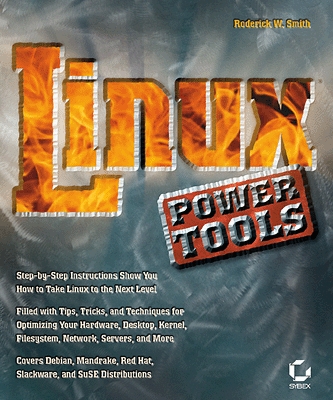
Linux Power Tools by Roderick W. Smith
I have been a UNIX user for more than ten years, and I recently made the move to Linux. When I picked up Linux Power Tools, I thought I had nothing new to learn about Linux, but boy was I wrong. After reading this book, I realized how modern Linux is compared to the Unices I have used. Linux Power Tools is a neat how-to book that explains many commonly performed tasks. It is great to read either from cover to cover or as a quick reference. The distribution-agnostic tone is one of the nicest things about this book and should help it find a wide audience.
The order in which topics appear in the book is an accurate portrayal of how a user would build a system in real life. No information is provided about how to install Linux on the system, however, because it's covered in your distribution's installation guide.
This book starts off by offering tips on how to locate drivers for your devices in case they were not detected automatically or were detected improperly. It then moves on to tweaking disk performance parameters and optimally laying out partitions on your hard disk. Shell programming is covered only briefly.
System administrators should love the coverage of both text and GUI system configuration mechanisms for all the major distributions. This book contains one of the best introductions to SystemV startup scripts I have ever read; it is an absolute must-read. If you have wondered why fonts look so ugly in your Web browser, you will learn the causes and solutions in the excellent coverage of X configuration and X font configuration. Recompiling the kernel is a tricky issue for a novice user, but this book effortlessly walks you through the process. Any machine connected to the Internet always is under attack, and the section on building firewalls using iptables is a life-saver. And, when you feel ready to run your own services, Linux Power Tools provides you with information to get the most common Internet services, such as Web and mail, up and running in no time.
In addition, Linux Power Tools has a good index, making it easy to find specific topics. I found a lot of tips sprinkled throughout the book, such as the -j option for tar to pass the file through bzip2. I would recommend this book if you are a new Linux user looking to make better use of your system or a power user looking for a quick reference book. If you want to excel in shell programming or become a crack sysadmin, though, you should look elsewhere.
Realizing the promise of Apache® Hadoop® requires the effective deployment of compute, memory, storage and networking to achieve optimal results. With its flexibility and multitude of options, it is easy to over or under provision the server infrastructure, resulting in poor performance and high TCO. Join us for an in depth, technical discussion with industry experts from leading Hadoop and server companies who will provide insights into the key considerations for designing and deploying an optimal Hadoop cluster.
Sponsored by AMD
Built-in forensics, incident response, and security with Red Hat Enterprise Linux 6
Every security policy provides guidance and requirements for ensuring adequate protection of information and data, as well as high-level technical and administrative security requirements for a system in a given environment. Traditionally, providing security for a system focuses on the confidentiality of the information on it. However, protecting the data integrity and system and data availability is just as important. For example, when processing United States intelligence information, there are three attributes that require protection: confidentiality, integrity, and availability.
Learn more about catching the bad guy in this free white paper.
Sponsored by DLT Solutions
| Designing Electronics with Linux | May 22, 2013 |
| Dynamic DNS—an Object Lesson in Problem Solving | May 21, 2013 |
| Using Salt Stack and Vagrant for Drupal Development | May 20, 2013 |
| Making Linux and Android Get Along (It's Not as Hard as It Sounds) | May 16, 2013 |
| Drupal Is a Framework: Why Everyone Needs to Understand This | May 15, 2013 |
| Home, My Backup Data Center | May 13, 2013 |
- RSS Feeds
- Dynamic DNS—an Object Lesson in Problem Solving
- Making Linux and Android Get Along (It's Not as Hard as It Sounds)
- Designing Electronics with Linux
- Using Salt Stack and Vagrant for Drupal Development
- New Products
- A Topic for Discussion - Open Source Feature-Richness?
- Drupal Is a Framework: Why Everyone Needs to Understand This
- Validate an E-Mail Address with PHP, the Right Way
- What's the tweeting protocol?
Enter to Win an Adafruit Pi Cobbler Breakout Kit for Raspberry Pi

It's Raspberry Pi month at Linux Journal. Each week in May, Adafruit will be giving away a Pi-related prize to a lucky, randomly drawn LJ reader. Winners will be announced weekly.
Fill out the fields below to enter to win this week's prize-- a Pi Cobbler Breakout Kit for Raspberry Pi.
Congratulations to our winners so far:
- 5-8-13, Pi Starter Pack: Jack Davis
- 5-15-13, Pi Model B 512MB RAM: Patrick Dunn
- 5-21-13, Prototyping Pi Plate Kit: Philip Kirby
- Next winner announced on 5-27-13!
Free Webinar: Hadoop
How to Build an Optimal Hadoop Cluster to Store and Maintain Unlimited Amounts of Data Using Microservers
Realizing the promise of Apache® Hadoop® requires the effective deployment of compute, memory, storage and networking to achieve optimal results. With its flexibility and multitude of options, it is easy to over or under provision the server infrastructure, resulting in poor performance and high TCO. Join us for an in depth, technical discussion with industry experts from leading Hadoop and server companies who will provide insights into the key considerations for designing and deploying an optimal Hadoop cluster.
Some of key questions to be discussed are:
- What is the “typical” Hadoop cluster and what should be installed on the different machine types?
- Why should you consider the typical workload patterns when making your hardware decisions?
- Are all microservers created equal for Hadoop deployments?
- How do I plan for expansion if I require more compute, memory, storage or networking?


7 hours 32 min ago
11 hours 59 min ago
15 hours 34 min ago
16 hours 7 min ago
18 hours 30 min ago
18 hours 34 min ago
18 hours 35 min ago
23 hours 4 sec ago
1 day 51 min ago
1 day 6 hours ago