
The Neuros MP3 Digital Audio Computer
The Neuros MP3 Digital Audio Computer is a portable digital music player that includes an FM tuner. For penguin users, however, the most interesting capabilities probably are its support for music encoded in the Ogg Vorbis format and its compatibility with Linux computers.
The reviewed product is the 128MB model, which weighs 5.8 ounces and measures 4.3" high, 2.5" wide and 1.3" deep. Neuros currently is shipped only in the US and is expected to reach Europe during the first half of 2004, after certification is achieved. Multivoltage AC/DC adapter and support for European FM frequencies also will be added by that time. The box includes earphones, a 110 volt AC/DC adapter, USB cable, belt clip and 35-page User's Guide, with a mini CD-ROM attached. The Neuros HD 20GB model also has a car power adapter.
The 128MB internal memory holds two hours of music encoded at 128Kbps or up to four hours of recordings, depending on the encoding rate—64, 96, 128 or 160Kbps. Everything can be recorded, not only radio input. The device has a built-in microphone and a line-level input to record from external sources. Because the computer sees it as a USB mass storage device, it also can be used as a portable hard drive to move around or back up any kind of file.
The battery is an internal memory-effect free NiMH and is not replaceable by the user. It is supposed to last for ten hours of continuous playback, and it takes eight hours to charge. Digital Innovations declares the battery lifetime is over two years and offers a replacement that costs less than $10 US if the battery dies.
As far as radio is concerned, the Neuros is more than a passive FM receiver thanks to a couple of patent-pending features, commercially called My-Fi and HiSi. My-Fi refers to Neuros' ability to find a free FM frequency and then transmit the digital music it contains on the frequency, up to a theoretical maximum range of 20 feet. The user must then synchronize his or her tuner to the frequency shown on the Neuros display to listen to it through the system speakers.
The HiSi acronym stands for Hear It! Save It! and allows identifications of songs heard over the radio. Pressing the orange button on the right while an unknown song is received creates a 30-seconds digital fingerprint. The next time the Neuros is connected to the PC, the fingerprint is transmitted to the NeurosAudio Web site, which compares it to a database and returns the current song title and artist.
The HiSi service requires a free registration, which writes a unique key based on the device serial number into the computer registry. This process is different from the Web site registration needed to participate in NeurosAudio Web forums, but the two sets of data are linked by the e-mail address. The key is used for verification purposes. The only user data sent to or logged by the server are that key and the IP address of the computer to which the Neuros is connected. Digital Innovations explained that “HiSi connections and data ARE NOT correlated with user profiles and no information is shared with third parties” and that “if the user lends the Neuros to a friend he would only 'appear' as a different IP address”. HiSi requires TCP ports 4447 and 4405.
Use of HiSi is based on the Neuros Sync Manager client, which runs only on Microsoft Windows. Support for Linux is under consideration. Because the Neuros is seen as a USB mass storage device, the user could copy the OGG files to it, but the songs would not be available in the Neuros menus.
The playback of Ogg Vorbis music in the Neuros and its management from Linux are based on special firmware and on a Python script. The firmware, called Neurosetta, has been developed by Xiph.org programmers (www.xiph.org) and is sponsored by Digital Innovations. Binary, installation instructions and release notes are available at www.xiph.org/neurosetta. Bugs should be reported to bugs.xiph.org. Future binaries also will be signed digitally.
The Python script, Positron, offers a command-line interface to synchronize the music files on the hard drive and those on the Neuros. We tested the RPM package of version 1.0 on Red Hat 9. It requires the pyogg and pyvorbis libraries, whose RPMs for Red Hat 9 are available at www.xiph.org/~volsung. Positron has its home page at www.xiph.org/positron and is distributed under the BSD license.
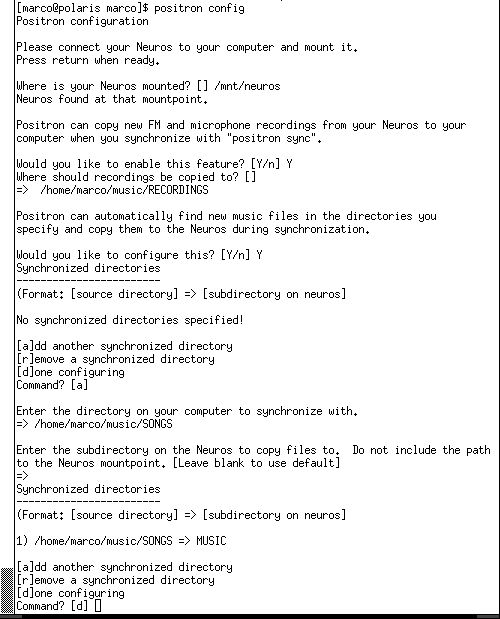
Figure 1. Configuring Positron, the Neuros Manager for Linux
Positron creates a database of all the songs in the user specified source directory and copies them and the database to the device. The main Positron operations are:
positron config     # for configuration
positron sync       # synchronizes hard disk and Neuros
                    # music repositories
positron rebuild    # rebuild the internal database
Oddly, the first command configured Ogg support as false, and it was necessary to open $HOME/.positron/config and change it to true. This should be fixed in future releases. It also is possible to add or delete single music tracks.
As of this writing (mid-August 2003) the Neurosetta/Positron combination still is declared as beta. It does not play back MP3 yet, and according to the home page, it may present “possible skipping on high-bit-rate files (over 200kps)”. We never experienced such problems during the review, however. Audio quality was superior to what the above statements had prepared us to expect. On the other hand, we did experience, “database problems [which] frequently cause the unit to freeze [during use], or songs to be missing or misfiled”—something predicted in the Positron troubleshooting guide. In our case, the misfiling corresponded to listing all stored songs correctly but playing back only the first one of the current list.
Digital Innovation hosts an open-source developers community at open.neurosaudio.com. Although Positron, the Neuros database specifications and the future Neuros API are available freely under the BSD or similar licenses, the Neurosetta firmware itself is not open source.
What is important is that Digital Innovation's position on open source, patents and DRM is stated clearly at open.neurosaudio.com/archives/000003.html. This page includes the declaration that “patents are an important defense against larger well-funded competitors in the consumer electronics space, but they will never be enforced against the Open Source community or other independent software developers”.
At the lower level, the Neuros then can be treated as an external USB 1.1 drive with a single FAT32 partition. This makes it possible to access it from any operating system supporting that class of storage devices. The specifications of the internal Neuros database are available publicly.
I would like to thank the Neurosetta and Positron developers, especially Stan Seibert, who provided technical support for this review.
A portable, integrated FM radio and digital music player obviously is a useful and cool gadget. Looking at it only on this level, the Neuros already scores well, but it is not the only game in town. The real news is it is the first portable hard drive player to support Ogg Vorbis playback. Now Linux-only users can enjoy and manage only one collection of high quality digital music in an open format, both on the desktop and on the road.
A portable OGG player means freedom from forced support of closed formats and from manual installation of software when using them on the desktop. Neuros promises this. Undoubtedly, the user interface still is not ready for general use (as of August 2003), and all the features, starting with HiSi, are not available yet under Linux, but the music is already there and it sounds good.
Product Information.
Manufacturer: Digital Innovations
URL: www.neurosaudio.com
Price: $149.99 US
The Good.
Useable with Linux-only computers and OGG music.
Good sound quality, even with beta firmware.
Broadcast music to FM radio.
The Bad.
Not all features are usable under Linux.
Linux/OGG playlist management not completely stable.
Marco Fioretti is a hardware systems engineer interested in free software both as an EDA platform and, as the current leader of the RULE Project, as an efficient desktop. Marco lives with his family in Rome, Italy.

