
OpenOffice.org 1.0 Resource Kit by Solveig Haugland and Floyd Jones
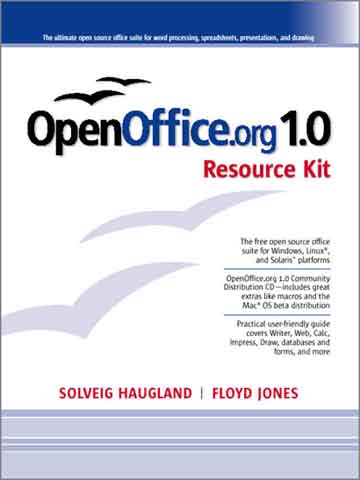
Based on Sun's StarOffice and maintained by a worldwide community of developers, the OpenOffice.org Project provides a full-featured office application suite with a language-independent API and XML-based file formats. The OpenOffice.org 1.0 Resource Kit consists of a book and a CD-ROM. The authors, Solveig Haughland and Floyd Jones, are veterans of the technical training field, and it shows in the quality of the text. The CD contains the OpenOffice.org 1.0 release, although two minor upgrades have become available since it was pressed. It also includes templates, macros and examples. The authors provide additional resources at www.getopenoffice.org.
The first five chapters of the book are devoted to basics, such as installation, migrating existing data and printer issues. OpenOffice.org is superb at converting Microsoft Word, Excel and PowerPoint files into its own open formats. The book shows how to use the handy AutoPilot, which can perform batch conversions of your existing data.
The next six chapters cover word processing. The organization of this section is quite intuitive; you'll easily learn how to create a simple letter. When you're ready to write your memoirs, you won't need to buy another book—it's all there: complex formatting options, page layout, linking cross-references and indexing. And don't forget office goodies such as mail merges, label printing and business cards.
Chapters 13–17 cover Web development. Serious Web designers may find this section useless, but the casual user will be able to create a home page without learning HTML.
The next several chapters deal with the Calc spreadsheet, Impress for creating presentations and the underrated Draw. Basic topics are organized neatly along with the more advanced ones, and neither seems to get in the way of the other. The final three chapters of the book explain how to incorporate data from a database.
An appendix covers macros, and makes the book into an all-in-one tutorial and reference, with high marks in all the important areas. It's comprehensive, well organized and has a great signal-to-noise ratio.
Superior open-source software alone isn't always enough to supplant the old way of doing things. Document it, however, and they will come. The OpenOffice.org 1.0 Resource Kit goes a long way toward fulfilling that prophecy.
Realizing the promise of Apache® Hadoop® requires the effective deployment of compute, memory, storage and networking to achieve optimal results. With its flexibility and multitude of options, it is easy to over or under provision the server infrastructure, resulting in poor performance and high TCO. Join us for an in depth, technical discussion with industry experts from leading Hadoop and server companies who will provide insights into the key considerations for designing and deploying an optimal Hadoop cluster.
Sponsored by AMD
If you already use virtualized infrastructure, you are well on your way to leveraging the power of the cloud. Virtualization offers the promise of limitless resources, but how do you manage that scalability when your DevOps team doesn’t scale? In today’s hypercompetitive markets, fast results can make a difference between leading the pack vs. obsolescence. Organizations need more benefits from cloud computing than just raw resources. They need agility, flexibility, convenience, ROI, and control.
Stackato private Platform-as-a-Service technology from ActiveState extends your private cloud infrastructure by creating a private PaaS to provide on-demand availability, flexibility, control, and ultimately, faster time-to-market for your enterprise.
Sponsored by ActiveState
| Non-Linux FOSS: libnotify, OS X Style | Jun 18, 2013 |
| Containers—Not Virtual Machines—Are the Future Cloud | Jun 17, 2013 |
| Lock-Free Multi-Producer Multi-Consumer Queue on Ring Buffer | Jun 12, 2013 |
| Weechat, Irssi's Little Brother | Jun 11, 2013 |
| One Tail Just Isn't Enough | Jun 07, 2013 |
| Introduction to MapReduce with Hadoop on Linux | Jun 05, 2013 |
- Containers—Not Virtual Machines—Are the Future Cloud
- Non-Linux FOSS: libnotify, OS X Style
- Linux Systems Administrator
- Validate an E-Mail Address with PHP, the Right Way
- Lock-Free Multi-Producer Multi-Consumer Queue on Ring Buffer
- Senior Perl Developer
- Technical Support Rep
- UX Designer
- RSS Feeds
- Introduction to MapReduce with Hadoop on Linux
Featured Jobs
| Linux Systems Administrator | Houston and Austin, Texas | Host Gator |
| Senior Perl Developer | Austin, Texas | Host Gator |
| Technical Support Rep | Houston and Austin, Texas | Host Gator |
| UX Designer | Austin, Texas | Host Gator |
| Web & UI Developer (JavaScript & j Query) | Austin, Texas | Host Gator |
Free Webinar: Hadoop
How to Build an Optimal Hadoop Cluster to Store and Maintain Unlimited Amounts of Data Using Microservers
Realizing the promise of Apache® Hadoop® requires the effective deployment of compute, memory, storage and networking to achieve optimal results. With its flexibility and multitude of options, it is easy to over or under provision the server infrastructure, resulting in poor performance and high TCO. Join us for an in depth, technical discussion with industry experts from leading Hadoop and server companies who will provide insights into the key considerations for designing and deploying an optimal Hadoop cluster.
Some of key questions to be discussed are:
- What is the “typical” Hadoop cluster and what should be installed on the different machine types?
- Why should you consider the typical workload patterns when making your hardware decisions?
- Are all microservers created equal for Hadoop deployments?
- How do I plan for expansion if I require more compute, memory, storage or networking?


2 hours 5 min ago
2 hours 38 min ago
2 hours 39 min ago
2 hours 40 min ago
2 hours 42 min ago
2 hours 43 min ago
2 hours 45 min ago
2 hours 46 min ago
2 hours 47 min ago
2 hours 48 min ago