
UPFRONT
A good choice for a spartan web-based mail agent is AeroMail. It has no frills, like address books, but it does allow you IMAP access to your mail server. It sports folders for storing and classifying mail. You can reply, forward and compose mail messages. All the important functions are present, but not a lot else. Perfect for road warriors who use a regular mail client when they return. Requires: web server; PHP, compiled with IMAP support; IMAP server.
—David A. Bandel
The FUSE (filesystem in user space) Project has reached version 1.0. One of the basic ideas of UNIX is to provide tools that perform fundamental operations in generic, interoperable ways. These tools typically work on streams of data stored in the filesystem as files. But some tools, including SSH, FTP and compression tools, interfere with this, because they either convert the files into a difficult-to-use state or they interact with systems located elsewhere on a network. Still other tools insist on providing all control internally to themselves, so none of the basic UNIX tools are of any use. FUSE allows the user to layer the appearance of a filesystem over any or all of these programs, so all operations can be done as file manipulations, taking advantage of the great wealth of basic tools available in UNIX.
The virtual memory (VM) subsystem in 2.4 now has some good documentation, courtesy of Mel Gorman. Once upon a time, Linus Torvalds dropped an entirely new VM subsystem into the Linux kernel, smack dab in the middle of a stable release series. This was tremendously controversial among developers, one reason being that Andrea Arcangeli, the author of the new code, provided virtually no documentation of any kind. Mel put in six months of work, much more than he originally thought would be necessary, resulting in a solid explanation of the workings of the entire VM, along with specific commentary on the source code itself.
The Kernel Bug Database has been documented extensively by its creator, John Bradford. Intended as an improvement over the current Bugzilla database used by a number of developers, the Kernel Bug Database rejects a generic approach, providing features based on the specific needs of the Linux kernel, such as the ability to search based on options in the .config file.
Dynamic kernel module support (DKMS) has come from a developer group at Dell. A GPLed project, it aims to allow device driver source code to reside anywhere on the filesystem, not only in the kernel source tree. This makes it easier for vendors to release new versions of their drivers and for users to recompile those drivers. As of March 2003, DKMS is 2.4-specific, and it doesn't take account of some of the massive reworkings appearing in 2.5, especially with the module code itself.
Several groups are working to implement IPSec for IPv6. The IPSec suite of protocols presents a framework for providing privacy and authentication support at the IP address layer, while IPv6 attempts to expand the number of available IP addresses. Although IPv6 is not yet in widespread use, it is important to continue to build the infrastructure to one day migrate away from the ailing IPv4 standard. Kazunori Miyazawa, Kunihiro Ishiguro, Hideaki Yoshifuji and Mitsuru Kanda recently joined forces to produce working IPv6 IPSec support in the 2.5 kernel tree.
—Zack Brown
Here's a fun game for the kids, but you can edit it and make it suitable for anyone. It's a game to learn about others, with questions and more. Think of it as a truth-or-dare game. Requires: web server, web browser, Python.

—David A. Bandel
Forecasted global percentage increase in IT spending for 2003: 4
Server growth percentage forecast: on top of a 50%-plus growth rate in enterprise servers in 2002, a 40% growth for Linux servers in 2003.
Forecasted 2003 percentage growth rate for Linux in Asia: 24
Forecasted 2003 percentage growth rate for Microsoft Windows in Asia: 6
IBM's claimed Linux revenue, in billions of dollars: 1
HP's claimed Linux revenue, in billions of dollars: 2
Damages in billions of dollars sought by SCO in a lawsuit against IBM for disclosing trade secrets in SCO-licensed AIX source code: 1
Percentage cost-savings range experienced by Merrill Lynch since deploying Linux on IBM mainframes: 40-50
Projected minimum yearly savings in millions of dollars for Merrill Lynch by fully deploying its Linux-on-mainframe strategy: 100
Number of Linux boxes currently in production at Morgan Stanley: 400
Number of Linux boxes currently “in the pipeline” at Morgan Stanley: 300
Price/performance increase multiple Morgan Stanley experienced on six new four-way Linux boxes: 13
Percentage improvement in cost experienced by Lehman Brothers with Linux: 50
Percentage improvement in performance experienced by Lehman Brothers with Linux: 20
Percentage bandwidth capacity of ordinary phone wire to households currently utilized: 1
Percentage of IBM's servers currently sold that are Linux-driven: 15-20
Percentage annual growth in Linux users over the next few years, predicted by Sun CEO Scott McNealy: 30
1,2: Aberdeen Group3,4: International Data Corp., in Economic Times5,6: eWeek7: SCO8-14: Risk Waters Group15: Bob Frankston16: Jim Stallings, IBM17: Associated Press
Mbrowse: www.kill-9.org/mbrowse/index.html
This is a nice, simple-to-use and easy-to-install management information base (MIB) browser. Those of you who use Simple Network Management Protocol (SNMP) know how easy it can make life. The Details tab provides information about those MIBs you might not know a whole lot about or use often, so you can interpret the information or make changes using the browser. Requires: libgtk, libgdk, libgmodule, libglib, libdl, libXi, libXext, libX11, libm, libnetsnmp, libwrap, glibc, libcrypto, libnsl.

—David A. Bandel
My Calendar: fuzzymonkey.org/newfuzzy/software
If you need only one calendar—not one for everyone, but one for yourself or for the office or the Web—this program is extremely easy and quick to install. And as long as the protected/ directory is protected, you don't need to worry about someone changing your appointments. This calendar also e-mails you the next three days' appointments if you set up cron to run the e-mail script. Requires: web server, Perl, cal, pscal (optional).
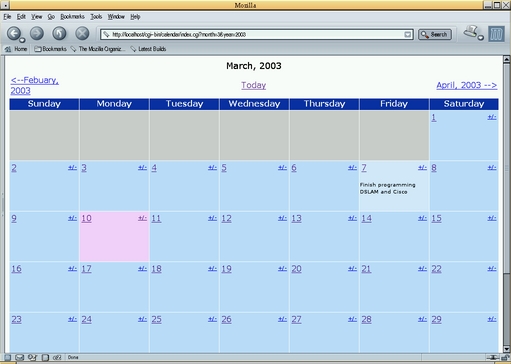
—David A. Bandel
ps-watcher: ps-watcher.sourceforge.net
If you need something to keep an eye on your process table and perform some action based on said table, you need ps-watcher. Every day I used to have to look for errant Netscape processes and kill them. Well, ps-watcher can do this before the system comes to a crawl. You can base actions on percentage of CPU time used and other parameters. Simply define the parameter in the config file and set an action to take. You can log, kill, log and kill, and any of a number of other actions. Requires: Perl, Perl modules Sys::Syslog, File::Basename, Pod::Text, Config::IniFiles, Getopt::Long.
—David A. Bandel
QBrew: www.usermode.org/code.html
A virtual beer is great, but a real one is undeniably better. Well, why not go that one step further and brew your own to your own tastes? This program comes with a tutorial for brewing real, not virtual beer. When you find the best combination of ingredients for a really hearty ale, pass the recipe on. Requires: libSM, libICE, libXext, libX11, libqt-mt, libstdc++, libm, libgcc_s, glibc, libdl, libfontconfig, libaudio, libXt, libpng, libz, libGL, libXmu, libX render, libXft, libfreetype, libpthread, libexpat.

—David A. Bandel
Alas, 2003 will not be the year of the enterprise Linux desktop; however, expect support from the large system vendors such as Dell, HP, IBM and Sun to be on the increase for desktop Linux (from practically nothing in 2002), as they realize that they can sell more Linux servers if there is a viable desktop Linux.
—Aberdeen Group
By 2007, we said one year ago, “No one will be fired for recommending Linux.” Shortening our own timeline by four years, we suggest that an IT buyer might already be fired today for failing to consider Linux. That's a small step but one of Neil Armstrong caliber.
—eWeek
Linux is a large component of our five-year computing strategy. We are investing and deploying it heavily in all areas of our Institutional Securities business. It's currently being used for mission-critical applications in our Equity and Fixed Income Divisions.
—Jeffrey M. Birnbaum, Morgan Stanley's global head of enterprise computing for the Institutional Securities business
We're no longer locked into a development platform. If we were going to port an application [to HP-UX], there would be some problems. Going with Linux, we can run the application on commodity hardware—IBM, HP or Dell—and take advantage of the benefits of the platform.
—Bridget O'Connor, Lehman Brothers
The other thing is continuing to enable all the platforms in the IBM family of products. When you do that, then no matter where the customer interacts with us, Linux is a part of this picture.
—Jim Stallings, IBM's Linux manager
Linux will not be very useful to ordinary people. It will be more useful to companies like ours.
—Scott McNealy, CEO, Sun Microsystems
Future Combat Systems (FCS, www.darpa.mil/fcs) is a $4 billion Defense Advanced Research Projects Agency (DARPA, www.darpa.mil) program with an immodest purpose that its web site puts this way:
The FCS program will develop network-centric concepts for a multi-mission combat system that will be overwhelmingly lethal, strategically deployable, self-sustaining and highly survivable in combat through the use of an ensemble of manned and unmanned ground and air platforms.
The Lead System Integrator (LSI) selected for the Army's FCS is The Boeing Company's Science Applications International Corporation (SAIC, www.saic.com), which is expected to field its results in the year 2010. The selection announcement was made in March 2002. In November 2002, at a Boeing C4ISR (Command, Control, Computers, Communications, Intelligence, Surveillance and Reconnaissance) conference, a Boeing FAQ (www.boeing.com/defense-space/ic/fcs/bia/faq_c4isr_conf.html) addressed the operating system question:
Q: COMPUTERS—What operating system will FCS use? Windows? VX Works? Lynxos? Linux? Other?
A: FCS C4ISR has selected the Linux OS.
—Doc Searls
