
Letters
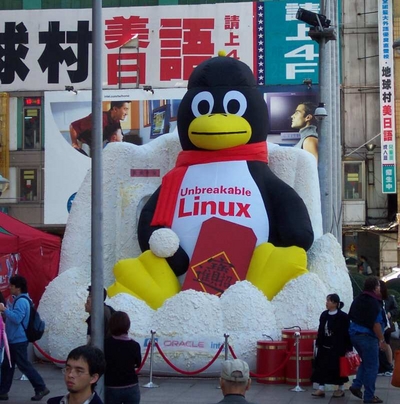
Thought you might be interested in this picture I took across from the main train station in Taipei, Taiwan. It is a very large Linux penguin, dressed up for Chinese New Year. I just finished up with Apricot (the Asian networking conference), and Linux had a large presence in the IPv6 appliances on display, as well as the research being presented. The research lab I work in has many Linux systems. The software engineers do most of their work on Linux and FreeBSD.
—Van Emery
Debit on the Left, Credit on the Right
I just read the article “Linux for a Small Business” by Gary Maxwell [LJ, April 2003]. He states that when you pay for a book, you debit your cash account and credit your expense account. I believe it should be the other way around. In accounting, debit refers to the left side of a T-account and credit refers to the right side of a T-account. The words are of Latin derivation meaning left and right. They don't mean decrease or increase. Depending on the type of account, a debit can either increase it or decrease it. The same applies to credits. I think this is probably the source of most non-accountants' confusion about double-entry accounting.
—Kathy
Thanks for the great article listing rdesktop, Marcel [Cooking with Linux, LJ, April 2003]. In a heterogeneous environment, rdesktop works nicely for getting to Windows machines. I have also found tsclient (www.gnomepro.com/tsclient), a GNOME 2 front end to rdesktop that looks and acts exactly like the Windows Terminal Services client. For those of us who must work in this environment, it helps things a little bit.
—Jeremy
To Jon “maddog” Hall: I am Brazilian and would like to let you know that I agree with your response to Bruno Trevisan's letter about the “Landless Workers' Movement”, Movimento dos Trabalhadores Rurais Sem Terra (MST) [LJ, February 2003]. I sincerely thank you for bringing out the facts. MST is addressing the very basic needs of landless people in Brazil in a conscious, organized and effective way. MST has shown results—tons of results. The land issue in Brazil is a serious one, and Trevisan's statements show a total lack of respect toward people in need of basic things, people in poverty, people that die from hunger. Former President Cardoso never had his farm destroyed. The Brazilian army was always securing his properties because of the lack of response of local police. A few years ago, in the Brazilian state of Para, in the Amazon region, the state police cowardly murdered dozens of rural workers. It took a very long time to bring the police officers to trial. A few years ago, in the state of S. Paulo, the state police invaded a prison and murdered 111 prisoners. Again, it took a very long time to put the responsible ones on trial.
—Nuno Vasconcellos
The term wardialing was in use in 1979-80. It was used to describe either linear or random dialing of phone numbers and keeping tabs on the modem carrier detects (CDs) received. Wardialing also was used interchangeably to signify using those numbers, getting the codes from the long-distance carriers, or if you were lucky, a PBX connect to trunk calls and make party lines. Nothing too intelligent, just brute force. Not that I ever did any of that. I think the term war was that you were at “war” with the phone company doing this. Think of it as carpet bombing the telco switch. Eventually, you'll hit something. There were a lot of turf wars like they have now, and essentially, the biggest “list” wins. The movie Wargames (1983) had nothing to do with it whatsoever.
—Craig
I disagree strongly with your description of GNOME 2 as “an excellent choice for first-time and nontechnical users” [“The GNOME 2 Desktop Environment”, LJ, April 2003]. I used GNOME 1 and persuaded my wife to use it too, but when I installed Red Hat 8 with GNOME 2 we found things had gone backward.
Under GNOME 1, with the Sawfish window manager, I set up all sorts of keyboard shortcuts. This was reasonably easy. There was a decent keyboard shortcuts tool, which allowed you to set the context (global, window, title) and then set shortcuts like Alt-MOUSE3, etc., with a long list of commands to assign them to. Now under GNOME 2, I find a very primitive “keyboard shortcuts editor” that offers a much smaller number of predefined commands and does not allow you to specify the context. Why adopt a worse new window manager without offering the choice of keeping the old one?
We wanted to have some programs run on GNOME startup. I looked in the menus for something like “startup”. It took ages: I finally found the required functionality in a program that runs when you click on Extras-->Preferences-->Sessions. Well hidden!
My wife found GNOME 2 unusable and unfriendly. I found it shockingly weak on everyday functionality, compared with GNOME 1. Overall, the point of a desktop is to make the computer more usable, but I see no sign of any user-sensitivity in the GNOME desktop. It feels like a half-baked programming project, not a user-oriented functional tool.
—Dr Mark Alford
Gary Maxwell's article “Linux for a Small Business” [LJ, April 2003] is very useful for an average desktop user like me. I'd like to add a small correction to his statement that “Mozilla lacks a feature that Konqueror has: changeable user agents.” In Mozilla 1.3 and later, the user can change User-Agent by changing profiles.
—Hiroshi Iwatani
I would like to say thanks for some really inspiring and interesting stuff about movies in Linux Journal. The January 2003 issue about Star Trek was excellent. I would also like to give a special thanks to Robin Rowe, because he's actually the reason I'm switching to Linux. The biggest problem as a 3-D animator is that there are not enough 3-D applications for Linux. Currently, I'm using the free Blender 3-D application, and I'm very impressed.
—Jesper Christensen
Robin Rowe replies: Thank you, and you may want to try Wings. That's free, too. See www.linuxmovies.org for a list of more movie-related software.
It would be great if you had a training section in the magazine highlighting where you can get free or paid training for the topics in that month's magazine.
—Mike Hjorleifsson
In response to the letter “..and Loses Another” [Letters, LJ, April 2003] that accuses LJ of containing “apologies for terrorists and other assorted anti-American, third-world riffraff”, I don't believe the editorial team should worry about losing another loser, but should rejoice that LJ does not encourage such xenophobia. Linux provides an opportunity to rise above this type of nationalism. Open-source software can help create a more equitable sharing of knowledge and access to wealth, and this is a great thing. Linux is most definitely a multinational effort in the best traditions of freedom and democracy (a European invention). And yes, that operating system you use every day includes contributions from the third world too.
—Ian, a citizen of the world
How dare you! I had canceled my subscription a few months ago, then what do I find when I look at Linux Journal at my local Borders bookshop? I find interesting, technically unrepentant articles. I find excellent design and a good balance between news, discussion and facts. The cheek of it! I was shocked by the current issue [April 2003], which I was forced to buy—a GNUstep programming introduction, a brilliant inspiring GIMP tutorial, USB drivers, a kernel cryptography overview, CMS chitchat, teasing screenshots of GNOME 2, gossip on kernel patches for the SGI VISWS—and all on lovely glossy paper! You do realise the pain you're putting me through knowing that I'm not subscribing anymore! People I have spoken to were really inspired by your GIMP tutorial. They couldn't wait to get back to their mice and keyboards to try it out. I think that's the key really: to show people how powerful the tools they already have are. “I didn't know you could do X with this Y I have here” is a nice feeling!
—Tariq
I don't get why everyone wants Linux GUIs to look like Microsoft Windows. I've supported Mac users and Windows users for years. It never fails to thoroughly confuse Mac users on Windows systems when something almost works like on their Mac, but not quite. Most users I've worked with had an easier transition from one platform to another when the two had very little semblance to each other.
—LT
Are there any plans for an article or two on the state of desktop publishing software and production on Linux? I'm in the middle of a small press startup, and I'm hoping to be able to standardize on Linux. I've looked at software packages like TeX, LaTeX, LyX and Scribus. None of them seem to be quite ready for my needs, though Scribus is very close. I think you guys are probably in a prime position to write articles on this subject, being already in the publishing industry.
—Charles
I regularly pick up the Linux Journal, but in February I was unable to. Now having picked up the March issue and seeing two letters about maddog's “I believe” response and how inspirational it was, I would really like to see it. Is it possible to post it on the web site?
—Chris Bruner
Yes: www.linuxjournal.com/article/6770—Ed.
I read with some concern your recent article on Koha [LJ, February 2003]. I wondered what would happen to small- to medium-sized software companies that currently produce competing library systems. No doubt these companies have invested real money into developing these products and need some return on their investment in order to survive. This led me to wonder about the long-term effect of free software. Any software product that has to compete with the equivalent open-source product must surely struggle to survive. This means one open-source product will eventually dominate each market niche leaving consumers with no choice. Presumably a lot of open-source products are developed by charitable professional software developers during their free time. Will the pool of professional developers shrink as there is little work available other than charity work? Why should large organisations increase their profit margins by significantly reducing the cost of software essential to their organisation? Charity is fine for those who cannot afford to pay but shouldn't be exploited by those who can.
—John
Richard Stallman covered many of the issues you raise in the 1985 GNU Manifesto (www.gnu.org/gnu/manifesto.html), and they have been the subject of intense community discussion ever since. That page, and a web search for links to it, is a good way to catch up on the debate—Ed.

