
UpFront
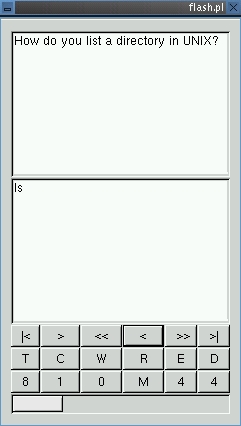
Gtk-Perl Flash Cards: www.masswire.com/flash.tgz
Flash cards have always been a good way to go through questions. You get the question, provide a response and see if it's correct. That's the theory behind this little application. You can classify the question as difficult or easy, put as many as you'd like in the data file and quiz yourself. The application provides a way to keep track of the number of correct and incorrect responses, total number of questions, a button to randomize the next question and more. Requires: Perl, Perl module Gtk.
—David A. Bandel
Checkbot: degraaff.org/checkbot
This is a simple, lightweight web checker. If you run it with the --match option and match your domain name, it will not wander off on all the sites you might be linked to. You can have it mail the results or simply watch it traverse your site picking up the URLs. No more broken links, no matter how complex the site—at least none you don't know about. Requires: Perl, Perl modules File::Basename and LWP.
—David A. Bandel
Dbmail: www.dbmail.org
If you're running a large mail server with thousands of users, Dbmail may be helpful. Users and mail are all stored in an SQL database; system users do not need to be created. The Dbmail program comes not only with dbmail-smtp, a receive-only SMTP dæmon (you'll still need sendmail or another MTA for outgoing mail), but also with dbmail-pop3d, a pop3 server, and dbmail-imapd, an IMAP dæmon. Instructions for setup are sketchy, so you'll need to figure it out for yourself. Fortunately, that's not too hard to do. Configuration includes things like POP or IMAP before SMTP. Requires: PostgreSQL or MySQL, libssl, libcrypto, glibc.
—David A. Bandel
In spite of the October 31, 2002 feature-freeze, developers continue to hack on their favorite projects. December saw a number of such developments, some weirder than others. In the POSIX realm, Krzysztof Benedyczak and others did some work on implementing POSIX message queues to allow processes to communicate more directly with each other. Linux always has maintained a love/hate relationship with POSIX (and other official standards), sticking to the principle that bad ideas should be avoided whether they have an official seal or not. Message queues have not been particularly controversial in the Linux arena, but the UNIX world at large has not always agreed on the proper public interfaces for them. So whatever the ultimate Linux message-queue implementation, there will be permanent issues surrounding attempts to port any applications that use the feature.
Drivers for new hardware are churned out constantly, development series or no. December saw several new drivers for Via cards (the 8633 AGP and 8233 onboard sound card) from Nathaniel Russell and a framebuffer driver for the Intel 810 and 815 graphics chips from Antonino Daplas. Overall the framebuffer code did not fare spectacularly well in December, though many patches and advancements were made. Part of the problem is the basic framebuffer design makes assumptions that simply are not true for certain hardware, and the design issues are hard to correct because a lot of user-space code relies on the existing implementation. But James Simmons has been quite active in addressing the issues that can be addressed, and a lot of work by him and others will be in the 2.6 framebuffer code, including some fancy new APIs.
A whole new architecture saw the light of day in December. After a month's intense labor, Andrey Panin ported Linux to the SGI Visual Workstation. Some might say, as Alan Cox did when Andrey announced his work, that such an effort belonged truly in the land of dementia. After all, the VISWS was apparently a flash in the pan, appearing briefly a few years ago and then dropping off the map. But Alan still applied the patch.
Intel's sysenter and sysexit instructions, introduced way back with the Pentium II, finally are starting to find support under Linux. Theoretically, they provide a quick way to perform system calls, but in practice it proves difficult to find an implementation that doesn't sacrifice too much of the speed the instructions are intended to save. A lot of progress was made in December, but this is all quite invasive work, and as Alan Cox has said, Linus Torvalds appears to be “doing the slow slide into a second round of development work again”, as was the case with all other development series.
Speaking of invasive work, it looks as though Andre Hedrick's new IDE subsystem will be dropped en masse into the 2.4 kernel. Normally such an invasive change would be attempted only during a development cycle, but apparently the old IDE code is too nightmarish to live. News of the new IDE code's imminent acceptance into 2.4 was greeted with shouts of jubilation from all sectors. Quite a different reaction from Linus' decision to drop a new virtual memory subsystem into an earlier 2.4 kernel.
In the final months of 2002, some folks decided to set up a Bugzilla database to help bring 2.5 to a successful, stable conclusion as soon as possible. Not all developers feel that Bugzilla is the best tool for the job, however. Since the bug database was first set up, it has proven difficult to use in certain ways. Bugs go unclaimed, and developers have trouble finding references to bugs in their areas of interest. In light of this, John Bradford decided to start from scratch and implement an entirely new bug-tracking system, designed specifically for the Linux kernel. He chose to focus on automating much of the search facility and enhancing the organization and presentation of bugs to streamline the ability to find bug reports in any particular area of interest. That said, the existing Bugzilla database has its adherents, and as of the end of December 2002, John still had not put together a fully usable replacement.
—Zack Brown

Domino on Acid: www.winterdrache.de/freeware/domino/index.html
This is an extremely difficult game but includes its own tips, hints and tricks manual. You can download this game or play it right on the Internet. It can be invoked as a jar file for a standalone game or called from any Java-enabled browser. If you're like me, you'll have tiles all over the place and be no closer to a solution than when you started. Requires: Java.
—David A. Bandel
Sum offered (and paid out in January 2003) by Lindows founder Michael Robertson for the successful port of Linux to Microsoft's Xbox by the end of 2002: $100,000
Sum offered by Robertson for a port to Xbox with no hardware modification by the end of 2003: $100,000
Year by which Linux is expected to become the majority server operating system: 2009
Position Linux is expected to occupy soon among desktop operating systems: 2
Price in rupees of Hewlett-Packard's AMD 1.5GHz Athlon-based Presario home computer, sold with Red Hat Linux: 30,990 ($645 US, as of January 3, 2003)
Price in rupees of Hewlett-Packard's Intel 1.6GHz Intel-based Presario home computer, sold with Windows XP: 40,000 ($833 US, as of January 3, 2003)
Additional discounts on the Linux Presario, in rupees, from “assemblers”: 2,000
Millions of Google results from a search for “Linux” on November 29, 2002: 41
Millions of Google results from a search for “Linux” on January 2, 2003: 59
Growth in “Linux” results per day over the same period: 529,412
Position of Linux among Google's top ten technology searches in 2002: 4
Position of Microsoft among Google's top ten technology searches in 2002: 9
Number of applications shown on stage by Sun Microsystems at Comdex Fall 2002: 2
Number of applications shown on stage by Sun Micrososytems at Comdex Fall 2002 that ran on Linux: 2
Percentage of servers on which Linux is expected to run by 2006-2007: 45
1, 2: Xbox Linux Project (xbox-linux.sourceforge.net)
3: Butler Group Server Operating Systems Report (www.butlergroup.com)
4: IDC (via ZDNet)
5-7: Financial Express
8-10: Google
11, 12: Search Engine Watch
13, 14: Doc Searls, reporting from Comdex
15: Meta Group, quoted in BusinessWeek
When a need comes up for a new file or print server, don't talk about installing a Linux box. Talk about installing a new file or print server. As long as what you implement does the job and works reliably, no one will care how it's done as long as it works.
—Craig Sanders, Debian developer and professional system administrator
A for-profit software company cannot compete with the economics of open source—free is as cheap as it gets. Nor, it turns out, can it compete with open source's quality testing process. Though the pace of open-source development can be languid and tends to create products less functionally rich than their proprietary counterparts, the stuff gets tested so often and so brutally by so many different people that most open-source programs are judged to be more stable and reliable. In a commodity market, low cost and reliability count more than bells and whistles.
—Christopher Koch, CIO Magazine
What I've found is that a Linux administrator who knows what he's doing should be able to administer two to three times the amount of boxes a Windows administrator should be able to administer.
—Brian Schenkenfelder, n+1
Mongolian makes the impossible possible and enters the list at a whopping 15th place (supported). Sanlig Badral, Ochirbat Batzaya, Tegshbayar, Bayarsaihan and the other guys in the Mongolian team have certainly made an impressive start by jumping right in the top crowd with over 95% translated messages!
—Christian Rose, on the GNOME-I18n Mailing List (GNOME is now 100% translated to Mongolian)
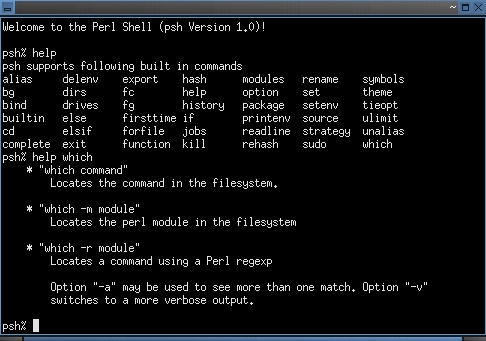
For all the Perl mongers out there, this shell might be for you. It has a number of the features of Bash, but it's a little more Perl-friendly. I've recently started using it as my login shell, so we shall see. It's certainly lighter. If you're skeptical, ask me if I'm using it a year from now. I see a day when Perl may replace all the other system utilities (if one is so inclined), but until then, I'll be satisfied with a Perl shell. Requires: Perl, BSD::Resources (optional).
—David A. Bandel
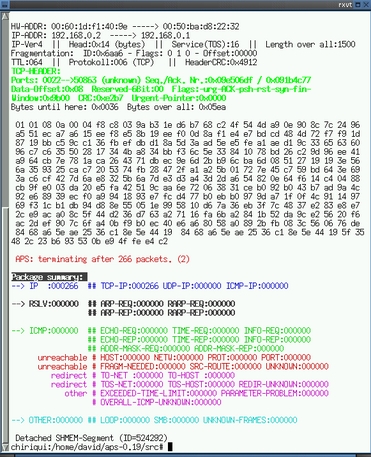
Advanced Packet Sniffer: www.swrtec.de/clinux
As I noted when I originally reviewed this application three years ago, this particular sniffer is unlike tcpdump. Here, you can see the packet payload, which may make a lot of sense to you or none at all (particularly if someone is using an encrypted connection). One of the reasons I most like this sniffer is you can show someone what information is floating around on their network for anyone to read. Requires: glibc.
—David A. Bandel
Mongolian makes the impossible possible and enters the list at a whopping 15th place (supported). Sanlig Badral, Ochirbat Batzaya, Tegshbayar, Bayarsaihan and the other guys in the Mongolian team have certainly made an impressive start by jumping right in in the top crowd with over 95% translated messages!
—Christian Rose, on the gnome-i18n mailing list (GNOME is now 100% translated to Mongolian)
email: david@pananix.com
