
Letters
Excellent article [“Must-Have Zaurus Hardware and Software”, LJ, January 2003]! Very informative and a lot of detail. I have just bought my Zaurus, and I downloaded a lot of utilities and was able to set my Zaurus's configuration with the help of Guylhem Aznar's article. Thank you.
—Vinh Duong
In “Playing with ptrace, Part II” [LJ, December 2002], Pradeep Padala talked about injecting code into a process and finding some “free space” to put it in to. It's worth noting that the space referred to is not really “free”; it's usually either the cleared space used for global storage in the executable and its shared libraries or the C library's heap storage area. In any case, writing over this data and not restoring it before allowing the execution to continue (as may seem reasonable at first) could cause all sorts of weird behaviour, including program crashes.
—Shaun Clowes
Just got my January 2003 issue of LJ and was quite surprised to see a FreeS/WAN article included—nice work! I was really happy to see you used the RSASigs in the examples instead of preshared secrets, a welcome change from the usual and insecure examples I've read in the past. I maintain www.freeswan.ca, an alternate source of information, patches and prepatched versions of FreeS/WAN for interoperation with many devices. Freeswan.org now ships RPMs for Red Hat 7.x and 8.x for all kernel combinations. These include only the ipsec.o modules and user-land tools and don't replace your vmlinuz and grub/lilo configs. Folks should update to 1.99, as there was a serious denial-of-service flaw that is now fixed.
—Ken Bantoft
Mick's reply: Thanks very much for your suggestions. Part II appeared in the February 2003 issue, and I doubt this is the last I'll write on the subject!
As a long-term LJ reader (fourth year), I am really surprised about the great January 2003 issue—it covers all the stuff that I am interested in without even knowing about it. The GCJ, Screen and DDD/quicksort articles shed more light into the daily use of our beloved Linux platform. Please keep us informed about developments in compilers, debuggers and other development tools to make us more effective in developing new stuff. Keep up the good work.
—Raphael Arlitt, Germany
What LUG meeting or BOF session would not be enhanced by penguin canapés and an igloo cheeseball? We humbly submit pseudo-code for building same and an image as proof that it's working code.
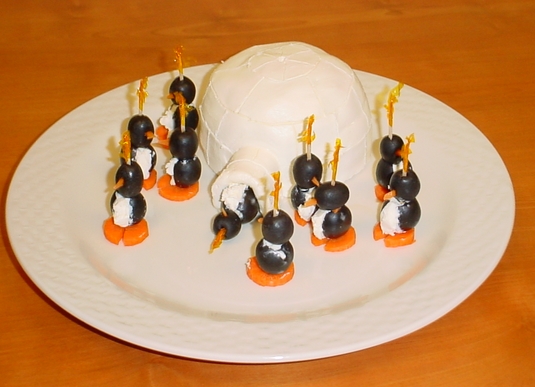
Ingredients:
2 packages cream cheese1 cheeseball1 can large black olives, pitted1 can small black olives, pitted1 carrot1 packages toothpicks with yellow or orange fringecrackers1 tin kippered herring (optional symbolic offering to penguins)
#!/bin/bash
while hungry;
do (\
        cut_cream_cheese_into_strips_and_cover_cheeseball;\
        make_igloo_entrance_tunnel_from_cream_cheese_strip;\
        use_toothpick_to_sculpt_snow_block_seams;\
        peel_carrot_with_vegetable_peeler;\
        cut_carrot_into_coin-sized_slices;\
        cut_slender_wedge_from_each_carrot_slice_and_reserve_for_beak;\
        slit_each_large_olive_and_stuff_with_cream_cheese;\
        puncture_each_small_olive_and_insert_carrot_wedge_beak;\
        skewer_small-olive_head_large-olive_torso_and_carrot-slice_feet_with_toothpick;\
        arrange_olive_penguins_about_cheeseball_igloo_on_serving_dish;\
        arrange_crackers_on_serving_dish_or_nearby;\
        serve);
done
Herring also can be served to set the scene. Herring are one of two things that make penguins contented. This recipe is a clean-room implementation developed by reverse engineering based on a study of olive penguins and a cheeseball igloo served at a party. We hope the process is not patented. In any case, we assert that the recipe is our own work, and we release it under the terms of the GNU Free Documentation License.
—Michael Callaham [penguins] and Jennifer Gentry [igloo]
I have just received the February 2003 issue of Linux Journal, was reading through the Letters and came across the one with the guy who wants to run Microsoft ads in LJ. If I want Microsoft ads, I will go to a Windows magazine. It is true that MS ads cannot harm us, but they are annoying!
—Mitch Anderson
Kudos for Jon Hall, the LJ magazine and the thought behind the GNU/Linux and other free, open-source software movements (“Back to Brazil”, Letters, February 2003). The heavy reluctance against land reform is the root cause of fundamental socioeconomic problems in many parts of the globe, including Southeast Asia, South Asia, Central and South America and Africa. I believe land reform movements in these countries share the same vein that the Linux/GNU movement has. Our country, Japan, had been coerced into doing a total land reform by the US occupation policy in 1940s. It liberated not only the land but the minds of so many common people, enabling the making of the world's second biggest economy and modern industry.
—Hiroshi Iwatani
In two articles [LJ, September 2002], Doc Searls incorrectly claims that the terms “wardriving” and “warchalking” were derived from the movie War Games. I believe they actually were derived from the term “war dialing”, the process of sequentially dialing a range of phone numbers in search of a modem connect tone. War dialers were utilities that could be left to run and accumulate interesting numbers to be investigated later. These programs were the equivalent of today's internet port scanners.
—Jonathan Hutchins
War Games came out in 1983, and we don't know of an example of the term “wardialing” before that. Although the other “war” terms are derived from “wardialing”, it's likely that “wardialing” came from the movie. Wardialing is still a threat according to a 1998 survey by Peter Shipley: www.dis.org/filez/war.pdf.
—Editor
Just to say what an inspirational answer to the unfair criticism maddog received from that reader in Brazil [Letters, LJ, February 2003]. I really liked maddog's reply, especially the paragraph that starts “I believe...”. I just might put that paragraph on an A4 page above my desk! Great stuff!
—Paul
PS: Not sure what you guys have done, but LJ now arrives in my office in-tray the day after you announce it on the web site. It used to take weeks (or longer). Whatever you've done, keep doing it.
I don't subscribe to LJ to read about politics, especially apologies for terrorists and other assorted anti-American, third-world riffraff. My subscription expires in March 2004, and I won't be renewing.
—Chas
I see Linux as losing its sense of humor. I am willing to bet a cup of coffee that this is due to the infusion of money from big business. Don't we have a wacky penguin? Don't we have XBill? Isn't that funny stuff? The answer is a qualified yes. It's funny, but it's funny in the same regard that recess is fun—that being because it is at a set time and place and supervised. But Linux never had a recess time before. You could play all day and still get everything done. It's time to get off our collective asses and put the fun back in Linux.
—Mutant
You can't spell FUN without U.
—Editor
Before I decide not to resubscribe, is Linux Journal going to return to the size that it used to be? I feel that the quality and content of the magazine has dropped in the last year and find it hard to sign up again for another year. The cost has not changed, but the content has!
—Tony
The number of pages of content depends on the number of pages of advertising. More ads fund more content. In a down economy when ads are few, page counts go down everywhere.
—Editor

