
Studying Wide Area Networks in the Classroom
Networking currently is taught at many places, and the majority of hands-on learning is done with local area networks (LANs). Even though wide area networks (WANs) are commonly used, course work typically is limited to theory, and students receive little or no practical experience using them. Reasons for this include the high cost of deploying and maintaining a WAN, the lack of WAN test equipment that runs on PC hardware and the impracticality of maintaining commercial data lines for strictly experimental purposes.
One product available for overcoming the obstacles in creating WAN labs is the Sangoma WAN EduKit. Seneca College of Applied Arts & Technology in Toronto is one educational center that is using this toolkit to successfully increase the number of WAN labs available for student use.
A wide area network connects LANs that are typically separated by great distances. The best known example of a WAN is the Internet itself. A smaller-scale example is a network that connects a company's corporate headquarters with branch offices in other cities.
The actual connection (e.g., a leased line or satellite) between the points is handled by a provider, such as the telephone company. The carrier has a point of presence (POP) at each end of the link to which the company connects their equipment.
At each separate site, a company would configure a router containing a WAN adapter card to connect to their carrier's POPs. WAN adapters can communicate over the provider's network using a variety of protocols, including frame relay, HDLC, X.25, SDLC, BSC, PPP and SS7. Because the Sangoma WAN EduKit provides software and sample labs for frame relay and X.25, these protocols are explained briefly below.
Frame relay is a simplified form of packet switching in which synchronous frames of data are routed to different destinations depending on header information. When frame relay is used to communicate over a WAN, the computers containing the WAN adapters are called customer premises equipment (CPE). These connections are identified by a number called a data link connection identifier (DLCI).
Once the hardware is in place to connect each office to the carrier's POPs, a path is established that allows information to be routed between them. This path is called a permanent virtual circuit or PVC, and it is always on as long as the equipment is working. The DLCI is used by the CPE to indicate which of the potentially several different PVCs configured by the provider is the correct recipient of the frame.
The maximum rate at which the carrier guarantees packets can be transmitted over the PVC without packet loss is called the committed information rate (CIR). Some providers offer the capability to specify different CIRs for inbound and outbound traffic along the PVC.
Because frame relay doesn't guarantee packet integrity, it can switch packets end to end much faster than X.25. For packet integrity, the company's routers could use a protocol such as TCP/IP to create packets encapsulated within the frame transmitted over the WAN.
The X.25 protocol is a packet switching protocol that defines an international recommendation for the exchange of data as well as control information. X.25 guarantees data integrity and network managed flow at the cost of some network delays.
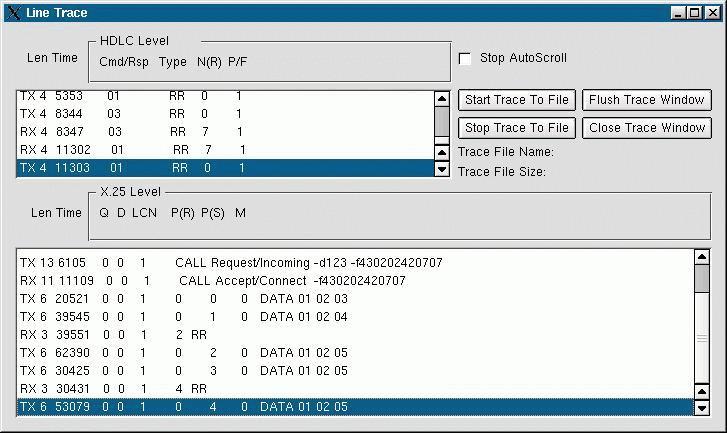
Figure 1. A line trace monitor screen, showing decoded HDLC level frames and X.25 level packets.
The computer connected to the carrier's POP is known as the data terminal equipment (DTE), and the network node is called data circuit terminating equipment (DCE). Connections over the network occur on logical channels of two types: switched virtual circuits (SVCs) and permanent virtual circuits (PVCs).

Figure 2. An X.25 packet statistics screen.
SVCs are similar to telephone calls; a connection is established, data is transferred and the connection is released. Each DTE on the network is given a unique DTE address that can be used like a telephone number. X.25 PVCs operate in the same manner as the PVCs discussed in the frame relay section.

Figure 3. An X.25 tester screen showing the various X.25 functions that may executed and an X.25 status window.
X.25 uses a store-and-forward mechanism that allows DTEs to have different line speeds, but this can introduce a noticeable delay when the blocks transferred between them are small. The store-and-forward mechanism also has a large requirement for buffering, which can make X.25 less cost-effective than frame relay.

Figure 4. A screen showing a history of X.25 asynchronous transactions.
For more information on wide area networks, I recommend reading Linux Routers written by Tony Mancill and published by Prentice Hall PTR.
Sangoma's WAN EduKit comes with a dual-CPU WAN adapter that can be installed in a standard PC. This means one computer can emulate both sides of the network independently of any other hardware.
The Sangoma WAN EduKit includes software for frame relay and X.25 protocols that run under Linux and Windows. The educational toolkit software allows the user to configure the network circuit using an interactive graphical interface. The software also allows the monitoring and emulating of WAN traffic. Full source code for the toolkit's drivers and applications is also available from Sangoma.
The monitoring application includes an extensive statistics package as well as a protocol analyzer that performs real-time line traces. This allows students to see actual WAN traffic and become familiar with its frame structure.
The toolkit also comes with a series of written lab exercises covering frame relay and X.25. Topics covered in the frame relay labs include the usage of FECN, BECN and DE bits; determining the status of a PVC; frame relay configuration; CIR usage; and frame formats. The X.25 labs cover the usage of Q-bits, D-bits and M-bits; virtual call setup and clearing; packet and window size negotiation; X.25 configuration; and HDLC frame and X.25 packet formats.
Mancill, Tony. Linux Routers. Prentice Hall PTR, ISBN: 0-13-009026-3
Ralph Krause is a writer, programmer and webmaster who lives in Michigan.

