
VariCAD 8.2-02
VariCAD is well known as one of Central Europe's strongest players for CAD tools for mechanical engineering. Their software has been continuously improved under industrial use for 14 years and has users in 40 countries around the world. They are a friendly company, willing to interact with you to solve a problem or glean feedback about their tool.
The product reviewed here was VariCAD 8.2-02, which was tested on a Red Hat Linux 7.3 system. VariCAD supports binaries for Red Hat, Mandrake and SuSE Linux distributions, as well as for Microsoft Windows.
Despite the low price (less than $400), VariCAD is a serious, high-end 2-D and 3-D CAD tool for mechanical engineering design and competes favorably with tools costing substantially more. In fact, if you have a design team, discount pricing is also available.
The tool capabilities include 3-D modeling and 2-D drafting, support for metadata, such as title blocks, and linking libraries of machine parts to designs. VariCAD is a fast GUI tool based on OpenGL. High-performance graphics are vital to a mechanical CAD tool, where a designer's time cannot be wasted on slow screen redraws for changes in views. The 3-D interface is responsive on my test system, a KDS Valiant 6480CiPTD laptop with an 800MHz Intel PIII, 512MB of RAM and a Trident CyberBLADE Ai1 video chipset.
However, due to the numerous GUI icons, there is a learning curve to get up to speed on the iconic language within the tool. VariCAD supports a nice on-line tutorial to help you familiarize yourself with the menu flow for icons and available features. Going through this really aids in understanding how the iconic language works. The language makes a lot of sense, and screen real estate for icons is well suited for providing control over a strongly visual environment. This all seems appropriate for a tool in the 2-D/3-D field.
However, VariCAD does not have a user-accessible scripting language. This is an important usability feature for users who need to automate key design tasks, such as making variations automatically given a starting or genus mechanical design. The tool will not serve well for users who need or already have large scripting applications for automating their design tasks.
The supported capabilities without scripting, however, are enormously powerful. In CAD tools, parts libraries are everything, and VariCAD is well stocked with libraries that can generate thousands of parts based on ANSI or DIN industry standards. This feature greatly simplifies generating components for designs. For instance, the components might be fasteners, building blocks in large designs that incorporate custom metal machined parts. It is convenient and fast to create screws, keys, springs, bearings and numerous other types of parts. All of the components used in a design may then be linked automatically to a very convenient Bill of Materials (BOM) generator.
The file-locking feature supported by the tool is a rather crude form of access control. If a user attempts to access a locked file, typically for an in-use document, contact information is displayed for the user desiring access. It certainly might make sense within a design organization for maintaining access rights for key drawings, but in this tool, it is only effectively operable in limited contexts—during edits. Adding GUI features to the tool to provide access using a minimal subset of a real version control system like GNU CVS would have been much more effective. This would have enabled significantly more capability for supporting access rights as well as multiple-person design teams.
The general feel of the tool is that of working on the level of a totally visual-oriented tool. The iconic hierarchies are specific and work quickly. One gets used to automatically created elements and working them into the design flow seamlessly.
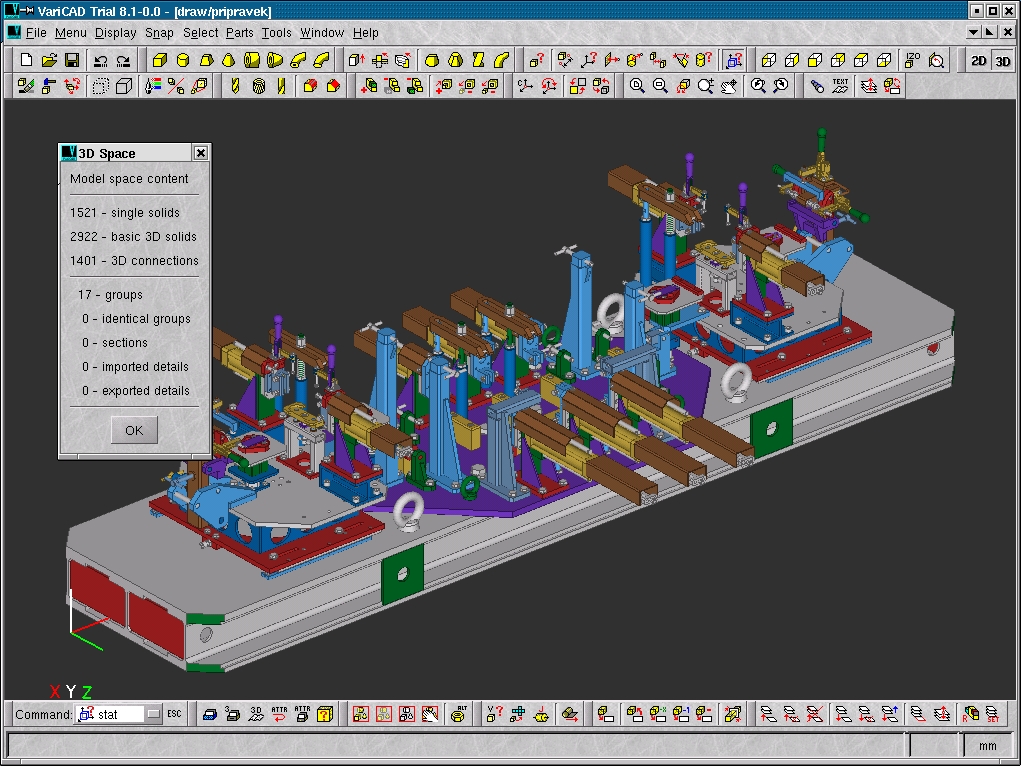
Sample Screenshot in 3-D Space
One of the best features of VariCAD is being able to work directly in 3-D to design an object. This mirrors experience in the real world—objects have mass, dimension and textures. From here, 2-D drawings can be created automatically. This is where the high-performance graphics shine in terms of usability. This performance is most likely due to the use of OpenGL as an infrastructure technology.
Also significant is the fact that VariCAD collaborates with the OpenDWG alliance. Getting CAD data into both standard and alternative digital forms is important for manufacturing, component testing and numerous other unique situations in mechanical engineering. The tool supports DWB, DWG, DXF and IGES data formats for maximum interoperability of mechanical datasets to/from other tools or manufacturing machines and to support Internet-based manufacturing. VariCAD also conveniently supplies a multiplatform drawing viewer free of charge.
The on-line (English) documentation supporting the project ranges from fair to good. And though it does contain grammar and spelling errors, the documentation generally allows you to grasp what you need to know. It's based on HTML, so it runs on a browser. Some professional users in North America might have preferred that this information be contained in a PDF instead—it's common to print a small number of relevant manual pages on paper, for working alongside a large screen monitor. But with Linux, it is also easy to have multiple desktops or a two-headed display. The company has taken a somewhat conservative approach to platform issues with their tool, supporting the KDE desktop only.
VariCAD is an impressive value proposition for a powerful Linux desktop application that supports 3-D and 2-D mechanical CAD engineering.

Michael Baxter has been working in computer technology since he was nine, imprinted by a 1969 viewing of 2001: A Space Odyssey. He is an experienced computer architect, system, board and FPGA logic designer. Michael holds ten US patents in computer architecture and logic, plus five patents as a co-inventor. His interests also include hiking, amateur radio and programming in Python.
