
High Definition Linux
What's the best looking Linux you've ever seen? Well, if you're among the shrinking number of people who haven't been stunned by HDTV, you may have already seen it. Acrodyne Industries, the television transmitter division of Sinclair Broadcasting, has a history of industry firsts, and the latest is embedding Linux in their newest transmitters.
Andrew Domonkos, principal systems software engineer with AI, says:
We are the first in our industry to introduce a television transmitter system using Linux as its operating system. Our-top-of-the-line HDTV transmitter series, the Quantum, uses an industrial PC running Red Hat Linux in a network server configuration. We chose Linux for both its reliability as well as its networking potential. Running anything else would be unacceptable; when a TV broadcaster goes off the air due to a system controller problem, the loss in revenue can be tremendous.
A paper by Acrodyne's Marc Polovick explains:
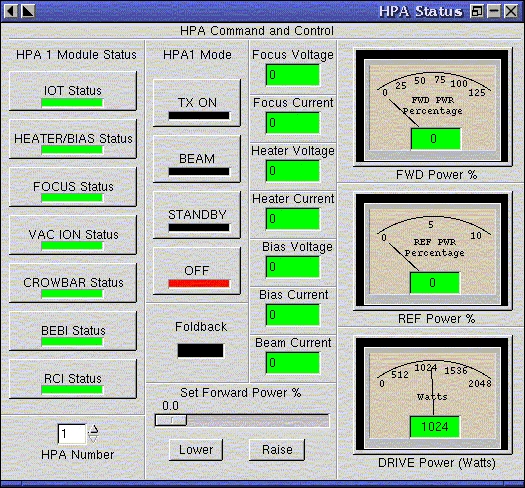
Linux (which is internet synonymous) is a UNIX-based OS and provided a valued starting point to this requirement. It was the intent of the Quantum designers to use UNIX as it was designed to be used, in a distributed processing "server/client" environment, a real-time/object-oriented data driven system architecture. A user-friendly GUI is provided and is displayed through one large LCD display device. This intuitive graphics-based interface has been designed to be mimicked and to provide secure "remote anywhere" monitoring capabilities that are network accessible in almost every network environment.
Quantum's User-Friendly GUI
At the receiving end, Linux has become a common operating system in set-top boxes as well. In fact, National Semiconductor created Linux4.TV, "Where open-source Linux meets interactive television"--for engineers working on products that use the company's Geode SC1200 integrated processor and SP1SC10 development platform.
More proof that Linux just keeps looking better.
Doc Searls in senior editor of Linux Journal.
email: doc@ssc.com

