
NIC Contest Winners
Many of the techniques, parts and code used by our winners will be useful for Linux desktop users who want to connect their computers to something other than the Net. If you're reading this because you're a Linux desktop user or a hobbyist who simply wants to figure out how to connect a radio or a temperature probe, welcome to the world of embedded systems.
The other finalists also came up with great ideas, hardware and software. You can see the remaining finalists' web sites at http://embedded.linuxjournal.com/advertising/press/c2.finalists.php.
As always, watch for future hardware overviews and contests in upcoming issues of Embedded Linux Journal.
Alexander Perry
http://candetect.sourceforge.net/
William Gibson wrote that ``the street finds its own uses for things'', and it looks like the runway does too. Far from the NIC's office-bound roots, this project does nondestructive testing for cracks in aircrafts (Figures 1 and 2). And, it was recently presented as a paper to the NDE and Health Monitoring of Aerospace Materials and Civil Infrastructures conference in San Diego, California on March 19, 2002.
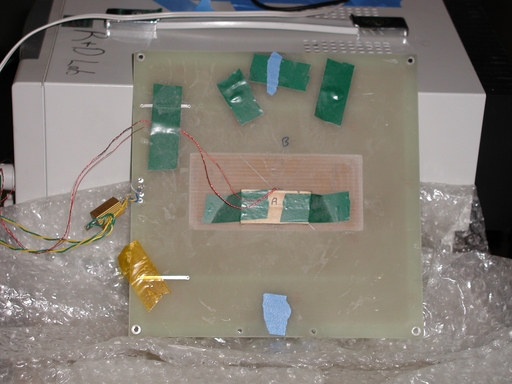
Figure 1. CanDetect's magnetic probe runs straight off the NIC's sound card.
CanDetect makes innovative and cost-effective use of the NIC's sound hardware to drive a probe, and it displays results using the xoscope oscilloscope utility (Figure 3). The project web site gives a thorough explanation of how it's done, along with an abstract of the conference paper, entitled ``Near-DC eddy current measurement of aluminum multilayers using MR sensors and commodity low-cost computer technology''.
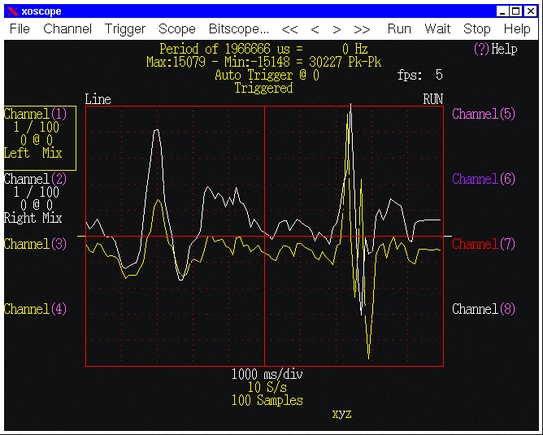
Figure 3. The free xoscope program displays CanDetect data.
Jay Sissom
http://www.sissom.org/edukiosk/
What do you get when you combine the NIC with a Ten-Tec computer-controlled RX-320 shortwave radio and a graphical application that gives the user control of the radio and explains the shortwave bands? A cool exhibit for your local science museum, that's what. In this project, the NIC provides an easy-to-use front end to hear faraway radio stations for the first time (Figure 4). This project uses GTK+ as the GUI widget set. When you burn the CD to run the exhibit, you can install a TIFF image easily that will customize the on-screen look of what might be a kid's first look at real radio. This well-thought-out project includes heavy-duty arcade game buttons for intensive public use.

Figure 4. A screenshot of the Shortwave Radio Education Kiosk in use. It shows information on radio bands as the user selects them.
Phil Zumsteg
http://www.stratis-ltd.com/gpl/elj/nic-aerc/index.html
Air conditioning is actually most efficient when the outside air is cooler, but a conventional thermostat runs it when the house heats up. You can pre-cool the house, but that's a waste when the weather will be cool enough not to need it. So what do you do? Predictive heating, ventilating and air-conditioning (HVAC) systems are expensive and only for big buildings, but this project can help. Using weather forecasts, the ``NIC-aerc'' can determine the most efficient course of action--to pre-cool or not to pre-cool. With it, users can save big money when the local utility offers off-peak discounts (Figure 5).
The web site includes good documentation on interfacing the necessary Dallas Semiconductor MicroLAN devices to monitor internal and external temperatures and to control the thermostat. The NIC uses its built-in modem to get on-line weather forecasts (Figure 6). Check out this site if you're interested in real-world examples of using the Dallas Semiconductor devices. And even with all that capability, this project isn't much more expensive than a seven-day programmable thermostat.
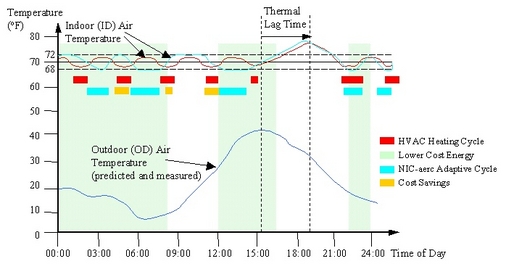
Figure 5. The NIC-aerc saves energy and money by running the heater or air conditioner at the most efficient, least expensive times.
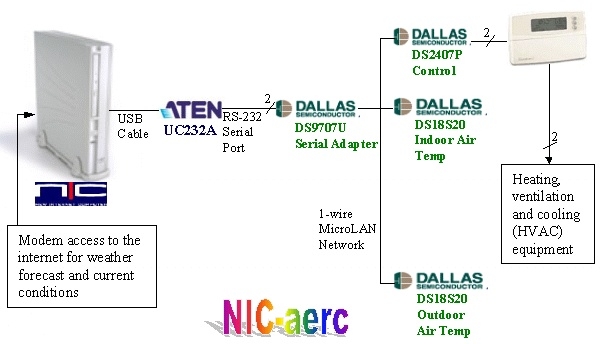
Figure 6. How the NIC-aerc connects to the Internet and the HVAC system.

