
Embedded Linux Targets Telecom Infrastructure
The 22-member nonprofit Open Source Development Lab (OSDL) used the occasion of LinuxWorld 2002 in New York to announce a major new Linux initiative aimed at the telecommunications infrastructure market. OSDL has created the Carrier Grade Linux working group that is chartered to provide “vision and guidance” and to “encourage the development of whatever commercial and open-standard components are needed on top of Linux to implement required platform functionality” for the telecommunications industry. The Carrier Grade Linux working group is made up of some heavy hitters in the telecom market, including Alcatel, Cisco, HP, IBM, Intel and Nokia. Linux vendors MontaVista Software, Red Hat and SuSE are also members of the working group.
OSDL has articulated several reasons why the telecommunications industry needs a new standards-based, carrier-grade operating system platform, and why Linux is ideal to serve as its basis:
Networks are converging for multimedia communication services.
More bandwidth and new architectures are needed.
Open-standards-based, off-the-shelf software components are needed to improve time-to-market of new services.
An open-standards-based approach reduces development cost/risk of products for the new architectures.
Linux is the fastest-growing, general-purpose server operating system.
Fragmentation of the Linux kernel must be avoided for both data center and communications market segments.
The group's initial focus is to collect market requirements and specify the architecture for a Carrier Grade Linux platform (see Figure 1) and also to encourage development of third-party components on top of Linux that implement the required functionality of the platform.
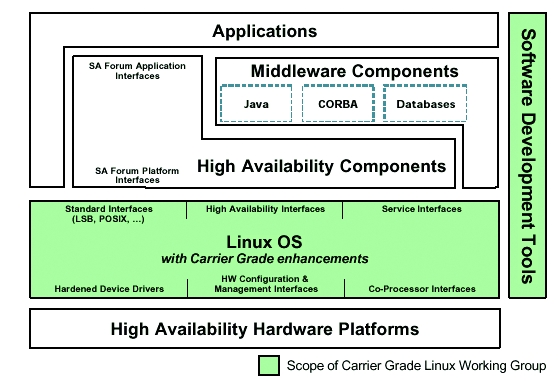
Figure 1. Carrier Grade Linux Architecture. Copyright (c) 2002, OSDL. Used with permission.
Other indications of the march of Linux into the telecom market are seen in the following recent headlines:
HP: “Linux Is the OS of the Future in Telecom”: Also this year at LinuxWorld in New York, HP unveiled a range of new Linux-based products and services targeting the internet infrastructure, telecommunications and network equipment provider markets. They include a family of Linux-based, carrier-grade servers and a developer's kit for HP Opencall software. The new telecom-oriented server family will be powered by Carrier Grade Linux, when available. According to Mark Butler, HP operations manager for telecom systems operations, HP is strongly supporting Linux as the OS of choice for the telecom market. “Linux is the operating system of the future in the telecom sector”, Butler said. “HP is leading the advance of Linux in the telecom market.”
Motorola Targets “6NINES” with New HA Linux Platform: Motorola Computer Group also is promoting Linux into telecom infrastructure. They recently announced the latest version of their telecom-market Linux platform, HA Linux 3.0, which Motorola claims implements “significant steps toward providing the key operating system features required for 6NINES-availability, or the equivalent of 30 seconds or less of downtime annually”. Motorola says to achieve that level of uptime, you need properly designed hardware, not just the right software; Motorola provides HA Linux as an OS for its carrier-grade CompactPCI systems.
Nokia Unveils Linux-Based Platforms for All-IP Mobility Networks: At the 3GSM World Congress in Cannes, France, Nokia announced a new Linux-based platform technology for what is being called “All-IP” mobility networks. The first products based on the new All-IP technology are to be Nokia's open, carrier-grade FlexiServer and FlexiGateway platforms. In January 2002, MontaVista Software announced that they had been chosen by Nokia Networks to help develop Nokia's All-IP infrastructure.
The preemptible Linux kernel patch, originally introduced by MontaVista Software and more recently championed by Robert Love, has now been officially merged into the main Linux development-kernel tree, starting with kernel version v2.5.4-pre6 [see Rick's interview with Love in the April 2002 issue of LJ].
Although this enhancement came about as a means to provide faster responsiveness of Linux for industrial and embedded control applications, the benefits will be, in the words of Love:
...a means to an overall better system. Besides the traditional markets for low latency—audio/video, specialized embedded/real time, etc.—a preemptive kernel can benefit any interactive task. The result is hopefully a smoother, more responsive desktop.
A Bangalore, India-based development company, perceived an opportunity between the high-end, high-cost Pocket PC PDAs and the low-end, low-cost Palm PDAs and created a new PDA called Kaii (which means “hand” in Kannada, the local language) to fill that gap. According to an article published in the Bangalore Times, Infomart (www.infomart.co.in) intends to sell the new Linux handheld devices for around $200 US with a 320 × 240 pixel monochrome LCD and for around $300 US with a TFT color LCD.
Infomart is trying for a high level of compatibility with Sharp's new Zaurus PDA, from both a UI and application software perspective. To accomplish this, they used the identical software stack: Lineo's Embedix Plus, Trolltech's Qt/Embedded and Qtopia, Opera's browser and Insignia's Jeode JVM. In an effort to minimize costs, however, the Kaii uses a 160MHz Hitachi SH3 processor and offers a soft (on-screen), rather than physical, keyboard.

Figure 2. Kaii Linux PDA
Other Kaii features include 32-128MB RAM (depending on version) and 32MB of either ROM or Flash solid-state storage memory, a USB interface with both device and host functions, an RS232 serial port, an IrDA interface and expansion slots for both CompactFlash Type II and MMC cards. Infomart plans to make use of the USB host capability to add external peripherals such as keyboards or specialty interfaces, making the Kaii useful for more than just traditional handheld PDA purposes. The company is looking for global manufacturing and marketing partners.
Question: Could this Zaurus-compatibility be the start of a trend among Linux PDAs?
For the latest information on Linux PDAs, be sure to check out LinuxDevices.com's “Linux PDAs Quick Reference Guide” at www.linuxdevices.com/articles/AT8728350077.html.
Rick Lehrbaum (rick@linuxdevices.com) created the LinuxDevices.com and DesktopLinux.com web sites. Rick has worked in the field of embedded systems since 1979.

