
High Seas Adventure
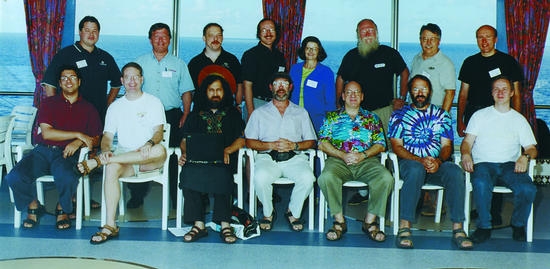
The Caribbean's a great place to get geeky if you can keep the sand out of your laptop. Of the many cruises organized by Geek Cruises, this was the first one devoted to Linux. Linux Journal had the opportunity of cosponsorship, and it's something we look forward to repeating next year.
Besides being treated to intimate sessions and abundant chances for one-on-ones with some of the most prominent names in the Linux community, for us the cruise was a chance to get to know many of our readers (and even some of their families).
The geek sessions were balanced very well with time off in some fabulous ports of call—well, except Puerto Rico. But even there, Geek Cruise organizer, “Captain” Neil Bauman, arranged a special excursion for geek cruisers to see the home of the world's largest single-dish radio telescope, the Aricebo Observatory, where much of the movie Contact was filmed, and where scientists from around the world study things out of this world 24 hours a day, 365 days per year.
Of course we weren't so lucky in choosing the lunch restaurant that day. It was a buffet that ran out of food after half of us had made it through the line. Fortunately, the entertainment value of seeing Richard Stallman spill his soda (accidentally of course) on the world's largest baby who was sleeping in his playpen near the cash register was some compensation for my hunger. I couldn't help but laugh internally—the irony was too much, but I actually felt more sorry for Richard than the baby; he felt so badly about it. In some cosmic form of retribution my own two-year-old daughter spilled her soda (same flavor as Richard's) all over my lap, leaving me looking as if the excitement of the observatory was too much.
In contrast to Puerto Rico, the other ports of call were absolute representations of paradise. At our last stop, Holland-America's private island, Half Moon Cay, I rented a Sunfish sailboat with my eight-year-old daughter, Geneviéve. We sailed to the end of the bay and still could see straight to the ocean floor. For someone used to sailing the dark water of Washington's Puget Sound, it was a unique experience.
Next year's Linux Lunacy cruise is rumored to be planned for the Pacific, down Mexico way. Bring your sense of humor, your goodwill and join us!
Richard Vernon is editor in chief of Linux Journal.
Today’s modular x86 servers are compute-centric, designed as a least common denominator to support a wide range of IT workloads. Those generic, virtualized IT workloads have much different resource optimization requirements than hyperscale and cloud applications. They have resulted in a “one size fits all” enterprise IT architecture that is not optimized for a specific set of IT workloads, and especially not emerging hyperscale workloads, such as web applications, big data, and object storage. In this report, you will learn how shifting the focus from traditional compute-centric IT architectures to an innovative disaggregated fabric-based architecture can optimize and scale your data center.
Sponsored by AMD
Built-in forensics, incident response, and security with Red Hat Enterprise Linux 6
Every security policy provides guidance and requirements for ensuring adequate protection of information and data, as well as high-level technical and administrative security requirements for a system in a given environment. Traditionally, providing security for a system focuses on the confidentiality of the information on it. However, protecting the data integrity and system and data availability is just as important. For example, when processing United States intelligence information, there are three attributes that require protection: confidentiality, integrity, and availability.
Learn more about catching the bad guy in this free white paper.
Sponsored by DLT Solutions
Free Webinar: Linux Backup and Recovery
Most companies incorporate backup procedures for critical data, which can be restored quickly if a loss occurs. However, fewer companies are prepared for catastrophic system failures, in which they lose all data, the entire operating system, applications, settings, patches and more, reducing their system(s) to “bare metal.” After all, before data can be restored to a system, there must be a system to restore it to.
In this one hour webinar, learn how to enhance your existing backup strategies for better disaster recovery preparedness using Storix System Backup Administrator (SBAdmin), a highly flexible bare-metal recovery solution for UNIX and Linux systems.
| Making Linux and Android Get Along (It's Not as Hard as It Sounds) | May 16, 2013 |
| Drupal Is a Framework: Why Everyone Needs to Understand This | May 15, 2013 |
| Home, My Backup Data Center | May 13, 2013 |
| Non-Linux FOSS: Seashore | May 10, 2013 |
| Trying to Tame the Tablet | May 08, 2013 |
| Dart: a New Web Programming Experience | May 07, 2013 |
- RSS Feeds
- Making Linux and Android Get Along (It's Not as Hard as It Sounds)
- New Products
- Drupal Is a Framework: Why Everyone Needs to Understand This
- A Topic for Discussion - Open Source Feature-Richness?
- Home, My Backup Data Center
- Validate an E-Mail Address with PHP, the Right Way
- New Products
- Trying to Tame the Tablet
- Tech Tip: Really Simple HTTP Server with Python
- enterprise
23 min 6 sec ago - not living upto the mobile revolution
3 hours 14 min ago - Deceptive Advertising and
3 hours 49 min ago - Let\'s declare that you have
3 hours 50 min ago - Alterations in Contest Due
3 hours 52 min ago - At a numbers mindset, your
3 hours 53 min ago - Do not get Just Almost any
3 hours 56 min ago - A fantastic rule-of-thumb to
3 hours 58 min ago - Keren mastah..
Penting,
4 hours 55 min ago - mini tablet compare
6 hours 14 min ago


Comments
RMS halo spotted in Caribbean
Gentlemen, on http://www.linuxjournal.com/article.php?sid=5591 we see
in the photo, Mr. RMS magically appearing in the same shirt and halo
as http://www.stallman.org/saintignucius.jpg .
http://www.stallman.org/saint.html says that this is an old disk
platter.
--
http://jidanni.org/ Taiwan(04)25854780