
UpFront
If you're a Linux usin' geek of nature, you'll certainly want to advertise it. Get a free “geek by nature, linux by choice” bumper sticker simply by practicing your snail mail skills and sending a self-addressed, stamped envelope to:
Linux Journal, “Bumper Sticker Promo”PO Box 55549Seattle, WA 98155-0549
Within just two weeks you'll receive a “geek by nature, linux by choice” bumper sticker.
Percentage of TimeWarner-related celebrities featured on AOL's starter page in a 30-day period: 78
Number of children who jumped up and down on one day in the UK hoping to cause an earthquake: 1,000,000
Tons of energy released by a million children jumping up and down: 75,000
Number of zSeries mainframe computers sold by IBM as of September 24, 2001: 1,000
Percentage of those mainframes on which Linux was installed: 10
Typical cost of a zSeries mainframe in millions of dollars: 1
Sum in millions of dollars pledged to Stanford University by Jim Clark: 150
Sum in millions of dollars suspended from the pledge by Jim Clark “pending the outcome of ongoing political deliberations” over stem-cell research restrictions by Congress: 60
According to a Cisco poster, number of cold beverages consumed per day by Cisco employees: 5
According to the same poster, annual savings in millions of dollars to Cisco from consumption of one less beverage per day per employee: 2
According to a web site responding to the poster, sum in millions of dollars Cisco spends daily venting carbon dioxide out of its buildings: 7
According to the same web site, sum in dollars saved monthly if every Cisco employee breathed four percent less: 140,000
Wireless manufacturing spending in millions of dollars by 2002: 884
Millions of Wi-Fi (802.11b) products installed by the end of 2001: 10
Percentage of companies that plan to allocate less than $250,000 to support wireless access: 60
Percentage of companies that expect to spend less than one million dollars by 2004: 61
Distance in feet traveled by the scramjet in 30 milliseconds: 5,325
Speed in miles per hour reached in the same flight: 260
Length in feet of the cannon from which the scramjet was fired: 130
Peak G-force acceleration of the scramjet in flight: 10,000
DARPA expenditures in dollars for the scramjet project: 800,000
1: Drudge Report
2-3: Yahoo News
4-6: Bloomberg News
7-8: Jim Clark, in an open letter published in The New York Times
11-12: The New York Times
13-14: William Gurley, CNET, quoting Frost & Sullivan and Cahners In-Stat, respectively
15-16: Dow Jones Newswire
17-21: Slashdot
Gee, everyone said that there'd be consolidation in the Linux space, but this is a bit bigger than I expected!
—Dave Sifry, on the HP-Compaq merger
Open Source and Complexity theory hold the strategic keys to managing risk in the age of terrorism.
—Eric Norlin
Tragedy purges the mind of trivia.
—George Gilder
Computers pose no threat to humans beyond Microsoft's blue screen of death and fatal-error messages.
—George Gilder
The problem [with the Internet] is that it was devised by a bunch of hippie anarchists who didn't have a strong profit motive. But this is a business, not a government-sponsored network.
—Tom Nolle
The Internet did not replace TV, newspapers, magazines, Sears, the US Postal Service, Barnes & Noble or grocery stores in people's daily lives. It augmented them.
—Jason Kottke
Proprietary software developers are all doing something wrong, but this doesn't mean they are all incompetent.
—Richard M. Stallman
Networking is simply the cultivating of mutually beneficial, give and take, win-win relationships. It works best, however, when emphasizing the “give” part.
—Bob Burg
Advertising is, and always will be, inherently ludicrous, and is generally deserving of satire.
—John Chambers
“Linux is not portable (uses 386 task switching etc.), and it probably never will support any thing other than AT-hard disk, as that's all I have.” --Linus Torvalds, August 25, 1991 The Current Ports of Linux web site reminds us how far Linux has come by providing information and links on on architectures to which Linux is ported thus far. Visit www.cyut.edu.tw/~ckhung/resource/linux_ports.html.
Jordi Bataller has a new web site for Maragda (see his article “Maragda: Running Linux from CD” in the March 2001 issue of Linux Journal): www.iti.upv.es/~maragda.
According to Jordi, the new site is faster, more reliable and includes a new version of Maragda, this time based on Debian 2.2r2 (potato).
On September 25, 2001, the research firm D.H. Brown released a study that went a long way toward legitimizing Linux as a serious business platform and not just a handy way to serve up web pages and perform other low-level business grunt work. The report begins:
For the first time since D.H. Brown Associates, Inc. began studying the functional capabilities of Linux-based operating systems, the strongest Linux distributions surpass the weakest UNIX systems in overall functionality. Using the version 2.4 Linux kernel has improved the features of the operating system. In addition, all of the vendors studied—SuSE, Red Hat, Caldera, Turbolinux and Debian GNU—have increased the breadth and depth of their bundled network infrastructure software.
The report analyzed scalability, RAS (reliability, availability, serviceability), system management, internet and web-application services, and directory and security services. “With these upgrades in place, the leading distributions of Linux are able to serve as general-purpose operating systems for a wide range of departmental and workgroup applications.” The graphic below shows how the various distributions stacked up.
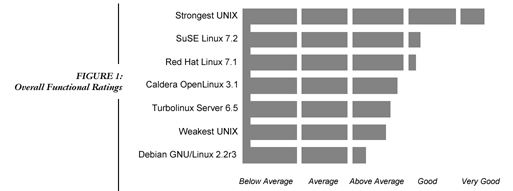
Overall Functional Ratings
In a 1999 study, D.H. Brown articulated the prevailing business wisdom about Linux at the time: “that Linux was primarily suited for low-end web, file and print service, along with use in appliance servers and clustering for high-performance technical computing.” Now, the company says, “the leading Linux distributions are quite capable of serving as general-purpose operating systems for a broad range of departmental and workgroup applications.”
Where Linux fell short of the top UNIX systems, the report said, was in areas “such as high-end shared memory multiprocessing (SMP) scalability and advanced reliability features [which] require a degree of close coordination between hardware and software designers that has not yet emerged in the Linux community”. The report adds, however, that “the gap between Linux and these UNIX systems has certainly closed at a rapid pace.”
For more information, visit dhbrown.com/dhbrown/Linux.cfm.
—Doc Searls
Tucows was the first of the big-time download sites to pay close attention to Linux, and the practice continues. In the past we've run occasional snapshots of one month's download percentages. This time we're looking at the six-month download trend running through August 2001 (see Figure 1).
Mandrake has been a steady leader, with Red Hat a strong second (though with a somewhat downward trend over the period).
As we see from the huge spike in SuSE downloads in May 2001, a six-month total tends to even out any one month's extreme results. Still, it's easy to ponder that SuSE spike: it was over 1.2 million downloads.
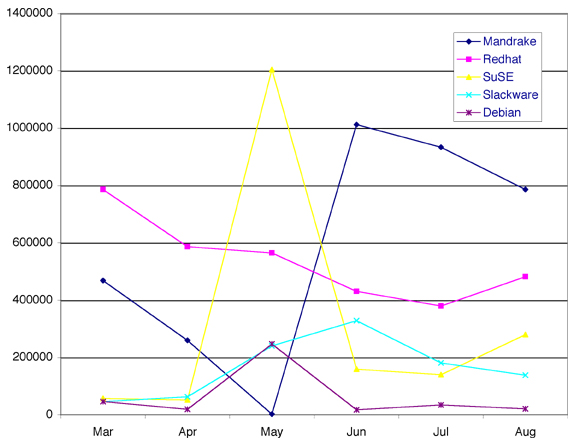
Linux Distribution Download Trends, March-August 2001
The pie chart (Figure 2) shows shares of download totals for the whole six-month period, showing the top ten distributions. While there is a clear break below the Big Five shown in the trend chart, the Brazilian CONECTIVA distro is an interesting standout contender.
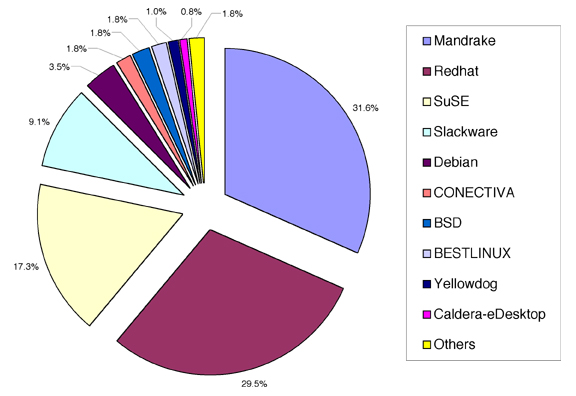
Linux Distribution Download Shares, March-August 2001
—Doc Searls
email: doc@searls.com

