
XFree86 4.1.0 and ATI RADEON
Linux graphic performance is significantly improved by the latest version of XFree86, making Linux viable as a workstation operating system. Major motion picture studios, including DreamWorks and Pixar, are adopting Linux as their standard movie production workstation.
XFree86 is a popular implementation of the X Window System, a technology developed in 1984 at MIT as part of Project Athena. MIT's goal was to build their existing assortment of incompatible workstations from various manufacturers into a network of graphical workstations. At first X was used primarily at MIT and DEC where much of the development also occurred, but in 1986 it was commercially released. Eventually MIT handed X off to the X Consortium, which later folded into Open Group. In 1999, Open Group spun off X.org. X.org estimates that more than 30 million people are using X, and that number is growing rapidly thanks to Linux and XFree86.
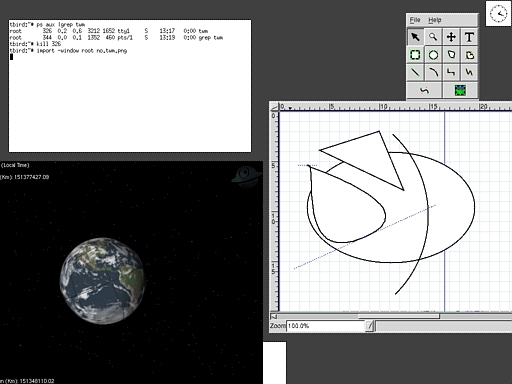
Deliberately killing the twm reveals what happens if you lose your window manager. Our Dia, OpenUniverse and xterm windows still display, but there is no means to move them.
In 1992, after X had stagnated for a decade, the project that became XFree86 was founded with the goal of offering a free implementation of X. The significant new features of X (font anti-aliasing, compositing and DRI) are due to XFree86. A volunteer organization, anyone may join XFree86 and gain direct access to the XFree86 code and docs in CVS. Originally focused on Intel x86, XFree86 today has the goal of being the best windowing system on every platform available. It runs with Linux, the BSDs, Mac OS X, Solaris and OS/2. CPUs supported include x86, Alpha, PowerPC and SPARC, with MIPS in development.

glxgears
In March 2000, a redesigned XFree86 was released. Version 4.0 added much better graphics acceleration plus features such as X-Video and multihead support with Xinerama. X-Video provides support for color space alternatives to RGB, such as YUV used in television and movies. Animators, in particular, often need to work with more than one monitor at a time. Ordinary multihead configuration supports placing windows on multiple monitors. Xinerama enables one window to span multiple physical screens simultaneously.
XFree86 3-D graphics performance is significantly improved by the addition of direct rendering infrastructure (DRI) and GLX. OpenGL is a platform-independent, scene-description language, well suited for animation and closely tied to hardware. GLX is the window-event code that connects the driver-level OpenGL graphics language with X. GLX and OpenGL were both developed by SGI. DRI is a pipeline that bypasses inefficiencies in the X server to bind the kernel, X server, OpenGL and graphics drivers together directly. All modern high-performance graphics boards now offer accelerated drivers for Linux, with the notable exception of 3D Labs, which has a driver in development.
A particularly handy feature when configuring XFree86, VESA display data channel (DDC) enables XFree86 to query modern monitors for their supported screen resolutions and refresh rates. XFree86 4.x integrates the read-edid utility to determine the correct monitor mode-line settings automatically.
In June 2001, XFree86 4.1.0 was released. Besides bug fixes, this version has many more supported drivers; of particular interest to us is the ATI RADEON. All the RADEON cards have excellent graphics performance, but the All-In-Wonder version of RADEON has the added feature of a built-in TV tuner. ATI, who had a bad reputation with open-source developers, went from being the worst to one of the best. ATI sponsored the development of the RADEON open-source driver.
Daryll Straus built the first accelerated Linux 3-D driver (for 3dfx hardware) in his spare time while working at Digital Domain on the renderfarm for Titanic. That was the first major film to have its effects rendered primarily using Linux. (See “Linux Helps Bring Titanic to Life” by Daryll Strauss and Wook in the February 1998 issue of Linux Journal.) From there, Strauss went on to build Linux graphics drivers as the lead for multimedia at Precision Insight, now a part of VA Linux. Precision Insight was funded by ATI, Intel, Matrox and 3dfx to build DRI-compatible Linux drivers. Strauss says:
I think that open source is the way to go. In 18 months we built ten drivers: 3dfx Voodoo 3, 4 and 5; ATI Rage 128, 128 Pro and RADEON; Matrox G400; Intel i810 and i815; and another not yet announced. Creating a common code base really helped. In looking at the source and documentation of proprietary drivers under NDA, we discovered that the vendors' code and hardware share many features.
His group did a limited implementation for RADEON, without acceleration for 3-D transformation and lighting. “The thing that's annoying about the RADEON is we created a rasterization driver, effectively turning RADEON into a fast Rage 128”, says Strauss. “As soon as you run Maya you notice you don't have the 3-D performance.” Maya, reviewed here last month, is a popular 3-D modeling application for motion picture film animators.
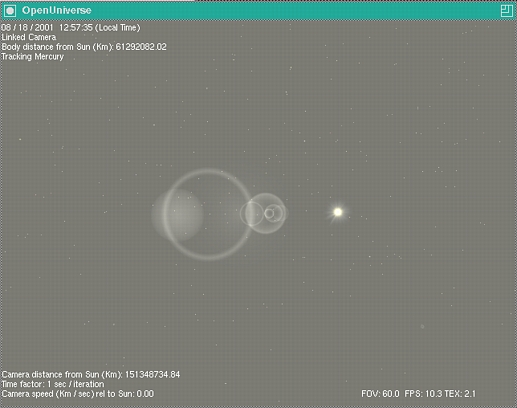
OpenUniverse lets you voyage through a simulated solar system, another test of graphics performance.

More graphics with Open Universe
XFree86 may be installed three ways: as a package, as a binary or from source. The packaged version wasn't available yet, so we couldn't follow that route. We tried to install from binary, but had problems. The Xinstall.sh install script didn't like the space in the name of the directory it was installed in, but more than that, we just couldn't get it to work right. Building from source seemed our only option, an interesting though challenging process. Version 4.1.0 relies upon the 2.4 kernel. We upgraded not only to kernel 2.4.7 but to Debian Sid. If you would like to read the details of that process, including several unexpected problems we overcame along the way, read the on-line version of this article at www.linuxjournal.com.
Installing XFree86 4.1.0 won't seem like such a challenge when it becomes widely packaged, but building it from source taught us a lot about how XFree86 is put together. The sheer size of it and the complexity of the build process is more than one expects. Vladimir Dergachev, who regularly helps RADEON users on the XFree86 Xpert list, was indispensable in helping us get it to work. He's one of the volunteers actively working on the RADEON driver.
The new DRI architecture with accelerated drivers (both open- and closed-source versions) make Linux a much more powerful platform for graphics. ATI, HP, NVIDIA, 3D Labs and others are actively working on closed-source drivers. What's not happening is further development of open-source drivers, such as the RADEON driver described here. Precision Insight has gone on to other projects, and no one is currently funding enhancements to open-source drivers or even to XFree86 itself.
The learning curve for volunteers to write DRI-compatible drivers is steep, especially because of the lack of documentation. With version 4.1.0, the changes have settled down in XFree86. It is time to write good documentation that will enable future programmers to build and enhance accelerated drivers. If anyone would like to help, please drop me a line.
email: Robin.Rowe@MovieEditor.com
Robin Rowe is a partner in MovieEditor.com, a technology company that creates internet and broadcast video applications. He has written for Dr. Dobb's Journal, the C++ Report, the C/C++ Users Journal and Data Based Advisor. He may be reached via e-mail at robin.rowe@movieeditor.com.

