World Domination Swings through Costa Rica
We talked a little more, and he suggested that if I was willing to speak, they would do some promotion and see if they could stir up additional interest. I said sure and suggested a talk about why world domination with Linux makes sense.
I arrived in CR on June 6 and spent some time being a tourist. The meeting wasn't until Saturday, June 30, and all seemed under control. Juan said he was going to contact people at the Ministry of Science and Technology to see if someone there might be willing to attend.
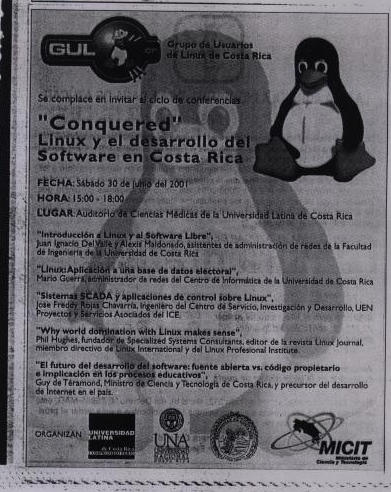
Well, things really got rolling. Guy de Téramond, the Minister, is seriously into Linux. Soon the meeting had speakers scheduled from the Costa Rican government and an ad in La Nacion, the biggest daily paper in Costa Rica.
The publicity paid off. In a beautiful auditorium at Universidad Latina, we managed to attract a crowd of about 200 Linux enthusiasts and people who just wanted to know more. The event included simultaneous Spanish and English translation and went off very well.
The first talk was titled "An Introduction to Linux and Free Software" and was given by Juan Ignacio Del Valle and Alexis Maldonado from the University of Costa Rica. It was a good intro for the newcomers. Next, Mario Guerra spoke on how he had developed a system using Linux and the PostgreSQL database to allow on-line public lookup of polling places.
The first half of the meeting ended with a talk by Jose Freddy Rojas Chavarria of ICE, the electric/communications utility. He discussed SCADA systems and Linux control applications.
After a break I spoke on world domination, followed by Guy de Téramond's discussion of the future of open vs. proprietary software and its implication in the educational process. After the meeting there was a small get together for the speakers and GULCR members who planned the event.
All in all, the meeting went off quite well, and I really enjoyed being part of it.
In recent e-mail with Mario Guerra, I have learned that another event is planned for Puntarenas, a province on the Pacific coast of Costa Rica. With a lot of hard work on the part of the GULCR members and serious government interest, I feel that Costa Rica is well on its way to being on the Linux side of the world domination scorecard.
email: ljeditors@ssc.com