World Domination Swings through Costa Rica
We talked a little more, and he suggested that if I was willing to speak, they would do some promotion and see if they could stir up additional interest. I said sure and suggested a talk about why world domination with Linux makes sense.
I arrived in CR on June 6 and spent some time being a tourist. The meeting wasn't until Saturday, June 30, and all seemed under control. Juan said he was going to contact people at the Ministry of Science and Technology to see if someone there might be willing to attend.
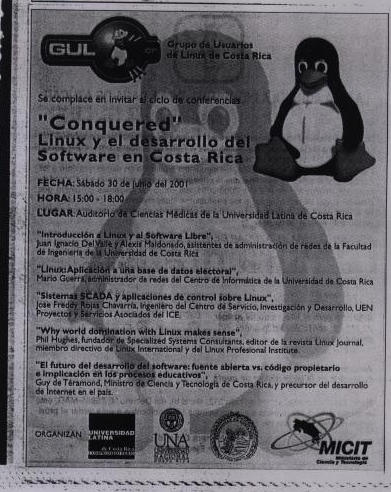
Well, things really got rolling. Guy de Téramond, the Minister, is seriously into Linux. Soon the meeting had speakers scheduled from the Costa Rican government and an ad in La Nacion, the biggest daily paper in Costa Rica.
The publicity paid off. In a beautiful auditorium at Universidad Latina, we managed to attract a crowd of about 200 Linux enthusiasts and people who just wanted to know more. The event included simultaneous Spanish and English translation and went off very well.
The first talk was titled "An Introduction to Linux and Free Software" and was given by Juan Ignacio Del Valle and Alexis Maldonado from the University of Costa Rica. It was a good intro for the newcomers. Next, Mario Guerra spoke on how he had developed a system using Linux and the PostgreSQL database to allow on-line public lookup of polling places.
The first half of the meeting ended with a talk by Jose Freddy Rojas Chavarria of ICE, the electric/communications utility. He discussed SCADA systems and Linux control applications.
After a break I spoke on world domination, followed by Guy de Téramond's discussion of the future of open vs. proprietary software and its implication in the educational process. After the meeting there was a small get together for the speakers and GULCR members who planned the event.
All in all, the meeting went off quite well, and I really enjoyed being part of it.
In recent e-mail with Mario Guerra, I have learned that another event is planned for Puntarenas, a province on the Pacific coast of Costa Rica. With a lot of hard work on the part of the GULCR members and serious government interest, I feel that Costa Rica is well on its way to being on the Linux side of the world domination scorecard.
email: ljeditors@ssc.com
Phil Hughes
Today’s modular x86 servers are compute-centric, designed as a least common denominator to support a wide range of IT workloads. Those generic, virtualized IT workloads have much different resource optimization requirements than hyperscale and cloud applications. They have resulted in a “one size fits all” enterprise IT architecture that is not optimized for a specific set of IT workloads, and especially not emerging hyperscale workloads, such as web applications, big data, and object storage. In this report, you will learn how shifting the focus from traditional compute-centric IT architectures to an innovative disaggregated fabric-based architecture can optimize and scale your data center.
Sponsored by AMD
Built-in forensics, incident response, and security with Red Hat Enterprise Linux 6
Every security policy provides guidance and requirements for ensuring adequate protection of information and data, as well as high-level technical and administrative security requirements for a system in a given environment. Traditionally, providing security for a system focuses on the confidentiality of the information on it. However, protecting the data integrity and system and data availability is just as important. For example, when processing United States intelligence information, there are three attributes that require protection: confidentiality, integrity, and availability.
Learn more about catching the bad guy in this free white paper.
Sponsored by DLT Solutions
| Making Linux and Android Get Along (It's Not as Hard as It Sounds) | May 16, 2013 |
| Drupal Is a Framework: Why Everyone Needs to Understand This | May 15, 2013 |
| Home, My Backup Data Center | May 13, 2013 |
| Non-Linux FOSS: Seashore | May 10, 2013 |
| Trying to Tame the Tablet | May 08, 2013 |
| Dart: a New Web Programming Experience | May 07, 2013 |
- RSS Feeds
- New Products
- Making Linux and Android Get Along (It's Not as Hard as It Sounds)
- Drupal Is a Framework: Why Everyone Needs to Understand This
- Home, My Backup Data Center
- A Topic for Discussion - Open Source Feature-Richness?
- Dart: a New Web Programming Experience
- Developer Poll
- What's the tweeting protocol?
- May 2013 Issue of Linux Journal: Raspberry Pi
Enter to Win an Adafruit Prototyping Pi Plate Kit for Raspberry Pi

It's Raspberry Pi month at Linux Journal. Each week in May, Adafruit will be giving away a Pi-related prize to a lucky, randomly drawn LJ reader. Winners will be announced weekly.
Fill out the fields below to enter to win this week's prize-- a Prototyping Pi Plate Kit for Raspberry Pi.
Congratulations to our winners so far:
- 5-8-13, Pi Starter Pack: Jack Davis
- 5-15-13, Pi Model B 512MB RAM: Patrick Dunn
- Next winner announced on 5-21-13!
Free Webinar: Linux Backup and Recovery
Most companies incorporate backup procedures for critical data, which can be restored quickly if a loss occurs. However, fewer companies are prepared for catastrophic system failures, in which they lose all data, the entire operating system, applications, settings, patches and more, reducing their system(s) to “bare metal.” After all, before data can be restored to a system, there must be a system to restore it to.
In this one hour webinar, learn how to enhance your existing backup strategies for better disaster recovery preparedness using Storix System Backup Administrator (SBAdmin), a highly flexible bare-metal recovery solution for UNIX and Linux systems.


51 min 32 sec ago
2 hours 8 min ago
2 hours 43 min ago
3 hours 6 min ago
7 hours 54 min ago
8 hours 41 min ago
10 hours 15 min ago
11 hours 51 min ago
13 hours 49 min ago
14 hours 6 min ago