Linux Conference at Open Systems World/FedUNIX'94
Open Systems World/FedUNIX'94 in Washington DC, in its sixth year, included several conferences and classes such as the FedUnix Sessions, Motif/COSE Users Conference, Novell AppWare Developers, SCO, Solaris, Windows NT, and World Wide Web/Mosaic conferences. For the first time, on December 1 and 2, Open Systems World offered a Linux International Users and Developers Conference and a one-day Linux Tutorial.
The suggestion to include a Linux conference at Open Systems World was made by Thomas Sterling, the Acting Director of CESDIS (Center of Excellence in Space Data and Information Sciences). Alan Fedder, the director of Open Systems World, made the choice to bring Linux to Open Systems World/FedUNIX'94.
Linux Journal developed and sponsored the Linux conference with immeasurable help from the speakers and other volunteers. One article cannot begin to include all the information presented at the sessions and the tutorial; future articles will include a more in-depth and technical report about each session.
Approximately 50 people signed up for the conference and the tutorial, but there were 67 people, including speakers, present during the one-day conference. Included in the conference were several panel discussions interlaced with presentations from experts on particular subjects.
Robert Young of ACC Bookstore moderated four panel members: Eric Youngdale and Donald Becker representing developers and Dan Irvin of Linux Systems Laboratories and Mark Horton, a support person for InfoMagic, representing resellers.
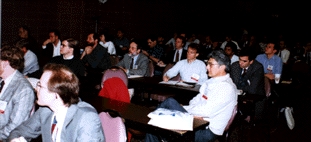
Audience during panel discussion.
The opinions of all the panelists seemed to be that a cooperative relationship existed, and would continue to exist, between developers and resellers. There was mild dissension about Linux support when the moderator commented that the user couldn't get, or shouldn't expect to get, Linux support for the low price of a Linux distribution on CD; this was disputed by Mark Horton, support person for InfoMagic, who replied that the InfoMagic CD-ROM included support, and discussed the kind of support they were giving. Horton added that, in general, the support wasn't getting abused/overused by the end user.
There was a feeling of good will between developers and resellers. This was definitely a panel discussion, not a panel argument.
Moderated by Michael K. Johnson, the four panelists included Marc Ewing of Red Hat Software, Mark Komarinski who writes the “System Administration” column for Linux Journal, Ross Biro of Yggdrasil Computing and Mark Bolzern of WorkGroup Solutions.
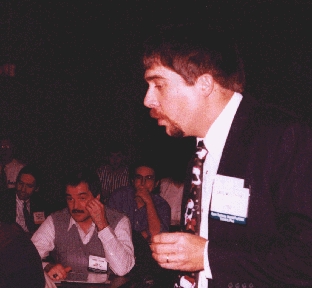
Mark Horton, Mark Komarinski and Phil Hughes
They discussed the current commercial products available for Linux, obstacles to the development of commercial products, and how commercial vendors might be persuaded to port their product to Linux and market it.
There are already about 50 commercial applications available for Linux, including Tecplot, ISE Eiffel, Genplot, dBMan, ESQLFLEX and JustLogic Database Manager. Although Linux users expect relatively inexpensive applications, it's not profitable for commercial marketers to produce such low-cost applications due to development and marketing costs. Distribution channels can be a significant cost factor in inexpensive applications, as well as the cost of advertising, which can, for example, run $3,500 for a one-time quarter page ad in a popular Unix magazine.
Mark Bolzern said that while Linux is becoming “the Unix of choice”, Linux is not yet trusted to be mission-critical. Bolzern anticipates, however, that over the next year, Linux will be used in this capacity, such as the application currently in use at Virginia Power for real-time data collection.
Ross Biro stressed the importance of hardware in the commercial future of Linux. Except for Cyclades who makes serial boards, there aren't enough hardware vendors making their products' specifications available for Linux developers. There was general agreement among audience members, the panel and the moderator about the need for more hardware support for Linux. (However, it's rumored that half of Cyclades' domestic sales of one of their serial boards is to Linux users.) Mark Komarinski noted that having most of the kernel written in C (as it is now) will help with porting to hardware.
Some panelists and audience members added positive comments about the two ports for the DEC alpha chip in progress: one being done by DEC, the other by Linus Torvalds on a machine loaned to him by DEC.
Mark Bolzern talked about how his company was investing in its Linux application now and pricing it far below the actual price the development and marketing costs would allow for such a product, because they anticipate that the future volume of sales to the Linux market will make this worth their investment.
Bolzern advised that his company is paying a PR firm to promote Linux, with the idea that increased sales of their product will follow as Flagship demos become available on many more of the different Linux distributions on CD-ROM. To help with the PR work, he asked for success stories, such as how Linux users replaced their whole network with Linux systems, or did something with Linux that could not be done any other way. Please e-mail to mark@linuxmall.com
Don Becker, who wrote most of the Ethernet drivers for Linux, is the principal investigator on a new project at NASA called Beowulf, a cluster of Linux processors, connected by parallel Ethernets. He discussed the project with an enthralled audience.
After lunch, participants returned for an inspiring talk on How To Convince Your Boss/Employer/Customer To Use Linux. Dr. Greg Wettstein from the Roger Maris Cancer Center (see Issue #5 of Linux Journal for his article about their Linux system) discussed a planned, reasonable way to present Linux to someone as a solution. He noted you should identify a specific problem that Linux can fix, explain how Linux can fix it, emphasize Linux advantages (for example, having source code available so you can make changes, its built-in networking and its support community). Don't try to replace an entire working system with Linux in one fell swoop—he emphasized, “Evolution, Not Revolution”.
Other subjects in the conference were: WINE presented by Bob Amstadt, Linux and The X Windows System presented by Przemek Klosowski and Linux and iBCS2 Compatibility by Eric Youngdale. iBCS2 defines a common object program format—a standard for PC Unix executables. The iBCS2 compatibility libraries will allow existing PC Unix applications to run on a Linux platform.
This panel discussion included Vance Petree, who is using Linux for real-time data collection at Virginia Power; Russell Carter, Sandia Labs, using Linux for a super workstation; Greg Wettstein, of the Roger Maris Cancer Center, who uses Linux for a Patient Information System, written using Perl and Tcl/Tk; Donald Becker, NASA, who is developing a cluster of Linux stations; Paul Tomblin formerly of Gandalf, who is using Linux to build test tools for testing Gandalf's networking products.
The audience at all the talks was attentive. The one-day tutorial included experts speaking on their particular area of expertise and will be covered in other articles. All in all, the conference felt like a big success with an amazing amount of information presented.