
Heavy Gear II for Linux

Manufacturer: Loki Entertainment Software
E-Mail: sales@lokigames.com/
URL: www.lokigames.com
Price: $29.95 US
Reviewer: J. Neil Doane
Set in the distant future (did I say distant? the 62nd century!) you are the squad commander of an elite assault force of huge humanoid battlefield vehicles called “Gears”. Using carefully planned tactics and sophisticated futuristic weaponry, you lead your squadron through an engaging story line directed against your people's arch nemesis, Earth.
It's a step in the right direction if the direction you want to go is away from the same old boring first-person shooters. Heavy Gear II is addictive, with a nice sci-fi story line, good multiplayer capability, enough single-player modes to keep you interested for days and game play that allows extremely fine control of your in-game combat experience but retains a strong arcade feeling. It features stunning graphics with picturesque landscapes (and spacescapes) and excellent accompanying audio. Heavy Gear II isn't perfect; extended game play will begin to expose interesting quirks that tend to become irritating at times, and there are some technical issues that could probably have been handled better (and some that apparently have yet to be resolved). Overall, however, this game's fun factor seems to win out in the end, and the game has little difficulty consuming one's evening hours and free time.
Developed around the Dream Pod 9 game system of the same name, HG2 is Activision's follow-up to Heavy Gear, and its story line picks back up about two decades after the end of the the first HG. To summarize, an interpolar war on your home planet, Terra Nova, (a former Earth colony but now independent) has come to a halt in the face of an explosive and cataclysmic event that appears to herald the return of invasion forces from Terra Nova's former arch-enemy: Earth. The governments of both poles of your planet have agreed to cease hostilities toward each other in order to confront this age-old enemy. As their first step toward the defense of your world they have formed of an elite fighting unit, composed of the best Gear pilots on the planet. You, of course, being the cream of the crop, white-hot ball of Gear-piloting fighting prowess that you are, have been chosen as the team's squad commander. Your mission, basically, is to take your team of combat specialists behind enemy lines to discover what attack plans Earth has in mind for your world and determine their tactical strengths and weaknesses.
What does this all mean to you as a player? Although the story line is relatively simple, it tends to grow on you as it progresses and, unlike many first-person shooter story lines, seems to add quite a bit to the overall feel of the game play. Moreover, the various dialogs and briefings direct your strategy toward different goals as the story line progresses. This gives you a nice change from the seemingly endless begin/fight/kill/end cycles of so many other first-person games. Based on where you are in the story, you'll have to use different tactics to succeed.
Heavy Gear II has been plagued since its release by comparisons to its competition, MechWarrior 3. Though based on similar themes, these games are actually quite different. Gears are physically different from MechWarrior's robots, and the game play style of the two games varies accordingly. With a Mech, you are a walking battleship, a massive hulking behemoth, with more firepower than a division of M1 A1 Abrams tanks, and could probably find camouflage in a futuristic skyline—as a building. Gears, on the other hand, while still large and extremely powerful, are typically a fraction of the size, the largest being only about 15 feet tall. With a Gear, one must use tactics and wits to a much greater degree than with its larger cousins. Gears are small enough to be sneaky and to use stealth as a valid tactic. In fact, their smaller stature also means, unlike their 20-story counterparts, they cannot stand in battle and just take the abuse given. Therefore, hiding, setting up ambushes and the like are widely used and often mandatory since you'll be sorely outnumbered from time to time.
Heavy Gear II isn't simple. This isn't something you can install from your CD and immediately jump into action. HG2 seems nearly flight simulator-like in complexity when one first sits down to it. In fact, to become thoroughly acquainted with all the controls and modes of game play requires a full seven-course meal of rather involved training missions and should probably include the convenient placement of the included keyboard-shortcut command placard just to keep track of the myriad commands used in the game. The payoff, however, is extraordinary; the level of control a player has in HG2 is amazing. For instance, even general movement consists of several axes of control, as one must coordinate the separate movements of the upper torso of your Gear to work in concert with the lower portion of your body. In turn, your lower body has several modes of operation, including jump jets, walking, kneeling, crawling and even, in Gearspeak, an SDS or “Secondary Movement System”, which deploys what amount to all-terrain rollerblades from the soles of your Gear's feet to allow you to, quite literally, skate into battle (or away from it) at high speed. Radar modes allow one to scan actively for nearby enemies, increasing the likelihood that they will be able to detect your Gear's presence. Or, you can enhance your Gear's stealth by switching to a passive-only mode. Your Gear is equipped with maneuvering thrusters for control in the weightlessness of space, and the act of accurately space-maneuvering a Gear in all its possible axes of motion while in a combat situation seems as difficult as neurosurgery the first few times at bat.
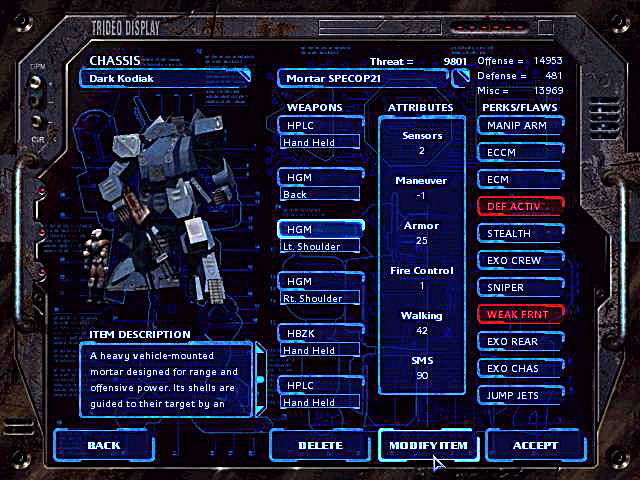
Figure 1. HG2's Gear Lab Boasts More Customization Options Than You Can Shake a Vibroaxe at.
The amount of customization possible in the game is unparalleled. Since you're fighting for two wealthy governments, your budget isn't really limited; you can have anything you want and as much of it as you can carry. The list of possible Gear models is seemingly unending (by my count about 70 primary models) and divided into four main categories: Light, Medium, Heavy (of course) and Assault. There are typically several base configurations for each primary model, and the Gear lab has the functionality to create and save your own custom configurations as often as you like. As for guns 'n ammo to attach to your Gear, again, the list is truly huge; just the names of weapons in the vast array at your disposal take a few minutes to read and a detailed study to understand fully. To create some modicum of balance in the game, a system of “threat levels” has been implemented. Missions have a maximum total threat level that the entire team can have, as well as the maximum total threat level for any single Gear in the team, and you are forced to configure the weapons and equipment of each Gear on the mission so that neither of these limits are exceeded. Added to the mix is a complex system of “Perks” and “Flaws” that can be assigned to alter the threat profile of each Gear (Perks increase the threat score, Flaws decrease it) and make it truly unique on the battlefield. If you're into this sort of highly detailed customization, you won't be disappointed.

Figure 2. Heavy Gear Missiles
So, does all of this preplanning and detailed control pay off in superior game play? Well, kind of: it's enough fun to keep you up all night. However, it also has some problems. Activision redesigned the entire game engine for HG2 (the so-called “Dark Side” engine) and, though it's very nice at times, it seems less robust and has poorer effects than some of its non-Linux-ported competition. The scenery is completely indestructible, allowing no cratering or deformation of any kind except for the exact targets that HG2's programmers thought you should be blowing up (which are typically only the handful of final goal targets, not just any ol' tree or rock along the route). There is also some curious clipping issues with the engine that can cause your Gear to, at times, slide right though mountains, rocks and even walls as though they don't exist. The AI is basically pathetic; although you have a great deal of control of your teammates through the relatively simple team-control commands, these guys are often as brain-dead as hockey pucks. On several occasions, squadmates become stuck in various landscape features, and I once had to destroy an entire base's defenses just to get to a single enemy Gear who was stuck against a wall, trying to go through it to get to me. The landscapes, although a bit dark, are quite spectacular at times, but the clipping distance is too short and, without the fogging effects activated, you can often clearly see the edge of the world dropping off on the horizon or appearing abruptly in the distance as you walk along. Again, these issues, while unsightly, aren't really enough to ruin the fun of the game, but they seem to leave a bad aftertaste at times.
There are several modes of game play available in Heavy Gear II. The campaign mode is very cool, the missions are short enough to keep you glued to the action, and the story line is compelling and unfolds in briefings and creative cut scenes that use the game engine to draw the action. Also available is a “Historical” mission section, which lets you relive and refight some of the greatest battles in Terra Novan history. For those of you who simply want basic combat, and want it right now, there is an “Instant Action” mode of play available that does just what it should; it puts you in the thick of your choice of a wide variety of highly customizable combat situations. There are several missions in the single-player training mode (which this reviewer highly recommends) and, last but not least, the multiplayer mode. HG2's multiplayer mode includes several types of game play: a one-on-one duel-type game; the traditional multiplayer “death match” free-for-all; a “steal the beacon” game where players accumulate points for the length of time they are able to hold onto the “beacon” before someone blows them to bits; a “strategic” variant where players form teams and attempt to destroy their opponents' bases; and, lastly, the classic “capture the flag”. Unfortunately, there are no cooperative multiplayer campaign-style modes in HG2. I think this would have added a great deal of fun to the game. However, I've heard that the historical missions were originally intended to be cooperative, but a scarcity of in-game resources forced the game designers to abandon the idea and make them single-player instead.

Figure 3. Shooting It up in Instant Action on the Ice Arena
Heavy Gear II was originally written in the Direct3D API (from that company in Redmond). It was the first Direct3D game to be ported to OpenGL for Linux and, as such, is a terrific accomplishment by Loki. For my money, they did a great job. Unfortunately, there are issues with the game that are, by and large, not really Loki's fault. This game has many of the same problems in every platform. On my G400-based VA Linux box, things worked fine, though I did experience some of the interesting clipping issues mentioned earlier. However, the closed-source drivers on my NVidia GeForce GTS-based Debian system went belly-up every time I went from 3-D mode back to the 2-D menus and debriefings, which made it impossible to use the single-player campaign modes at all on that machine. Loki's support gave me some interesting suggestions and patches to try to alleviate this problem, but none were successful in the end. I've since heard that this is a known issue with the NVidia cards and this particular game.
Heavy Gear II is a great game, and it's highly addictive once you get past the steep initial learning curve. The story isn't just a few cut scenes used to break up the action; it's fun to watch unfold and holds your interest. The overall feel of the game is fast-paced and fun, nearly arcadelike at times; however, the game play problems are hard to ignore. I can't help but feel as though this game was picked from the vine a bit before it had ripened fully. That said, I'd certainly recommend giving Heavy Gear II a try, especially if, like me, you really enjoy simulator-style games with some strategy and tactics required. However, if you want a simple and easy-to-learn first-person shooter, you should probably pass on HG2.


