
StarOffice 5.2
Manufacturer: Sun Microsystems
E-Mail: so_inquiries@sun.com
Price: Free download (shipping and handling for media)
Reviewer: Stephanie Black
The need for business applications that run on Linux is well documented. We all want something that will further diminish the hold of the Redmond Contingent on the corporate market. We want to be able to cheer on anyone bold enough, brash enough and bright enough to create a successful rival to Microsoft Office 2000. “Successful” is the key word here.
This certainly is an office suite. The manual says you can do everything administrative from “one place”. It's described as “intuitive”. The first claim assumes that the user has no temporal requirements with respect to those administrative tasks: it can take a while just to find the required administrative task. The second claim assumes that the user has been doing this sort of work for far too long, only under one other operating system. “Star” quality is elusive.
Granted, it doesn't cost a few hundred units of your local currency, even if you want the media. It installs without a hitch. It no longer requires every iota of available memory to run, unlike its predecessors. It's not a “special” or “millennium” edition. It's available for several different platforms. It doesn't crash when you open it. Technically, all the pieces are there in nearly the exact order as described in the manual. It apparently works as a word processor, presentation tool and Swiss Army Knife clone. And, I have to admit, the technical support available for it really is superb.
The problem is, someone decided StarOffice should follow St. Paul's dictates, to wit: to be all things to all people. StarOffice is not, and will never be, all things to all people. If it manages to be a simple suite of office software that is clean, original, functional and comprehensible, it will be enough for thousands. Especially if running it on 64MB of RAM makes for a quick initialization, as opposed to one during which you can talk with your lawyer, editor, mother-in-law and local bill collectors and still have time to get a cup of Starbucks Special before the software is ready to actually use.
Hint: there's a Start button at the bottom left of the application window, and it's labeled that way. The butterfly pixmap makes no difference to the functioning of the software. Really.
You will not necessarily require a whole Gig of either hard drive space or RAM to install StarOffice. Both, admittedly, might be helpful if you're going to use really large databases, but they're not necessary. I chose a custom installation of about 250MB running on SuSE 6.4. You can choose parts of packages, if you don't want the full allotment of graphics, templates, effects and backgrounds, but wish for only a selection of those gallery items that suit your purposes. This applies to other components of StarOffice as well. For this review, Draw, Image, Basic and Calc were omitted.
Note: StarOffice includes a kind of BASIC for macro and script creation. This would have usable applications under Windows but under Linux seems rather misplaced, given that C is the mother tongue of Penguinese and Bash.
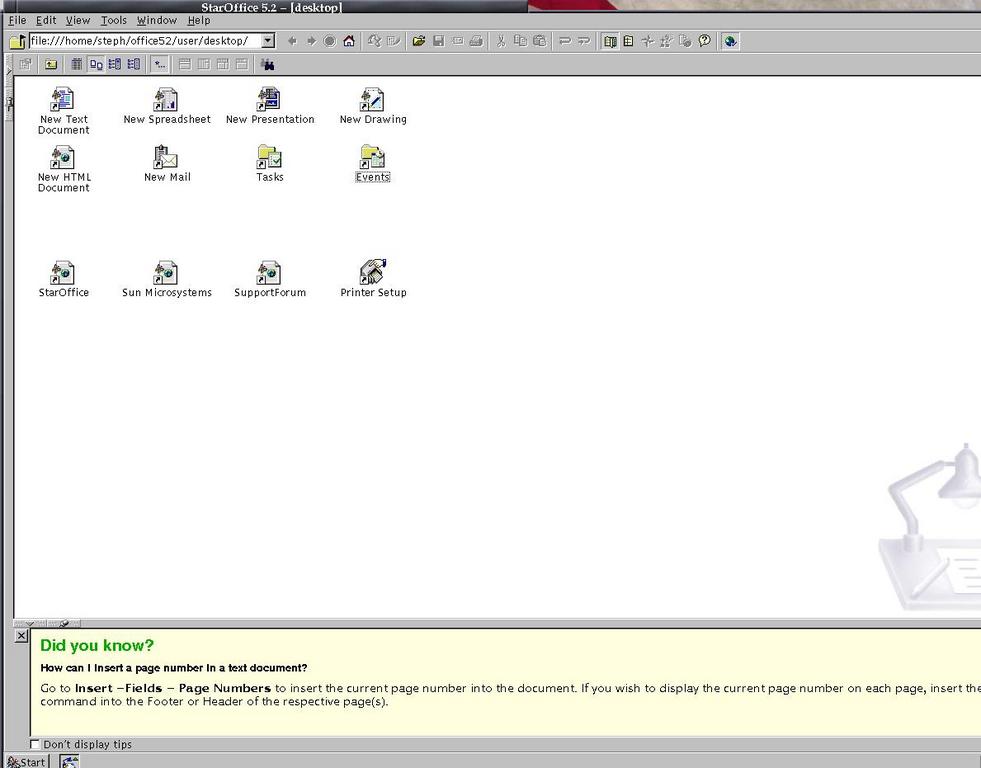
Figure 1. StarOffice Desktop
It is cause for concern that, by default, the “Integrated Desktop” option is enabled in StarOffice. A splash screen is something common enough with applications run in a GUI environment. A suite of applications taking over the desktop without the user's knowledge (or choice) is something else entirely. However, deselection of View --> Integrated Desktop (or Ctrl-Shift-l) will allow you to keep your chosen desktop and reduce the desktop to an application-size window.
To get started, you will need to look for a vertical grey arrow on the left-hand border of the desktop window. By opening Click & Go (see Figure 2) you will see a list of choices of what you can do.

Figure 2. Click & Go
As mentioned, the word processor functions all seem to be present and accounted for. Mercifully, there are some elements that exist and can (once you've closed the “correction” windows) be ignored, such as the tendency for the automatic spell checker to write “quantitative”, when you were simply typing “quantity”. The manual mentions “streamlining routine formatting tasks”, which by all accounts involves turning on wordwrap as a default setting and not indicating this to the user.
My personal bias against HTML editors was confirmed upon attempting to draft a simple grey-on-black information page. SO 5.2 did not display the grey-on-black information page; it did display a black-on-black information page, which may indicate a certain independence of spirit to its creators but is hardly a useful quality in web publication.
There are several formats supported by Writer, including Word 6.0, Rich Text Format and StarOffice's “housebrand” of text formatting. ASCII is, thankfully, also supported—although you have to confirm this choice when saving your document.
There are two ways to configure Mail and Discussion: you can specify that the configuration parameters should be the same as used in Netscape Messenger, and choose for the program to do this automatically, or you can manually enter these parameters. As I'm not altogether certain of the security risks involved in the first choice, I've chosen to do this manually. You can bypass these options by specifying “Don't Use Internet” with the click of a mouse.
E-mail is a nice thing to be able to access whilst pounding away on a recalcitrant document. Access you may, but replying to that proton epistle is a wee bit more of a challenge than one might wish, especially if “Reply” buttons/keystrokes are your custom. If all else fails (and it will), right click. The same principles apply to newsgroup-reading.
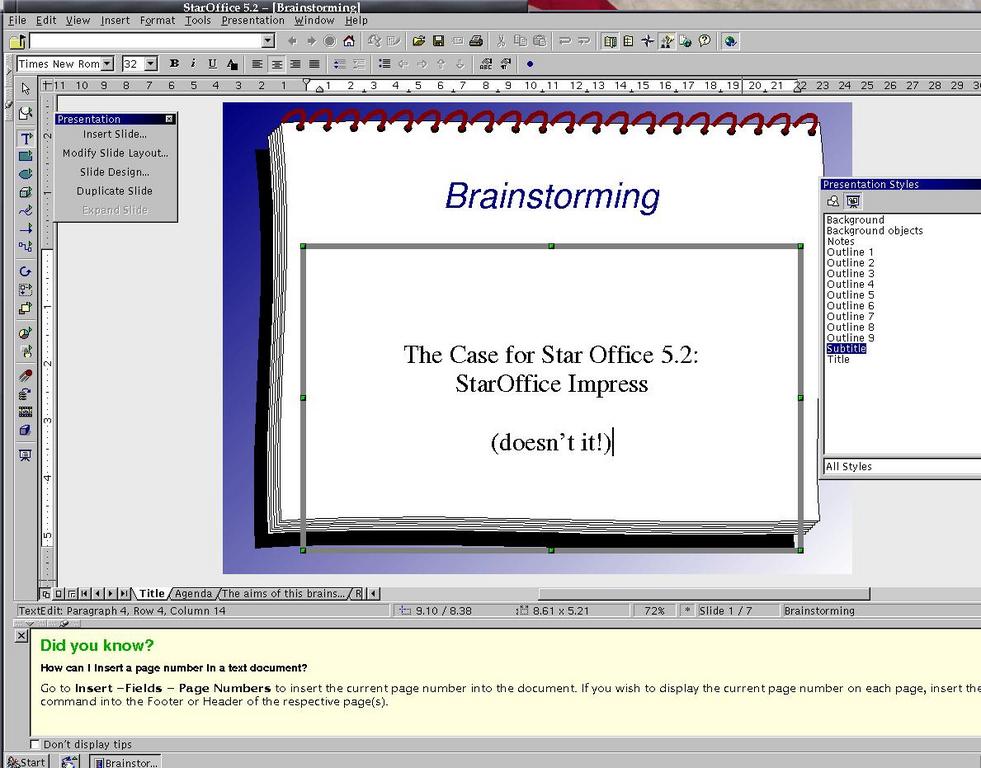
Figure 3. StarOffice Impress and StarOffice Player
Need to make a presentation to the board? Need to be able to rehearse timings of slides and make the best impression you can?
Both of these tools were surprisingly good. I'm no graphic artist but still managed to get a little slide up in less than seven minutes. Actual presentation makers could probably get the whole presentation done in that time. As it was, I attempted to make a few more “slides”, create a slide show, change the order, etc., and view the results with Player. In terms of tools that are designed for productivity, and not for messing about with configuring/de-configuring options, these two applications exemplify the ease of use the developers of other StarOffice applications should be aiming for.
There are minor components of SO 5.2 that are interesting and provide pleasant “dressing” to the office suite. Some of the clip art is quite welldesigned. The Schedule is very nicely set up, allowing the user to survey an entire week at a glance. Fonts, as well as 2-D and 3-D effects, make for some eye-catching products.
On 10/13/2000 (yes, a Friday) Sun made the code for StarOffice 5.2 available for download (http://openoffice.org/). It's worth noting that Sun is still retaining the copyright of the project, regardless of who contributes what code or how much of the code is completely rewritten.
From what this writer has seen, three elements are missing from Star Office 5.2: consistency, modularity and unity. There is no consistent quality among the applications: some work very well indeed, while others are “not-yet-ready-for-prime-time”. Modularity would allow each application to run separately, as does Player, and therefore give the user more direct control over what s/he wants to run. Running everything from “one place” sounds nice, but better results would arise out of an expanded context menu than from a bulky pseudo-desktop, which is more visible and serves less purpose than the menus concealed in its left border.
An office suite is normally categorized as “Productivity Software”. StarOffice 5.2 doesn't yet belong here.
Stephanie Black is a recent migrant to IT and owns and runs Coastal Den Computing, a Linux consultancy. She has spent 80% of her coding life working with Linux and can be reached at alphafemale@radiant.net.
