
UpFRONT
Increase in XML usage among Linux developers over the six months prior to September 2000: 75%
Surveyed Linux developers using XML: 28%
Surveyed Linux developers who use XML up to half the time: 27%
Surveyed Linux developers who use Java: 54%
Decline in club meetings over the last 25 years: 58%
Decline in family dinners over the last 25 years: 33%
Decline in “having friends over” over the last 25 years: 45%
Reduction in your chance of dying if you join one club next year: 50%
Year by which open-source standards are expected to completely change the software industry: 2004
Number of unrelated Zelerate (formerly Open Sales) founders whose surname is Ferber: 2
Return on U.S. venture funds in the fourth quarter of 1999: 59.4%
Return on U.S. venture funds in the First quarter of 2000: 23.1%
Return on U.S. venture funds in the Second quarter of 2000: 3.9%
New funds raised by venture capitalists through mid-October of 2000: $64,000,000,000 US
Projected percent return on venture funds over 20 years, as of 6/30/2000: 19.9%
Share price once predicted for Priceline by Merrill Lynch Internet Analyst Henry Blodget: $150 US
Priceline share price on April 22, 2000: $76.38 US
Priceline share price on April 30, 2000: $165 US
Priceline share price projected in May of 2000 by Jamie Kiggen, then of DLJ: $190 US
Priceline share price on October 17, 2000: $5 US
1-4: Evans Data Corporation (September 26, 2000)
5-8: BowlingAlone.com
9: Wired, quoting Forester Research
10: Zelerate
11-13: Venture Economics
14: San Jose Mercury News, quoting Venture Economics
15-20: CBS.MarketWatch.com
The work of thought is one of the most ancient and useful activities of humankind. To generate thought is to create life, liveliness, community. Consensus isn't important. What's important is how the generative power of our thought makes life vivid and burns out the dead brush, dead thoughts, dead institutions.
—Michael Ventura
Genius is applying the originality of youth to the experience of maturity.
—Michael Polanyi
Documentation is like sex: when it is good, it is very, very good; and when it is bad, it is better than nothing.
—Dick Brandon
Idealism is fine, but as it approaches reality the costs become prohibitive.
—William Buckley Jr.
Crappy old OSes have value in the basically negative sense that changing to new ones makes us wish we'd never been born.
—Neal Stephenson
Believe it or not, the Internet is actually under-hyped...We are coconspirators in the largest, legal creation of new wealth, primarily in Internet companies.
—L. John Doerr
Perpetual growth is the creed of the cancer cell.
—Edward Abbey
Simple, clear purpose and principles give rise to complex and intelligent behavior. Complex rules and regulations give rise to simple and stupid behavior.
—Dee Hock
The cracked ones let in the light.
—Tom Peters
The only way to be truly creative is to never repeat yourself.
—Rob Breszny
We don't have a good language to talk about this kind of thing. In most people's vocabularies, design means veneer. But to me, nothing could be further from the meaning of design. Design is the fundamental soul of a man-made creation.
—Steve Jobs
The corporation as we know it, which is now 120 years old, is unlikely to survive the next 25 years. Legally and financially yes, but not structurally and economically.
—Peter Drucker
The greatest danger for most of us is not that our aim is too high and we miss it, but that it is too low and we reach it.
—Michelangelo
Once again we're writing about something before it's happened, for publication afterward. Dig this: where I am, it's still October, the windows are wide open on the 26th floor above West 56th in Manhattan, and the leaves on the trees in Central Park are just starting to turn color. Where you are, every one of those leaves is mulch and Open Sales has long since morphed into Zelerate.
Which is what really matters, for this story. The leaves fall every year. Open Sales can shed its name but once.
It makes sense, of course. Open Sales was founded by two unrelated guys named Ferber (Coincidence? Yes). And a quick check of Google (whose collection of umpty-thousand Linux machines has intimate knowledge of 1,247,340,000 web pages) discloses some persuasive statistics:
open = 31,000,000
sales = 18,100,000
open sales = 801,000
“open sales” = 5,180
zelerate = 0
In other words, Open Sales was a good example of applied generics. You couldn't ask for better camouflage if your name ended with “Solutions”.
So what's with Zelerate?
Paul Carlstrom, the company's director of corporate communications, says this: “Rob and Glenn (Ferber)...cofounded Open Sales to offer open-source e-commerce applications in 1998. A lot has occurred since that time: The GPL'd software has caught the attention of a growing cadre of developers. The product has matured rapidly. The installed base of Open Sales AllCommerce has risen...”
Soon, the company found itself doing “accelerated commerce solutions”. And, “because we feel you can't get from (a) to (z) without knowing where (z) is located, we've chosen the last letter of the alphabet to start our name.”
Carlstrom also wants us to know that open source is what primarily accounts for development speed—for two reasons.
One is that “we have expanded the open-source model to include customer-mandated direction as part of our development process.”
The other is that Zelerate isn't a product company. it sells service. With enterprise-class applications, he explains, “e-commerce packages can cost in the hundreds of thousands of dollars, and the customer will still end up paying more for services and support than for the original licensing fees.” By not making development secretive, Zelerate allows constant customer input to the development process.
There is a common belief that service companies can't grow (or, to use last year's word, scale) as fast—or as large—as product companies. This may not be a bad thing in any case, but Zelerate is now named to test the theory.
—Doc Searls
The references to IMAP in Mark Stacey's article, “Linux as a Work Environment Desktop”, (issue 79, November 2000) should read MAPI rather than IMAP.
In LJ six years ago this month we published “A Conversation with Linus Torvalds” in which Linus reflected on being bitten by a penguin in Canberra, his preference for Irish beer, getting ready for 1.2 and his decision to name the OS Linux rather than Freakix. Linus wrapped up the interview by revealing his plan for “World domination. Fast.”
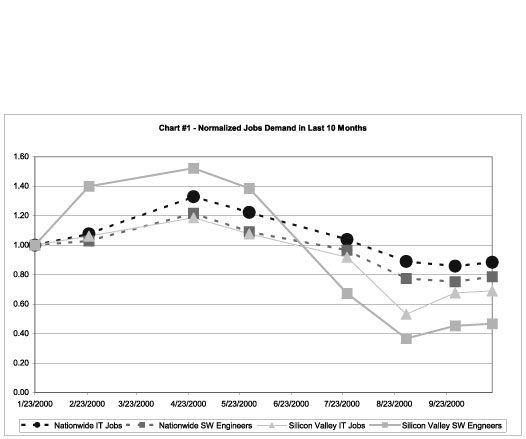
Last month, there was a slight up-tick in the number of software engineering jobs in demand, particularly here in the Valley. This month proves that it was no fluke. There is still a continuing demand for both IT skills in general and software engineering in particular. However, it does look like it is leveling off. The demand now for software engineers appears to be increasing at the same rate as for all IT positions. (Note: Chart #1 is normalized for the number of jobs in January of this year. That is, the number of openings in January 2000 has been taken as 1.00.)
Language Demand Trends
The demand for all the major computer languages have shown an interesting set of trends since the start of this year. Chart #2 shows the demand for today's most popular computer languages. The demand peaked in the April-May time frame when demand overall for language skills was at its highest. Since then, demand for language skills has decline until last month when things turned around. Demand for the Internet-related languages, XML and Perl have increased while the demand for Java and C/C++ has leveled off. My conclusion is that the desire to connect systems together using shared data definitions and universal scripting languages like Perl is driving this demand. Visual Basic is the anomaly. Demand for it increased, probably because of new prototyping being done.

Reginald currently heads the US chapter of the Association of C and C++ Users. Visit their site at http://www.accu-usa.org/ to learn more.

