
sendmail for Linux
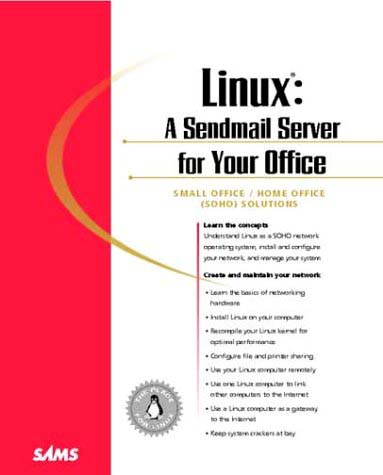
Author: Richard Blum
Publisher: SAMS
Price: $34.95 US
ISBN: 0-672-31834-2
Reviewer: Russell J. T. Dyer
One of the most basic features of the Internet is e-mail. There's nothing complicated about it, right? Well, try configuring sendmail on a Linux server. Recently, I needed to set up a Linux server at work for e-mail service. It seemed like a simple enough task, but it quickly proved to be quite frustrating. It's one of those projects that requires paging through endless scripts, man pages and books. Don't bother asking anyone for help—you're on your own. Being a book lover, though, I saw it as an opportunity to visit the bookstore!
A very comprehensive book about sendmail was published by O'Reilly. I just love O'Reilly's books—usually. Their sendmail book is a killer: about a thousand pages long, very detailed and very advanced. I quietly put that back on the shelf after a couple minutes of looking at it (although I did go back to it three times, hoping I was too hasty). It took quite a bit of rummaging to find anything covering sendmail. Most authors touch on it only briefly—they know to stay away from it. I did buy one book that was fairly helpful in learning how to set up various Internet services, including e-mail: Red Hat Linux 6 Server by Mohammed J. Kabir (M&T Books, 1999). However, it wasn't quite sufficient. Besides, no good Linux task is solved with only one book purchase.
After many failed attempts at configuring sendmail and three visits to the bookstore (I have an undying belief that all my problems can be solved with books), I discovered Richard Blum's new title, sendmail for Linux. The answer to my prayers! Not that it offers any quick fixes, but it explains fairly clearly how to set up an e-mail server. It's about 500 pages of useful information with plenty of diagrams, screenshots and brief (let me say that again: brief) configuration examples. I hate it when books are loaded with long scripts that are already on my computer, just so I can admire them in a printed and bound format. There's also the customary CD. This one includes a distribution of Linux, qmail, Eudora Light and a few other related programs.
Blum's book is broken up into three sections: an introduction to e-mail services, installation instructions and sundry items. The introduction is an in-depth educational primer on e-mail. At first I skipped this part, but as I dug into the second section, I realized I didn't know as much as I thought about e-mail, even after something like a decade or so of using it. So, I went back to basics, and read through the first section. It was worth the effort. In addition to a minimal amount of history, Blum covers DNS, SMTP, IMAP, POP and sendmail itself. You see, it's not just sendmail, but everything related that makes it so involved.
With the foundation of the first section, the second describes basic configurations to make sendmail work. Blum explains what's necessary to get e-mail running for typical scenarios. The second section also covers setting up clients in Netscape, Outlook Express and Eudora; integrating e-mail service with an ISP; and the system administration involved.
The third section contains instructions on integrating an e-mail server with a firewall (e.g., ipchains and ipforward). It also includes setting up dial-in clients, e-mail aliases, masquerading and list servers. Yes, you too can be a major domo.
Let me wrap up now with something that Blum's publisher might want to quote: it's a comprehensive, but not overwhelming, manual on sendmail for the intermediate-level Linux system administrator. It's well-written, well-illustrated and well-edited; an educational, extremely useful and desperately needed resource on e-mail service.
Russell Dyer (russell@dyerhouse.com) is an IS manager for a national firm. He's married with three children and is a graduate student in English at the University of New Orleans. He likes to install Linux wherever he can sneak it in: resistance isn't futile, if it's subtle.
