
Yopy Puts Linux in Hand
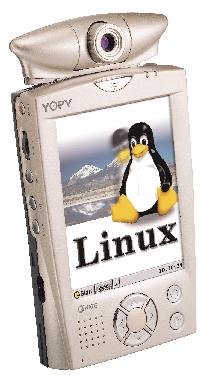
Samsung subsidiary Gmate has announced Yopy, the first handheld computer that runs Linux. Gmate hopes that its support for Linux will lead to a flood of third-party software for Yopy, rivaling the software infrastructure that has emerged for Palm's handheld devices. While Linux shows some promise for handhelds, displacing current leaders Palm OS and Windows CE will be challenging. The prize is a market that will ship more than 10 million units this year and is growing by more than 30% per year.
Yopy is a true handheld device, measuring just over 5 inches by 3 inches and weighing just under eight ounces. It bears a striking resemblance to the latest crop of Windows CE devices known as Pocket PCs, particularly to Compaq's iPaq H3600 device.
Yopy is nearly the same size as the H3600, although it is 25% thicker and 25% heavier. Both devices include a color TFT display and have a similar array of buttons. Inside, both rely on a 206MHz StrongArm CPU with 32MB of battery-backed DRAM for storing user data. These similarities are probably not coincidental—both devices appear to be based on the same Intel reference design.
32MB of flash ROM are required by Yopy to store its Mobile Linux operating system and the core set of applications. The Pocket PC version of Windows CE is apparently lighter, as the H3600 requires only 16MB. The extra flash ROM adds $30 to Yopy's manufacturing cost, more than offsetting the $10-$20 license fee for Windows CE. (Mobile Linux is free, of course.) Yopy takes advantage of its relatively speedy CPU to offer a range of media functions such as voice recording, MP3 playback, video playback and games. It also includes a personal information manager (calendar, address book, etc.), e-mail, a web browser and other utilities. To take full advantage of the browser, users must add a modem using the Compact Flash expansion slot.
The H3600 and other Pocket PCs offer all of these features as well and, like Yopy, sell for about $500. Thus, any advantage for Yopy must come from Linux itself, either in ease of use or application availability. We were not able to test a Yopy unit, so we can't comment on its usability, an area where Pocket PC has gotten lukewarm reviews. When comparing application availability, one must remember that standard Linux and Windows applications must be modified to fit on a 240 x 320-pixel display. Microsoft has already modified key programs such as Word, Excel and Outlook; over time, the Linux community will develop a variety of applications for Yopy.
Yopy offers nearly 100 times more CPU performance than the popular Palm devices and 16 times more data memory than the Palm V. The Palm products use a smaller, lower-resolution display that, except for the new Palm IIIc, can't display colors. But the Palm V is smaller, half as thick and less than half the weight of Yopy. The Palm III and Palm V are also less than half the price.
Most handheld computers sold today are from Palm or Handspring, a Palm-compatible vendor. These devices have gained popularity due to their relatively low cost and, more important, their ease of use. Over the past four years, independent programmers have developed thousands of Palm applications, many of which are freely distributed.
Yet Palm remains vulnerable. The only new features that Palm has added to its units since their 1996 debut are wireless connectivity and a color screen, and these features are currently available only in expensive, unpopular models. A true second-generation handheld could generate many new sales and tip the market away from Palm.
Linux and Windows CE already deliver next-generation features such as multimedia capability and expandability, and they are good platforms for adding voice recognition and wireless Internet access. Linux has the advantage of being freely available, including source code. Its larger footprint adds cost but, as the price of flash memory falls, this penalty will be reduced. Additional work on the code base could also bring Linux's code size in line with that of Windows CE.
Although Gmate www.gmate.co.kr is the first to deliver a Linux-based handheld, other vendors, both large and small, are investigating this opportunity to eliminate a Microsoft license fee. Therefore, more Yopy-like products are likely to appear. If the Linux community can rally around these tiny computers to develop an easy-to-use operating system and key applications, Linux could flourish in the palm of your hand.

Linley Gwennap (linleyg@linleygroup.com) is the founder and principal analyst of The Linley Group (http://www.linleygroup.com/), a technology analysis firm in Mt. View, California. He is a former Editor-in-Chief of Microprocessor Report.
