
We Talk to Everybody
The editors here at Linux Journal have been talking about doing a Who's Who in Linux for some time, but couldn't decide on a way to do it that would make sense and not need the space of a book. With so many people contributing to Linux and new ones joining the community every day, it would be almost impossible to compile a list that didn't leave someone out. We finally decided that what we wanted to do was present short profiles of the developers who contributed to kernel 1.0, and of a few others who were involved at the time of its release. We got the kernel 1.0 credits file and split it up. I took a few names, including Linus', having talked to him just last year. With the help of Jason Kroll, we spent a good bit of time tracking people down, and were not entirely successful. A list of those whom we couldn't get hold of and the contribution they made to the kernel is included as a sidebar. If any of you guys are reading this, please get in touch (ljeditor@linuxjournal.com.com)—we'd like to talk to you.
We wish to thank all these people for talking to us and providing this look at who they were then and now. Since there was not room to include each interview in its entirety, we will put the interviews on the LJ web site in the coming weeks. We also thank these folks for their invaluable contributions to Linux—without them, where would it be today? Or LJ, for that matter?

Everyone knows who Linus Torvalds is. He's the metaphoric father of the Linux community, having brought the Linux operating system into being. After doing so, he kicked it out of its nest and onto the Internet and invited others to try it out and participate in its growth, not realizing at the time what a tiger he had let loose on the world. He is a quiet, self-assured young man, a family man who obviously loves his daughters, allowing them to join him onstage at conferences they attend with him and his wife Tove.
Writing Linux earned Linus his master's degree at Helsinki University. Since then, he has turned kernel maintenance over to Alan Cox. Development is done by many others, yet Linus remains the mainstay of Linux. He makes the final decisions about what will and will not go into the kernel and when a new version will be released. His word is law, and no one disputes it.
After leaving the university, Linus moved to the United States with Tove, near San Jose, California, and went to work for the ultra-secret Transmeta. Early this year, Transmeta announced their Crusoe chip, which is headed for the mobile appliance market. Linus had been helping by making a Linux version that would fit in flash ROM—here's what he said about it in a conversation with Doc Searls.
It's the standard 2.3 kernel with some power management stuff done on it, but anybody can see what that is. There is the compressed file system that I made part of the standard kernel not long ago. And that's really the question of... you have a very limited amount of ROM. You want to fit Netscape in there, too. And you want to page things in from the ROM. You obviously want to compress it. That's number one. But how do you compress it so you can still do random seeks and paging in things? Those are the kinds of questions I spent a fair amount of time thinking about. What's the good way of doing this? What fits in and works well? These are not fundamental design shifts.
Linus agrees to make appearances at many trade shows, although these days, he prefers question-and-answer sessions over giving talks. In fact, he agrees to so many that I once wondered if he knew how to say “No”. (He does.) But he also realizes he is a big draw, and helping Linux and Linux shows become successful is something he is willing to do. He remains unassuming, and says fame has not intruded on his personal life.
Linus has proven to be a good father to both his children and Linux. The community couldn't have a better leader.
Donald didn't respond to any of our messages, but we know a bit about him so we decided to wing it. First of all, we know Donald because he was on the cover of issue 10, February 1995, where he was a part of the Linux Conference at Open Systems World in Washington, DC.
Donald was a big contributor early in the Linux game, writing the code for the Ethernet drivers. He did this while working for NASA at the Center of Excellence in Space Data and Information Sciences as a staff scientist. Information on Donald and his code can be found at cesdis.gsfc.nasa.gov/people/becker/whoiam.html.
He was the principal investigator on NASA's Beowulf Project, “an effort to develop a software distribution to help others build high-performance workstations based on a cluster of off-the-shelf processing nodes running Linux.”
He is now the Chief Technical Officer of Sycld Computing Corporation, where he “continues the Beowulf work, making available the expertise to non-NASA entities.”
For fun, Donald likes to kayak, and you can read about his kayaking trip down the Yukon River in 1993 at his web site. There is also a beautiful picture of the river and mountains, as well as information on how to reach him.
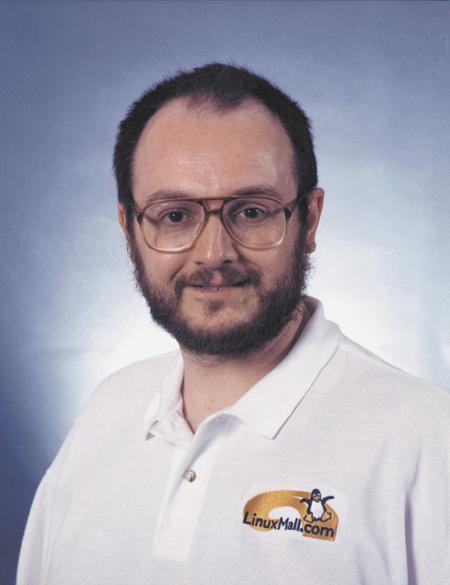
Mark discovered Linux back in 1992, and by 1994 was predicting it would be the next-generation UNIX and challenge even Microsoft. That's what I call prescient. Rather than become a Linux developer, he instead took the road of an advocate.
When he started his business, Workgroup Solutions, he sold one of the first commercial products for Linux: Multisoft's FlagShip. In fact, he persuaded Multisoft to port it to Linux in the first place. He also sold his own distribution, Linux Pro, based first on Slackware and later on Red Hat. It was always a bit behind the cutting edge, but this meant it was always stable, a definite plus for the business market at which he was aiming. Today, with all the advances in Linux distributions, he no longer feels there is a need for Linux Pro and has withdrawn it from the market. Workgroup Solutions has turned into LinuxMall, and as a business proves that supporting Linux can bring success.
When asked what he liked most about Linux, Mark replied, “Its openness, its use of the GPL, its ability to educate those willing to take responsibility to educate themselves, and finally, its flexibility to adapt to the needs of anyone educationally empowered or able to hire someone who is.” He strongly compares Linux and American history in this way: “I see the Linux movement as a parallel to the American Revolution, where the GPL is analogous to the Constitution. This, I guess, makes Richard Stallman a Thomas Jefferson, and perhaps `The Cathedral and the Bazaar' is the Declaration of Independence.”
Mark dedicates his life to his business and Linux advocacy, finding no time for a family or even a vacation. However, he doesn't feel he is wasting his life on computers, but rather providing a service that will benefit others and perhaps even the whole world, when Linux achieves “world domination”. His belief in serving others is proven through the way he runs his company. He hires people who are already a part of the Linux community, and gives a percentage of the company's gross profit back to the community in support of Linux events, projects and public relations work.
An all-around nice guy, Mark is a familiar face at the trade shows. His web page is http://www.linuxmall.com/, and he can be reached at mark@linuxmall.com.
When it comes to Linux, mathematician Andries Brouwer has a simple explanation as to why it worked for him:
I tried it and it worked. In fact, it worked really well. FreeBSD I tried later, and I preferred Linux.
Unlike many of those whose hacking of the Linux kernel was a natural by-product of their work as a computer scientist, programmer or software developer, Andries, who managed international character handling for the Linux keyboard and console, arrived at Linux through a different route.
I use my machines mostly for mathematics—(for) both computations and writing papers and books. Whenever something is wrong, I like to fix it, and this brought me to various parts of the kernel, mostly with small fixes, sometimes with slightly larger code fragments.
But working on Linux over the Internet, in fact working over the Internet itself, is nothing new to Andries, who today still considers himself a mathematician.
I released Hack on the Net, maybe around 1984. This led to lots of contacts with many people all over the Net, both via e-mail and via net.games.hack. So, to me, cooperation over the Net was a well-known concept, not revolutionary at all.
Andries Brouwer's e-mail address is aeb@cwi.nl.
Ed Carp, whose contributions to the Linux kernel include work on cron, UUCP, Elm, Pine and pico, first ran into Linux in late 1991 when someone forwarded him the Linux project announcement from a BSD newsgroup.
I was attracted to Linux because of the distributed development model. I had looked at 386BSD, but the development model was completely controlled by William Jolitz, who made releases about every six months, and I couldn't wait for bug fixes that long.
Sound familiar? At the time, Ed was working at Sun Microsystems, “downloading a full newsfeed via a Telebit modem to a XENIX box.” When his upstream newsfeed switched to HDB UUCP, and the XENIX UUCP could not support the new protocols, Ed went searching. “When I called SCO, they quoted me $1500 to upgrade my very old XENIX. So I was in the market for something cheaper and that I could tweak the source if I needed to.”
Insofar as Ed's Linux hacking rose directly from his computer needs, UUCP, Sendmail and Elm were among his first Linux contributions. Of the times, Ed remembers “overnight, I became the application port guru. People were e-mailing me from all over the world, trying to get their applications ported over.” He also counts driver and kernel work among his larger contributions.
Unfortunately, nowadays many of those moving most quickly around the Linux community are, for lack of a better word, the carpetbaggers. To those people, Ed shows very little regard, admitting that
I think [Linux] would've survived regardless—there are a lot of operating systems around that haven't received the publicity that Linux has, and are doing quite well ... I think the popularity of Linux can be a two-edged sword.
Ed is still involved with computers and, more importantly, still involved with Linux. He says, “I'm involved in two projects, one to bring a port of Linux to a PowerPC platform for an embedded ATM controller, and two to develop a new server-side scripting language for the Web.”
And outside of computers?
I backpack, and am also involved in ham radio. I don't think I've wasted my life. Working with computers has produced a lot of personal satisfaction for me. I've written pager notification systems for severe weather alerts, and I'd like to think that software has saved a life or two along the way.
Ed Carp's e-mail address is erc@pobox.com.

Among the Who's Who of the Linux Kernel, Alan Cox is probably one of the bigger Whos in the bunch. From his work on the Linux networking code to his current role as maintainer of the stable kernel releases, there are few who have meant as much to Linux as Alan.
I like the flexibility and the control of free software. Most of my experiences with proprietary software have been either getting screwed as a user or being part of a larger company that had to threaten its suppliers with lawsuits to get service.
Somewhat provocative, but a familiar cheer and lament from many who have spent a goodly amount of time with Linux and open-source software.
Alan was actually working on ideas for his own operating system when his interest in Linux first began.
I had pondered getting a decent PC since the Amiga was getting a bit long in the tooth. 386BSD came out, and it looked like finally there was an OS worth running on x86 hardware. Linux came out about the same time, but didn't need an FPU, so I started running Linux.
As one of the operating system's true progenitors, Alan is well aware of the importance of the GNU project to the development and maturation of Linux.
In fact, in many ways Linux exists because GNU chose to pursue the HURD rather than using UZI as their UNIX OS core ... GNU/Linux is perhaps overstating it, but ignoring the FSF (Free Software Foundation) contribution is even worse ... It's really x11/BSD/GNU/.../Linux.
Alan now works for Red Hat, the poster boy and problem child for many in and around the Linux community. He still has time, however, to hack free software at home, as well as visit friends and colleagues while traveling to conferences and trade shows. While there are many more people who have contributed to Linux than could ever fit under one roof, Alan seems to have made his peace working for “a vendor.”
I get regular mail from people trying to find Linux-aware folks to hire. I think those who wrote code for fun have plenty of opportunity to reap rewards. Even when I wasn't working for Red Hat, it didn't bother me. I wrote it for fun, and the fact that people found it useful was a greater reward than money.
Alan Cox's e-mail address is alan@lxorguk.ukuu.org.uk.
Among those who made major contributions to the Linux kernel yet moved on to a relatively hack-free lifestyle, Laurence Culhane is one of those who stands out. A radio presenter for the BBC when he first encountered Linux, today Laurence is a senior BBC journalist. But in between then and now, he enjoyed several heady years in the thick of Linux kernel hacking. He recalls,
It was fun. At first I didn't realize how revolutionary the idea was—it seemed so natural. It wasn't perfect, and with only limited free time, I found it quite hard to keep up with the demands for improvements to what had initially been just a quick hack to keep me connected.
Like many others, including Linus Torvalds himself, Laurence's Linux hack sprang from “purely selfish reasons.” As he tells the story,
I wanted Usenet and e-mail, and for that I needed SLIP/PPP. Neither had been written at the time, so I went and looked at the RFC's and wrote something that gave me adequate SLIP access.
Laurence wrote the original alpha SLIP code for the Linux kernel “and sent Linus the odd patch when I couldn't get other code to port and it looked like a kernel issue.” Given Laurence's need-based arrival in the world of Linux and open-source software, it is little surprise that much of the philosophy behind the Linux movement was initially lost on him: “I hadn't thought about free software, free speech or anything at that point. I just wanted Linux to work.”
What attracted him to Linux? “The fact that it was free was the first reason I looked at it,” Laurence admits. “I'd just left the university, had no money and certainly couldn't afford thousands of pounds [for] a commercial UNIX license.” It was at the university where Laurence got his first taste of a major UNIX system. Having built his first s-100 z-80A system at the age of 15, he “fell in love with BSD UNIX” while at the university, “found a 32016 S-100 CPU and MINIX and never left.”
Although Laurence no longer considers himself a Linux developer, he is still a regular Linux user and tries to keep up with the latest developments in Linux in general and the kernel in specific. While he thinks the current popularity surrounding Linux is “great,” he thinks a little reserve is probably a good idea. He says,
I think it's important that people don't get overzealous about Linux ... I'm a passionate fan; I had never even used an MS product until 1998 when work dictated that I did. [But] I'm suggesting that my dad have a dual-boot Linux-Windows machine, with a Mac emulator under Linux because having access to all three operating systems is the right solution for his job.
Laurence Culhane's e-mail address is laurence.culhane@bbc.co.uk.
Another mathematician who spent some time with the Linux OS during its formative years is Thomas Dunbar. “Getting TeX/METAFONT running on Linux” was his most significant contribution to the operating system. Thomas had been using MINIX and doing technical typesetting work with TeX when he first started thinking of Linux as a way to move from his life as a math professor into “something computer-related.” Says Thomas,
I needed a low-cost, programmer-friendly OS that could use minimal PC hardware. There were no barriers, neither technical nor social, to helping with Linux development.
Like many kernel hackers, while working over the Internet was both a fun and necessary part of working on Linux, Thomas never saw the Internet part of his work as particularly revolutionary—although it did play a positive role in promoting “family values.” As Thomas tells it,
Linux coming along right when the Net was opening up was very fortunate. I did not feel this myself too much, as I already had professional contacts. However, I know this was very significant for my son, Daniel, who was just entering [his] teens when “we” started using Linux. The resulting accessibility of expert developers provided an alternative to the normal college, job training ...
Thomas still uses Linux on his desktop (as does his secretary), although he hasn't done any development work since his early TeX/METAFONT days. He sees commercialism as something that has, for the most part, helped increase the popularity and use of Linux—yet he doesn't believe Linux will become the “dominant desktop.”
Currently, Thomas is senior DBA for the Warehousing group at Virginia Tech and also CEO of a little WebCyS shop, diads.com. Says Thomas,
My work is almost exclusively Oracle-related with databases running on Sun/Solaris (though that is migrating a bit to Linux) with Linux being a convenient client platform for system administration and database administration of the systems.
What is the most important thing to him about Linux today? “Keep it fun and sociable, wherever that leads,” Thomas says. “The more popular, the better, in my opinion.”
Thomas Dunbar's e-mail address is tdunbar@vt.edu.
Bjorn Ekwall, whose contributions to the Linux kernel include D-Link drivers, likes to make sure that some of the people who helped him discover and solve problems aren't forgotten. Hackers like Joshua Kopper and Jacques Gelinas, to name a few, are among the first Bjorn mentions.
There were a lot of other very skilled hackers involved ... and I tried to make sure that all got credits for their contributions. I definitely learned a lot from these guys.
Bjorn first got involved in Linux through his devotion to UNIX in the late 1970s. Having worked on UNIX machines as a co-sysadmin, Bjorn had little time for the Apples and PCs that started shipping (“just toys,” he called them), but because proprietary Unices did not offer the freedom or the source code Bjorn wanted, he had to rely on merely collecting and building the parts of his very own UNIX machine, “with full source.”
It wasn't until 1992 that, while looking through comp.sources.unix postings on Usenet, Bjorn first saw mention of Linux. After a bit of independent research, he settled on an early Slackware distribution. “I think it was with the 0.99.3 kernel,” Bjorn says. But his reaction was epiphanic. “It had all the sources! It even had X11! It fitted neatly into my new 386SX/25 laptop with 5MB of memory!” says Bjorn. “It was close enough to UNIX for me to give in completely!”
And “give in” he did. After developing a D-Link driver for the Linux kernel to allow him to network with his laptop, and a few more projects dealing with kernel downloadable modules, Bjorn sent snapshots of his patches to Linus. “He answered by putting the whole package up for FTP together with the official kernel sources,” Bjorn says. “I admit that I was a bit flattered. A lot, actually. Suddenly I had been promoted to an official kernel developer/maintainer!”
The responses from fellow Linux hackers was something that made a serious impression on Bjorn. He says,
the openness in the acceptance of new ideas and the ease of getting quick and high-quality feedback is definitely the most important thing about Linux, as far as I'm concerned. The basic rule, “show me the code”, is key, since it keeps in check those who have only opinions and no solutions.
All the same, much of the Linux politicking tends to leave him cold. Asked about commercialization, Bjorn says he has “no problems whatsoever” with people making money from Linux, “as long as Linux stays open, which it will,” he adds. Asked about Microsoft, Bjorn says frankly that he doesn't care:
I'm only interested in getting access to an environment that fills my needs, which is what my Linux-based system does. If I need something completely new in my environment, then I will build it. If that is useful for other people, then that's a nice side effect.
But when asked about life outside of computers ... now that's a different story.
There is definitely a world outside of computers, and I try to enjoy it as much as possible ... I do “have a life,” which includes my two daughters, now aged 9 and 12. We have a lot of fun—when I'm not working, that is.
Bjorn Ekwall's e-mail address is bjorn@blox.se.
For some, Linux represented the on-ramp to a life of hacking on the open-source operating system. For others, Linux represented a momentary opportunity to explore interesting, non-trivial software development work. It was in this latter group that Drew Eckhardt found himself as an 18-year-old CS student at the University of Colorado. Like other Linux hackers, Drew was not satisfied with Bill Jolitz's BSD work, and the attraction to a freely redistributable UNIX system proved irresistible. He told me,
I wanted to run some free UNIX on my hardware. Since I didn't like what Bill Jolitz was doing, that meant Linux.
Drew's first problems with his new Linux system led to his first contribution to Linux development. “I was too impatient to wait for someone to fix these problems (boot blocks that didn't work, disk driver problems), and solutions ... weren't too difficult,” he says. “Farther on, I continued to contribute to the Linux kernel because it was fun.”
Drew spent most of his time as a “Linux developer” working on the SCSI subsystem. But he is no longer involved in the development end of Linux. “Developing for the Linux kernel and user lands would be too close to what I do at work,” he says. The little UNIX hacking Drew has done on his own recently has tended to be FreeBSD.
While Drew emphasizes that the size of the Linux community of hackers was one of the best things about it, he doesn't think there is anything too revolutionary about the way Linux was developed. He suggests,
In hindsight, the development effort wasn't too different from commercial environments where developers hide in their offices, work on some subsystem and release the code as certain functions are completed.
Drew may not play much of a role in future Linux development (he is a software engineer for a company that builds digital video servers for broadcast and post-production). But his thoughts on the future of proprietary software vs. open-source systems do reveal a future for Linux. He says,
In niche markets, we'll always have proprietary software because those markets can't or won't fund new products, and software companies can't guarantee they'll sell the support needed to pay for development after the fact. In the general consumer market, its days may be numbered ... buying shrink-wrapped proprietary software is a bit silly when you can get the same software on a CD-Recordable for a dollar.
Drew Eckhardt's e-mail address is drew@poohsticks.org.
Some people find Linux, stay for awhile and then part ways. And others? Well, for some, when it comes to Linux, once you hack, you'll never go back.
Rik Faith is currently working with Precision Insight and, as such, gets to spend all of his work time “using and improving” Linux. Says Rik,
The popularity of Linux and the willingness of vendors to pay for Linux improvements (both in the kernel and in user space) have enabled me to find what is very nearly my ideal job: I can work at home, use Linux all the time, and get paid for improving Linux and XFree86.
Rik first discovered Linux while toiling away in graduate school. He had been working on his Ph.D when he heard “rumors about a free UNIX” in late 1991. All the same, it wasn't until spring of the following year that Rik actually downloaded the source code and booted it up. As Rik remembers, “it booted fine from floppy and was able to see my old 40MB drive, but it didn't support my Future Domain SCSI controller.”
And this is when Rik Faith's inner penguin started singing.
I ordered a manual for the Future Domain chip set, and as soon as finals were over, I started to write a SCSI device driver. After about three days, I was convinced that this was too difficult for me. But on the fourth day, I had a working SCSI driver!
And by the end of the month, Rik's hack was fully interrupt-driven and ready for Linux 0.97.
In addition to his work on the Future Domain SCSI driver, Rik also worked on the APM driver, and later did kernel work on the Direct Rendering Interface (DRI) as an engineer with Precision Insight. And like some of the other original kernel hackers, Rik has been involved in a number of non-kernel Linux projects. These include maintenance of the util-linux collection and coordination of the man page project—both of which have since been taken over by Andries Brouwer, another of the original Linux hackers. Rik even worked on his own Linux distribution, BOGUS Linux, with colleagues Kevin Martin and Doug Hoffman. “The BOGUS Linux release was the first Linux distribution to use the `pristine source plus patches' paradigm that is now familiar to all RPM users,” Rik notes.
All this nonstop Linux work has kept Rik exceptionally busy over the years. In fact, he says,
I found that I had to cut back on my Linux work for a few years while I finished my Ph.D and started a family—my wife, Melissa, and I have two daughters, Rhiannon (4 years) and Selena (7 months) ... For fun, I spend time with my wife, play with my kids, and work on free software to format, search and serve human-language dictionaries.
Rik Faith's e-mail address is faith@alephnull.com. Visit his work with “human-language dictionaries” at http://www.dict.org/.
Why did the hacker hack the kernel? According to Jeremy Fitzhardinge,
I started hacking it for the reason that everyone hacked on it then: there was a lot of stuff it didn't do right, and there were things I wanted it to do for various programming projects.
In the beginning, Jeremy was working at his first “real job” when he got deep into kernel hacking. He says,
I was also looking at relatively obscure research operating systems (Amoeba, Sprite) and wondering whether I could run one at home. Then a friend showed me Linux, and I was amazed at how concise it was compared to, say, SVR4.
Jeremy, whose contributions to the Linux kernel include work on file systems and VM (virtual machine), is currently working on more “stuff it didn't do right,” such as autofs, the Linux automounter that he has been trying to improve. He is also one of those hackers who has been fortunate enough to make a living hacking Linux. Right now, most of his work is in embedded systems, getting Linux to boot out of flash memory on a “reasonably powerful PPC-based server the size of a CD-ROM drive.”
And, as might be expected, Jeremy is thrilled with both the prospect of commercial applications being written for Linux, as well as the overall popular success of Linux these days. If anything, however, Jeremy sees little sense in fixating on competing with Microsoft. He tells us,
The number-one threat [to Linux] is thinking that competition with Windows is important, or indeed, that all the commercial interest is important to Linux.
Let Linux be Linux, Jeremy seems to suggest, very much as many of his hacker colleagues continue to urge:
There's still a way to go before people will happily sit down to a Linux machine and do work, because the desktop applications are not there yet. I like the fact that there's lots of different efforts, but they should all go to some effort to keep their file formats interchangeable wherever possible.
All the same, he thinks Linux does undermine many of the pretensions of shrink-wrapped, proprietary software. “I think people will become wary about buying closed-source programs as the quality of open source improves.” Furthermore, Jeremy believes that the expectations open-source customers have will make closed-source vendors more accountable.
Philosophically speaking, Jeremy is among those “kernel forefathers” who places high value on the GNU Project, even though his support for the GNU Project is more on the practical side. “Without GNU, we'd be stuck without a serious compiler to base everything on, and also be without many of those programs which make the UNIX experience,” he says.
Jeremy Fitzhardinge's e-mail address is jeremy@goop.org.
Philip was interested in making Linux a good platform for timekeeping. He added the kernel phase locked loop and “fixed a bunch of problems with timekeeping.” He continues to assist in this area of development, but his “principal area is now bug-fixing obscure conditions.”
Linux was not Philip's first experience with developing software via the Internet. He had done so previously with Tom Lane. This work produced the initial version of the IJG (Independent JPEG Group) JPEG library. The recent mission of the Mars Pathfinder used JPEG encoding, but Philip has not yet been able to determine if this included his work.
In 1991, Linux found him working as a consultant for a large New York City-based bank. Philip was concerned with connecting the company to the Internet. He relates it best:
We needed to build a system to act as the name server. Somehow I found out about Linux, and I built a system on a 386 running 0.99pl15 and bind. It served as the external DNS server for many years—only rebooting after power failures.
Philip “can't say anything” about his new job, where he works for a new startup in the Network Security field. He still runs Linux on his laptop and home systems, but home life allows for only the occasional bug fix. He adds, “my principal contributions [to Linux] are now work-related. There are times when I produce something at work that can be given back to the community.”
He still views Linux as a good platform for “certain types of solutions.” Having more support for Linux from hardware manufacturers on the driver end is necessary. “It's not realistic to rely on the free software community to produce drivers for everything.” Philip doesn't see Linux taking the desktop in the next three years, citing “no consistency in user interface style” as one problem. He does feel that Linux should be able to hold the server market, as long as “the management tools are improved.”
Is there a life outside computing? Philip says, “Very much so. If you never have children, then you will miss out on something much more important than computers.” He is married, has a daughter and another child is on the way.
Philip Gladstone can be reached at philip@gladstonefamily.net.

Dirk has been involved with Linux since the early days. He was 24 and a student of mathematics/computer science at the University of Wurzburg in Germany. Working as a system administrator within the university, he “found postings from Linus in the comp.os.minix group, where he talked about a project of his.” Dirk wanted a UNIX operating system for his own machine. “FreeBSD didn't exist and 386BSD wasn't an option,” says Hohndel. Linux was the best choice, so he began to develop.
With an interest in memory management and adding hardware support, he helped with the first Ethernet drivers (for the WD8003) and the first SCSI support (ST01). “Soon thereafter,” he says, “I became involved in the first implementation of shared libraries (based on jump tables) and applied that for the XFree86 shared libraries.” Dirk can recall an e-mail exchange with Linus “where we joked that at some time, it might be possible to run X on Linux.” Since then, he has continued his work with the XFree86 project, currently holding the title of Vice President.
Dirk was recently named CTO of SuSE Linux AG. This means he spends much of his time managing projects and not so much on programming. “Working on XFree86 is what I do for fun,” he says with a smile. Helping Linux continue to grow is an overall goal. “Making Linux easier to use for the end user” is one area for Linux developers to place focus on. Dirk doesn't see this as “dumbing down,” as it in no way subtracts from the power and flexibility of the operating system.
Claiming to have a life outside computers, Dirk said, “Having friends that know nothing about computers and get bored when you talk about computers really helps.” Do such people exist?
Dirk Hohndel can be reached via e-mail at hohndel@suse.com.
Nick Holloway doesn't think the beginnings of Linux were all that revolutionary when it started out. As Nick recalls,
I have seen it in action with the various source newsgroups (alt.sources, comp.sources.unix, comp.sources.misc), where I could make changes, submit them back to the author, and see them in the next release. Initially, Linux wasn't all that different. It was just an OS kernel, rather than an application. It just grew to be a much larger scale.
Nick considers his contributions to Linux to be relatively modest—as do many original kernel hackers.
I was interested in the areas that I needed to work for me. I contributed patches to libc4 when I found problems ... I contributed tab expansion for the tty layer in the kernel when I wanted to use a dumb terminal that couldn't handle hardware tabs. However, these days, my involvement normally is restricted to tracking the Linux kernel mailing list and browsing the patches. I'll submit minor patches from time to time, but I am not a mainstream contributor.
As a Ph.D. student at the University of Warwick, Nick first heard about Linux through Usenet. “I immediately subscribed to alt.os.linux so I could read more. In early 1993, I bought a machine specifically to run Linux.” Nick was one of the many Linux hackers who was weaned on UNIX, having used both BSD and the SunOS “almost exclusively” since starting at the university in 1985. The problem was that he wanted a home computer and he wanted to run UNIX. “When Linux became available, it was the obvious choice to me,” he says. “It had enough to get started and be usable, but there was plenty of scope for being able to contribute to the development.”
This best-of-both-worlds thinking carries over to Nick's opinion of Linux's present-day situation. The open-source operating system's exceptional popularity, he thinks, has definitely helped quicken the pace of development, guessing that Linux might have remained “a hacker's plaything” otherwise. As such, Nick believes there is a place for commercial applications being written for Linux. He says,
Just because the OS and many of the standard applications are free doesn't mean they all have to be. If a company has to invest in producing an application for Linux, then they have the right to charge for it.
In fact, as far as Nick is concerned, such so-called profiteering can actually end up helping the Linux development community. “For example, Red Hat and SuSE are in the position to employ important hackers, which means [hackers] don't suffer from real work getting in the way of their Linux work.”
Which is something Nick knows all too well. Currently employed in “the development of business-to-business e-commerce solutions,” Nick spends his work time with Windows NT and Solaris. All the same, he says, it's not so bad. “It allows me to separate work and play in a clean way.”
Nick Holloway's e-mail address is Nick.Holloway@alfie.demon.co.uk.

In typical open-source development fashion, Rob Hooft began hacking on Linux “because I could”. There were limitations to the 0.95c++ kernel (the first one he installed at home). Rob says, “0.95c++ was only 200KB in .Z form” and it did hang on his home machine. So, he jumped into the kernel in order to understand the driver and implement modifications. This was how Rob became a Linux contributor.
I improved the OPL3 sound code in the kernel sound driver; changed the floppy formatting routines to use sector shifting; and helped develop some shared libraries.
Linux had little in the way of libraries then, but as we all know, Linux development grew because of what wasn't there.
When Rob first encountered Linux, he was at a UNIX users group meeting of the Dutch Hobby Club. Linux was the only true free UNIX. Ignoring the limitations, he “decided that Linux was what I had been waiting for, and I bought a computer (my first x86 after a Z80) specifically to run it.” He had a lot of faith, seeing that Linux was equipped with “only 64 processes, with 64MB virtual address space each; only four partitions on a hard disk (maximum 64MB each); init/getty/login (IGL) were barely completed; and no X.” One of the true wonders of the Linux world comes from the belief early developers had in the potential of Linux.
Rob is now a programmer for Nonius BV, which makes “machines that are used for crystal structure analysis. The control software is written almost completely in Python on a Linux machine, using Tcl/Tk GUI.” He is using only free software to create a commercial application. Rob made the shift from academia to industry because of his wife and son, and a little thing called job security. Not surprisingly, he doesn't have a problem with, as he puts it, “smart brains getting rich, even if they're not programmers.”
Though he writes commercial software, Rob tries to make certain modules freely available, but
only if they are generally applicable. If I make the whole lot open source, the only one studying it would be our competitors. My competitors are not feeding my family.
Fair enough. Rob Hooft can be reached at rob@hooft.net.

Olaf discovered Linux while writing his master's thesis in mathematics. He says, “Linux was so cool that I ended up spending a lot more time on it than on gnawing pencils over my theorems.” He did finish the thesis eventually and went on to write the The Linux Network Administrators' Guide (first published in 1993). This was his first Linux project, and it has since gone to paperback and no doubt sits on many a system administrator's desk.
Attracted to Linux by the lack of an “initial” hierarchy, Olaf worked with Jeff Uphoff on the first Linux security list, then turned his efforts toward Linux NFS implementation. He has maintained the user space NFS daemon for the past five years, but has “toned down” his overall involvement to spend more time with his wife Maren and their 18-month-old daughter.
Looking back on the early days, Olaf was struck by “the cooperative spirit that reinforced itself.” Nothing has changed there. The community has always been the driving force behind Linux. The Internet has always helped to connect to the community. Back then, Olaf relates, “it [the Internet] felt like giving money-grubbing UNIX vendors the finger.” He credits not wanting to pay hundreds of dollars for inferior software as a key factor that drove early Linux development.
As for the future of Linux, Olaf is hopeful that the major Linux distributors will adopt the Linux Standard Base definition. Olaf sees platform differences between the various distributions as an increasing obstacle to software vendors entering the market. He believes that “once LSB is finished and accepted, there will be a common base platform for porting commercial software to Linux, and we will experience a surge in new software being made available on Linux.”
He currently works for Caldera, doing “security and a lot of network stuff, as well as developing an admin tool framework.” Working for Caldera affords him an opportunity he did not dream of eight years ago: being paid to work on Linux.
Olaf can be reached at okir@caldera.de.

Ian Kluft has done a lot for Linux and open-source software. He founded sbay.org in 1993, which he calls “a communications geek group in Silicon Valley.” He is still the group's coordinator and notes that Linux has been the backbone of the group's infrastructure since the beginning. Ian also helped with the Usenet Volunteer Votetakers. He contributed a module (mod_mime_magic) to Apache and helped start the Apache JServ (Java servlet engine) project.
His work with Linux was born out of time spent in Amdahl's mainframe UNIX lab in 1992, where he first discovered Linux. He says, “I had been involved with maintaining the smail mail transport agent on Amdahl's mainframes.” He noticed that smail was not yet ported to Linux. He did the port on a 486, then passed his work on to the smail maintainers. “Little did I know at the time, I had made the first Linux e-mail server.” He continued his work with smail by maintaining the Linux binaries on Sunsite, an early Linux FTP site. He maintained smail for Debian and Slackware until mid-1995, when “it looked like the Linux distributions were able to handle e-mail servers on their own.”
Ian was attracted to Linux because he didn't feel limited by a commercial organization. Like many, he didn't want to pay SCO $800 for a two-user UNIX license. After a few weeks, he had Linux running on a 386. The real draw was that there was no one telling him what he could or could not do with his computer. “Any code I could write, I could run. Anyone competent enough to be the system administrator of their own server had uncommon computing power in their homes.” Like the rest of us, the current success of Linux astounds Ian and he certainly “never expected to end up with Linux stock worth about a year's salary.”
In 1995, Ian left Amdahl for a smaller, lesser-known company called Cisco Systems. He is currently a software engineer in Cisco's IOS technologies division. Outside the computing/Linux world, Ian involves himself with the West Valley Amateur Radio Association, serving a term as president. He has a strong interest in amateur rocketry and works with other rocketry hobbyists “on using a real-time variant of Linux as an on-board flight control system for a suborbital amateur rocket.” He spent a week in the Nevada desert in March to help a group from Sacramento attempt the first amateur rocket launch to space.
Ian can be reached via e-mail at ikluft@thunder.sbay.org.

Michael was introduced to UNIX during the first week of his freshman year at St. Olaf College. He was “deeply impressed by the communication potential of a true multi-tasking and multi-user system.” He was primarily attracted to UNIX, but his student budget sent him looking for another alternative. BSD386 wasn't available, and there was no free software alternative. He tried Coherent, “but they didn't deliver on their promises [SCSI drivers, networking, etc.] and weren't interesting as a result.”
After the release of kernel 0.02, Michael downloaded Linux and placed an order for an IDE hard drive to run it. “I was excited to see that my dream of a home-built operating system was viable.” From there, he read the entire kernel source code in an attempt at understanding the user space. He has worked on many aspects of Linux development, but focused mainly on user space, “specializing in system component interface and integration.” Michael helped Matt Welsh with the Linux Documentation Project and worked on writing procps and the parallel port device driver, as well.
It is interesting to hear Michael talk about the early development of Linux. He admits that “...there was no way you could call me a hacker. I was quite clueless—as was, in some ways, Linus when he started.” The early developers of Linux weren't always experienced programmers. Many learned as they went, sharing their knowledge with others. He says, “we developed a community that worked despite its imperfections ... and didn't waste time pondering the idea that we might be making history.”
He isn't upset with the commercialization of Linux, saying it “has made it possible for me to put Linux on my father's computer.” This is something the early developers probably didn't foresee. At least it wasn't the reason they volunteered their efforts. Michael had no idea he would be able to make a living by working on Linux. Like many, he worked on Linux to learn, and as he says, “that learning was sufficient compensation for my volunteered efforts.”
Michael currently works at Red Hat, which he says provides a good balance between his desire to work on Linux and the need to make money. He was an early editor of Linux Journal and co-authored Linux Application Development with Erik Troan. Michael considers this to be his “biggest indirect contribution to Linux development”. He can be reached via e-mail at johnsonm@redhat.com.

Bas wrote the ftape driver. A Linux driver did not exist, so Bas decided to write one. His reason: “because I needed it and thought it might be useful for others.” This is how open-source software gets developed. His continued work with Linux produced the code that would become the kernel modules package. The package allowed driver development and debugging without constantly having to reboot. As Bas says, “It also allowed the user of the ftape module to load it only when needed, keeping kernel memory usage as low as possible.” Though his real job forced him to “pass the ftape driver to a new maintainer,” his modules code was eventually integrated into the kernel tree.
In early 1993, Bas “found a complete `free UNIX clone' on a local BBS.” It took him a few weeks to download the kernel, but the result was the ability to use UUCP to retrieve information from the Internet, including e-mail. “That was part of the thrill: development via the Internet was fascinating.” Bas credits the Internet with bringing together highly talented and motivated people, most of whom were working to “contribute to and create the most perfect system.” His experience was far from unique.
Bas still works at the same company as he did back then, but is contemplating ways to combine his family life and make money developing Linux. This shouldn't be too difficult for someone with his credentials and commitment to open-source philosophy. However, he is concerned that the large sums of money being tossed around in the name of Linux will change everything. He worries that the success of Linux might pose the biggest threat. “Way too much money is involved, and I'm not sure that Linux is ready to replace the Microsoft-based environments yet,” he says. Bas would like developers to place more focus on making Linux easier to install and on making the switch from Windows more transparent.
When asked if there is a world outside computers, Bas replied, “Tell me more about this world.” He lives in the Netherlands with his wife and 18-month-old son. He can be reached at bas.laarhoven@home.nl.
Warner Losh isn't so enamored with Linux these days. He says, “I've grown beyond Linux. It was a cool hack once, but Linux doesn't live up to its hype.” Currently, Warner is a software engineer working on FreeBSD. “I have a high profile there,” he says, “which gives me chances to work on consulting projects to augment my income.” He is a senior committer to FreeBSD along with serving as its security officer.
When his opinion of Linux was higher, Warner worked to get his company's C++ toolkit and GUI open sourced. He also worked on porting Linux to the ARC-based RISC machine, which was built around the MIPS processor at a time when Microsoft was touting the Intel processor. He was also involved with the early efforts to bring Linux up on the Windows CE devices. His Linux days are basically over, though. He thinks Linux's development model is horrible. “I stopped using Linux on my Intel machine because it took so much time to keep up to date. Download a new kernel, and you will need a new libc. But that libc will also need a new gcc, and the new gcc needs new bitutils. It all got very hard to keep track of.”
Now, Warner prefers the FreeBSD development model, “where you get the entire tree from one place ... which makes it easier to contribute back to FreeBSD faster.” He thinks the GPL is “evil,” preferring the BSD license “because it encourages cooperation.” Cooperation between developers made Linux what it is today. Warner refers to the “millions of random monkeys writing” for Linux as the best thing about Linux. However, he adds “the worst thing is that there's little filtering of their code or making the architecture coherent or stable over the long term.” As for the future, if Linux is to continue to succeed, he says, “it needs to organize its chaos.”
Warner Losh can be reached via e-mail at imp@village.org.
H.J. Lu first discovered Linux almost a decade ago in 1990, while he was a student looking for a “decent OS” for his 16MHz 386sx with only 4MB RAM—a common theme among many of our original kernel hackers. Not a big fan of Windows, and unable to get his hands on BSD, H.J. not only started running Linux, but soon got involved with Linux development. “Many things didn't work and I needed them,” he says.
As a Linux developer, H.J. worked on the kernel's C library, binutils and gcc, the latter a project he had been working on before he even learned about Linux. Similarly, H.J. had learned about the GNU project—which he calls “very crucial to Linux”—before starting on Linux, as well.
Without a doubt, having access to the source code is what made (and makes) Linux worthwhile to H.J. “We can fix it if it doesn't work,” he emphasizes. At the same time, H.J. is undaunted by the increasing commercial interest in Linux. “I think Linux will attract commercial developers who are threatened by Microsoft and want to make money on Linux,” he says. Given the fact that H.J. works for VA Linux Systems, it is perhaps no surprise that he is less intimidated by commercial interests than others may be.
I don't mind that people profit from my work. I do it because I enjoy it—it is not bad to get paid to do what you enjoy.
Where does Linux need to go from here? H.J. has a couple of areas he would like to see worked on further, including a journaling file system, “decent NFS” and improved VM and networking. As for the Linux-on-the-desktop battle, he is convinced that more desktop applications will be important in winning over more end-user converts, whether the applications are commercial or free. “But the basic stuff,” he adds, “should be free.”
H. J. Lu's e-mail address is hjl@valinux.com.

James MacLean lives in Nova Scotia and works for the Department of Education as manager of technical services. He says,
We use Linux all over the place at work. It was accepted early on for anything we could get it to do.
This makes for a good balance between work and Linux. Plus, he gets paid. Not surprisingly, then, James believes “all the financial activity is part of what makes Linux fun to be a part of.” He doesn't resent or fear the money influence. Instead, he welcomes the commercialization of Linux, seeing it as “an honest way to support Linux.” James says, “the biggest addition [needed for Linux] would be more applications that are currently supported on Windows.”
He expects Linux to grow on the desktop, and believes that “over time, it will leave fewer reasons to not deploy it as a desktop solution.” The only thing he sees that could ultimately hurt Linux development would be if the leadership in Linux diminished. In case we forgot, James reminds us that “taking over the world” is still the goal, and he thinks it is highly unlikely that the “people and parts that make up the heart of Linux” will curtail their devotion to its development.
James discovered Linux through a friend who had seen mention of a “free UNIX-type OS” in Byte magazine. Not quite thirty and newly employed by the government, he worked to automate the mainframe connection in order to collect data. He was “trying to make use of OS/2 2.0 on a 4MB 386DX33 ... but missed the flexibility of UNIX.” OS/2 was too slow, and Windows wasn't production-ready: “It crashed too much with the applications I tried to use.” It's reassuring to know that some things never change. James eventually found Linux.
He doesn't have much time these days to work on Linux outside of the office, but he does appreciate all the effort being put forth by others. James does custom things around the office to meet the specific needs of his section. This work generally does not find its way outside the office, but someday it might. He points out,
It used to be that even in a crude form you could put things out for others, but now I get shy, because if it will not work out-of-the-box, then I have to be ready for storms of e-mails.
James can be reached at macleajb@trademart-1.ednet.ns.ca.

Kai Makisara didn't begin working on Linux because he is Finnish, but it did seem proper. “I was using UNIX systems at work and wanted to be able to do some research work at home,” he explains. Linux supported most of his hardware, so he chose it over the BSD variants and Windows, which he could not run on his hardware without major changes.
Kai first saw references to Linux in network news. This was in 1992, and he was 38 years old. At the time, he was working on remote-sensing methods at the Technical Research Centre of Finland. Coming from a research organization, he found development via the Internet to be “natural and not revolutionary.” He had been using “the network to exchange messages, software and data for a long time.”
Kai began working on an area of Linux that related best to his background in computer science. He says, “I had used SCSI devices in our workstations, and tapes were/are an essential part of remote sensing work.” So, making a SCSI tape driver was a natural choice. Kai still maintains the SCSI tape driver and posts the occasional fix.
“The biggest threat to Linux,” in Kai's opinion, “is that all key people working on Linux lose interest.” This has always been a bit of a problem, but thankfully there has been no real shortage of developers willing to contribute. He doesn't “think that Linux should compete with Microsoft in the fields where they are strongest.” Kai finds “systems that enable people to process information anywhere” are much more interesting than the traditional desktop. “I have never accepted the attitude that work can be done only [by] sitting on one's chair facing one's personal computer.”
“Continued development is necessary for Linux's survival,” he continues. The current popularity of Linux makes him happy, as it shows that good software can be successful without being backed by large sums of money. But he does point out that “if better and affordable solutions for my computing needs emerge, I may jump ship.”
Kai continues to work on remote sensing research at the Finnish Forest Research Institute and can be reached at makisara@metla.fi.
Looking back on the meteoric rise of Linux over the past few years, some of our original kernel hackers have expressed surprise, enthusiasm or a cautious optimism over the distance the open-source operating system has traveled, from Internet hack to Wall Street/Silicon Valley darling. But in and among the many comments we've heard a slight tone of nostalgia for the old days, typified by the passing comment from one of those original kernel hackers, John Martin.
It might have been more fun within a small community. With the Internet early on, there was a sufficiently large community to sustain itself, while it was not viewed as threatening to the powerful. [However,] once Linux got bigger, it may have been important to get very big, very quickly.
Today, John Martin is an independent consultant with “practically no time to call my own,” he says. But once upon a time, he was just another hacker looking for something interesting on which to ply his talents. “I was working with big iron, but was interested in learning about UNIX when I stumbled upon the Linux-activists list,” John says. He had a new Intel box that “would not run anything until I tried Linux, which worked immediately.” Worked, that is, except for a small file system problem that he was able to fix by way of a workaround developed by Stephen Tweedie. John was up and running within two hours of first trying to boot from the floppy. “I never looked back,” John says. “I wanted to do what little I could to put something back into the community.”
He calls the Linux activists “congenial and productive”. But, like many original kernel hackers, he didn't think he and his colleagues had embarked upon anything especially new, per se. “The challenge to the orthodoxy of large-scale software development was apparent long before Linux 1.0,” John notes. Similarly, John has little time for the financial pyrotechnics that have accompanied Linux's rising popularity as a potential “Windows killer,” nor is he particularly interested in issues of commercialization of Linux or what is often called Linux profiteering. John says,
If commercial applications must be written, better they be written for Linux than for something else. Proprietary software and protocols are evil for practical reasons. Linux and open software and protocols are good for practical reasons. It is because these practical reasons are profound that they are embodied in a philosophy.
A tremendous fan of the GPL, which John considers the most important thing about Linux (“the GPL and the Linux development community ... seem inseparable”), he is no less passionate about open-source software in general. “Support only open source,” he says. “Unless one believes that the value of pi and the human genome should be patented, this is no place for equivocation.”
John Martin's e-mail address is jam@jamux.com.
Bill was a 46-year-old Ph.D. student when he first began “using Linux 0.97pl2 and submitting bug reports in August 1992.” He gave up the “research environment” of his job as an electronics engineer to study theoretical physics. This led him to the mathematics department at Monash University. At the time, Linux did the things he needed, while UNIX systems were too expensive for personal use. Bill says, “I was sick of the closed world of proprietary software.” This was the impetus for his work in free software. He went from using MS-DOS and Turbo-C to DJ Delorie's port of gcc (djgpp). Linux took him in the direction he wanted to go.
Bill's involvement with mathematics gave him the ability he needed to help improve the FPU (floating-point unit) emulator in djgpp. Not being able to afford a machine with an FPU provided him with “the motivation to work on an emulator.” Linux had poor support for FPU emulation, so Bill transferred his work to Linux and continued the development. He isn't too involved with kernel development these days, but still maintains the FPU emulator.
He sees Microsoft as the biggest threat to “World Domination”, but hopes the recent ruling against Microsoft will benefit the revolution. The commercialization of Linux is a necessary element to continued success, he points out. And what of profiteering from the volunteered work of others? “Profiteering is an inherent part of capitalism as it exists today. Greed is good”, he says.
As for the future of Linux, Bill believes the desktop interface will need to be dumbed down. He adds,
The trick is to keep the dummies away from the underlying operating system so they can't burn themselves ... sometimes you have to put a fence around dangerous places to protect people. Unfortunately, some people are still perverse enough to blame you if they climb the fence and fall over the cliff.
Outside the computer world, Bill is secretary of the Federation of Victorian Walkers. He tries to spend time away from the screen, but rationalizes that “there are times when I become aware that I am probably devoting too much time to some activity, but life is full of illusions and the sense of wasting time is probably just another illusion.”
Bill Metzenthen's e-mail address is bill@melbc.org.au.

Pauline lives in Enshede, Holland and runs her own business, specializing in writing software and Internet consulting. She is also on the board of an Internet Service Provider, IAF, there. Believe it or not, not all her projects are Linux, but most involve the computer. She has forgotten what the word “fun” means (just kidding) and is comfortable with the computer dominance of her life.
She discovered Linux through the free UNIX version, MINIX. At first, she contributed small fixes here and there, but after developing an interest in connecting all her computers to the Internet, she developed the IP Masquerade module—real programming by a real programmer. Her main development interest for Linux today is in video4linux, maintaining the Zoran driver in the kernel, and “some VCR projects.”
With work and personal life taking up much of her time, Pauline finds it harder to keep up with developments and says, “I am having some concerns about getting behind current developments. It's hard to know what is going on, and with the advent of the Internet and worldwide development, things can happen incredibly fast.”
Pauline feels the Linux community owes a lot to the GNU project and thinks it might be fun to have a distribution from them named “GNU/Linux”. That's Debian, isn't it? She is more interested in Linux remaining a good, robust OS than in seeing it become popular in the user world—“a difficult low-profile market that doesn't bring in new developers.”
When I asked her what Linux still needed in order to continue growing, she told me:
Full-blown USB. USB devices are crawling out of the wall everywhere, and not supporting all of them would be a deadly sin. For Linux to succeed more would not depend on the kernel itself; we need a good desktop with good office tools which are accessible to Joe Average, who is still a drag-and-drop kind of guy. Linux top qualities are still in the development speed, and when looking at common usages, the server market. It makes a tremendous network/web/mail server with outstanding firewall capabilities, which only will get better in the upcoming 2.4 series.
Pauline's home page is at http://www.polyware.nl/~middelink/En/ and she can be reached via e-mail at middelink@polyware.nl.
Rick was hooked on Linux from his first kernel compile. “The experience is difficult to describe,” he says. Rick was into Linux before the first free BSD. He was an engineer at an electric power utility and was looking for a UNIX-like system to run on his PC at work. Then he heard about Linux on Usenet (comp.os.coherent). He “decided to give it a try because it was free.” Rick admits,
... another draw was Linus' own personality. One guy was so pleased at the money [given to him] he saved using Linux that he started a fund to send money to Linus. Linus nearly refused, complaining almost belligerently that no one should expect anything in return for the money and that he would probably spend it all on pizza and beer.
This only fed the flame, as the community began to rally around Torvalds.
Rick contributed to Linux by maintaining a “registry of device allocations.” Say you were writing a device driver and had this question: “Where can I find out what major:minor numbers aren't being used so I can use them in my new driver?” Rick saw this as a necessary service. Linus agreed, and Rick became the maintainer.
Since the early days, Rick's “career shifted into more computer-related fields where [he] was obliged to write Windows software.” However, his current job, as a key software engineer at Merge Technologies, Inc., involves developing medical imaging products to run on Linux. “We're creating our own distribution to carry it and I get to dabble in the SCSI kernel code!” Good luck.
Rick isn't bothered by money infiltrating the Linux community, and he doesn't share the view of some that undeserving profiteers are making money at the expense of Linux developers.
The people making big bucks ... are the ones who take the responsibility to support what they sell ... who market it and put the customer together with the product. That's business, whether you're selling free software or bottled water.
Rick fully supports the proliferation of applications for Linux, commercial or not.
In his spare time, Rick is married and likes making flutes from cheap plastic pipes. He can be reached at rmiller@merge.com.

The number one reason Corey Minyard became part of the Linux community was Linus' attitude. He told me,
Linus had the right attitude to make it succeed. I knew it would be big from the beginning. I helped because when things don't work right, well, it annoys me. Plus, everything else cost too much or was lousy. Except for FreeBSD, which I didn't know existed. I'm not sure it even did exist at that point in time.
He began contributing, like many others, by sending in small code patches, then went on to write the CDU31A proprietary CD-ROM driver and work on the TCP stacks to find race conditions. Currently, he is “doing some work on the PowerPC code; I did a major restructure to make adding new platforms easier and I did a port to the Force Powercore board. I'm doing lots of little things for work.”
Corey is one of those lucky programmers who gets to use Linux at work. He is a “system architect at a major communications equipment supplier.” However, he also believes in having a life outside work and Linux, and has a wife and two children to prove it. He says,
Of course, a world exists outside of computers. They shouldn't be our raison d'etre. I worship in church, take my children to the zoo, spend time with my wife, and do a host of other important things. If I had to choose between computers and those things, computers would lose. Thankfully I don't have to choose. I try to spend my time in front of a computer helping others or learning. Those things are not a waste of time.
Corey can be reached at minyard@acm.org.

Johan Myreen is an easy fellow to talk to, giving his opinions and thoughts completely without prodding. He chose to work on Linux, discovering it at version 0.11, because Microsoft Windows had its “roots in toy operating systems, running on toy microcomputers,” while UNIX's roots are in a “more powerful computing environment.” He gave us this quote about operating systems:
Somebody once said that if you compare operating systems to hammers, Windows would be a colorful and pretty to look at “Fisher-Price” type of hammer, while UNIX is perhaps not so good-looking, but is a sturdy tool that gets the job done.
Johan was and is interested in device driver development, “writing the PS/2 mouse driver and minor hacking in the keyboard driver.” He still does the maintenance needed for these drivers. He adds,
In the early days, I also wanted to add support for diacriticals in the keyboard driver, only to discover that Linus had written the keyboard driver in assembly language. So the first thing I did was convert the driver to C. This was a long time ago, before we had loadable key maps.
Asked about working with others over the Internet, Johan had this to say:
It certainly has been exciting following how Linux has developed over the years. I can understand the experts were skeptical, because pulling through a software project this large over the Net hadn't been tried yet. The Internet was a revolution. Probably the skeptics had a traditional view of the process, and didn't take into account the open nature of the development process. Linux was this great job advertisement, essentially saying: “Just pick any task you find interesting. You can start straight away.” (Of course, you didn't get paid for working on Linux.) Anybody could volunteer and jump in and work on what was interesting—there was no bureaucracy. What further boosted development was that, since nobody told who to do what, there was some internal competition. You had to work hard if you wanted to get your code into the kernel, before somebody else beat you to it.
Compare all this to the traditional software development process with its managers, software engineers and testers, many with an “I just work here” attitude. Now try to manage this with your programmers scattered all around the world. The skeptics may still be right...
Johan Myreen can be reached at jem@iki.fi.

Alessandro has been a part of the Linux community from almost the beginning. He wrote gpm, the mouse server for the Linux console, and we are all happy he did—what would we do without our mouse?
Attracted to Linux because of its freedom, he bought a computer just to be able to play with Linux. He started hacking the kernel with version 0.99.14 to get it to work with his oldest video board—a patch he considers “dirty” but necessary for him. He also contributed a one-line patch to kernel 1.0.6 to increase performance in low-memory situations. His primary programming interest is in drivers.
A long-time author for LJ, Alessandro's first article for us appeared in the September 1995 issue (#17) and dealt with writing mouse-sensitive applications. In the March 1996 issue, his articles for Kernel Korner began appearing, and he became one of our most popular writers, among both our readers and us. His articles were always accurate and needed very little editing, even though English is not his native language. Would you believe he's Italian? He is, and a most dashing one at that, with a dark and brooding look in the pictures he sends us.
After completing a degree in electronic engineering, Alessandro decided to have a life outside Linux, so he got married and started a family. He has one child, and a second is expected. Even while devoting much of his time to family and work (writing free software), he managed to find the time to write Linux Device Drivers for O'Reilly & Associates, and is currently working on an update to that book. His software can be found at ftp://ftp.linux.it/pub/People/rubini/.
Alessandro is a strong supporter of GNU and the Free Software Foundation. He calls Linux “GNU/Linux” in the speeches he gives advocating Linux. People tell him he sounds and looks more like Richard Stallman every year. He told me, “If a package is not open source, its author doesn't deserve any help from unpaid contributors.” In fact, he believes the biggest threat to Linux is proprietarization: “the rise of products that are based on free software but are not free as a whole. There's a risk of forking the user base and repeating the UNIX fragmentation.”
Alessandro has a home page at http://www.linux.it/~rubini/ and can be reached via e-mail at rubini@linux.it.
Tommy Thorn was a computer science student at DAIMI, University of Aarhus in Denmark, when he saw Linus' first announcement about Linux. At version 0.01, he felt Linux was “promising”, and at 0.11, quite usable. But to run it himself, Tommy needed support for his SCSI adapter, Adaptec 1542b, so he wrote the initial driver for it—and was soon in the Linux business.
When asked what Linux needed in order to succeed, and its biggest threat, Tommy waxed eloquent. Here is his answer verbatim:
Intellectual property (i.e., patents) is the greatest threat to free (speech) software and Linux in particular. In fact, I believe it is a threat to humanity.
As a UNIX, Linux is already very good and steadily improving; however, the UNIX model has it share of problems. For example, the anarchical, disintegrated and inconsistent tradition of UNIX configuration, and the fact that setting up devices requires a lot of low-level knowledge and much manual intervention. Better tools can patch the problem, but only a radical change will really improve the situation. However, the thing about UNIX (and thus Linux) that bothers me most is the security model, especially in these Internet days of heavily interconnected machines. The three-level permission model is grossly naïve. Is it too much to ask to be able to share permissions with a selected set of users, to specify permissions on [an] object with common properties instead of each individual file, to be able to launch subprocesses with restricted rights, etc.? Other operating systems such as HURD, L4, VSTa and EROS incorporate interesting solutions, and there has been work on adding capabilities to Linux that holds some promise, but we need some big changes, changes that I fear are too drastic to ever be accepted into Linux. The first step is to agree upon the problem.
For the desktop, user interface is really important. Gnome and KDE have done much to make UNIX easier to use, but the underlying model is still one of the flat file and the hierarchical file system, which isn't necessarily what is best for users (Anti-Mac, useit.com). In consequence, applications invent their own, but mutually incompatible, richer model, such as the mailbox formats, configuration file formats, etc. The result of this is the lowest common denominator is the ASCII file with no semantic content. Maybe XML will finally provide a path to richer files that will allow applications to share data in a more intelligent manner, but other issues remain, such as object replication, migration, object and process persistence, cross reference, etc., that all must be implemented on top. The challenge is to achieve this in a consistent manner across all applications.
The area most likely to see innovation in user interface is the embedded applications. This is a new domain for Linux, and it calls for new solutions. As an example of the willingness to part with tradition, part of the community has abandoned the X Window System in favour of Microwindows, a new and smaller windowing system written from scratch for embedded applications.
Tommy Thorn can be reached via e-mail at thorn@brics.dk.

Today, Jon Tombs is a professor at the University of Seville's Engineering School in Spain and finds “little time for Linux.” But in the beginning, he was involved mainly in X issues. He relates it this way:
I worked on the CD-ROM code (Mitsumi driver), as I had an unsupported Mitsumi single-speed CD-ROM. I worked on bits of the NFS code, as I wanted to use Linux on the university network. I worked on the Colorado FC10 floppy tape interface, because I had one. I worked on kernel modules, as they allowed me to work on the CD-ROM and FC10 drivers without rebooting. I was also interested in accelerating graphics and the X Window System (partly for xpilot and xblast gaming) and started compiling the X386E Xserver for Linux. I was quite proud of the fact that for a time, Linus was downloading my Xserver compile.
I soon got involved with the XServer S3 support (together with Amancio Hasty of the NetBSD band). He had good contacts within S3 Inc., and during a conference in Denver, I managed to upgrade my original S3 card for the latest unsupported card (S3 801).
This led to my involvement with the founding of the XFree86 Project, Inc., of which I am still a founding board member. I still write applications from time to time, but my work schedule doesn't allow me time to modify the kernel, unless I touch a bug that annoys me. I still give support to students who work on Linux or applications for Linux. EtherApe is a recent application by a student of mine.
He likes Linux best for its productive environment, saying, “Windows makes me feel [as if] I am computing with one arm tied behind my back.” He admits that knowing UNIX before MS-DOS may have warped his expectation, that a computer should be “a tool, not an application.”
When asked if Linux should have stayed within the hacker community, he told me:
I would have preferred that the non-hacker community had stayed more disconnected from the hacker core. Many hackers have been molested and insulted by the e-mails of “dumb users.” On more than one occasion, this has prompted developers to give up. The “signal to noise” feedback a developer receives nowadays is much worse than it was. Hopefully, the distribution vendors will in the future be the firewall between developers and irate users.
Jon Tombs can be reached via e-mail at jon@gtex10.us.es.

Theodore Ts'o is another person who didn't get back to us, but whom we know enough about to write something anyway. Ted is the author and maintainer of the e2fsprogs package, which contains the EXT2 file-system utilities. He is one of the core Linux kernel developers and serves on the technical board of Linux International. He currently works for VA Linux Systems, but was a long-time systems programmer for MIT before joining VA. He is much sought after for his knowledge and lecturing abilities.
While at MIT, he headed the Kerberos development team, was a member of the Internet Engineering Task Force and worked on the Telnet Encryption Specifications. He took his degree in computer science in 1990.
He is a fan of Gilbert and Sullivan and enjoys folk dancing, ham radio, cooking and bicycling. More about Ted can be found at web.mit.edu/tytso/www/home.html, a site which includes a picture of him proving that “playing with a Van de Graph generator can be a shocking experience.”
Other credits include authoring the serial driver, e2fsck, job control and system call restart code, ramdisk device driver and loopback device driver.
Fred admits he has “made a lot of money off the Linux thing and cannot say it feels bad.” He is perhaps best known for selling the Linux domain names—both Linux.com and Linux.net—although he “cannot share any details regarding those deals.” He is also “a medium-to-large shareholder of some U.S. (Linux-related) companies.” There are critics who blast Fred for profiting from Linux, but he has contributed heavily to the development of Linux. The money issues are his business.
Fred thinks Linux belongs in the “Big Bucks World ... where decisions about future technologies are being made. Linux is there now, and thus will be part of that decision making.” Adding money to Linux development is a good thing, because developers “can now be paid a decent salary to work on Linux stuff.” It's hard to argue with people enjoying their work.
UNIX and Minix were Fred's first programming interests. He relates,
I was a UNIX (2.9BSD, 2.11BSD, 4.2BSD and V7) systems programmer already, playing with DEC PDP-11's at home. I played a major role in the development of MINIX, and Linux was the most natural next phase.
He was introduced to Linux by a fellow MINIX developer, Miquel van Smoorenburg, who urged him to try it. He did, and “the rest is history,” Fred says, smiling.
His primary areas of focus on Linux were networking and the high-performance/high-availability part. This work has continued, as Fred works as a senior consultant for Nobel Van Dijk & Partners (the Netherlands). He works on “big iron machines for enterprise-level customers ... which means very large networks, massive server parks and lots of Windows NT and Tru64 UNIX on FAT Compaq servers.” He holds most major certifications, and is “working” toward his RHCE!
He would like to see Linux with more “FAT server support”. He wants Linux to “scream” on big iron, believing it “can actually replace several other UNIX systems and/or Windows NT.”
As for the desktop? “The desktop means only one thing: business applications. For many reasons, the business desktop means supporting Microsoft applications.” Fred thinks that Linux, if it wants to be used for these things, “will have to at least resemble that desktop.”
Outside work, Fred spends some days “living the good life in sunny Southern California with my fiancée. Yes, there is life outside of these things [computers]. Uhh ... I think. I've been told stories about beaches, the ranch and kids.”
Fred van Kempen can be reached via e-mail at fred@nobel.nl.

Patrick put out one of the first distributions of Linux—Slackware. For a long time, Slackware was the most-used distribution available: if you were running Linux, odds were good you were running Slackware. Like many others, Patrick became involved with Linux as a university student studying UNIX, because it was free and was compatible with his machine—386BSD was not.
In those early days, Linux had a lot of bugs, and Patrick found himself fixing a good many of them in his version—love having that source. When he read Internet postings from others who were having the same problems, he decided to make his changes available to others on-line. Walnut Creek stepped in about this time, and offered him archive space at their site. Eventually he went to work for them, and they now sell the Slackware distribution.
Patrick feels strongly about the Open Source movement, but still thinks people should support whichever product is best, whether it is free or commercial. He believes that in order for Linux to continue to expand, it will need the support of both sides. He also feels that making Linux easier for new people could result in making it more complex, and he has no intention of “dumbing down” Slackware only for it to end up on the desktops of newbies who don't care how the system works, only that it does. He says, “I appreciate the simple elegance of UNIX. [Dumbing it down] would spoil its flexibility.”
When asked who he felt was the most influential person, other than Linus, in the community today, Patrick replied,
I'd have to say Jon “maddog” Hall of Linux International, because at a time when Linux seemed to be viewed as a hacker product that couldn't really be trusted and didn't have any centralization, he put a friendly and trustable face on the OS and seemed to say all the right things to get the mainstream computer world to start taking Linux seriously. He's also a master at fostering cooperation and compromise among all the individual groups working on Linux projects. I'm really glad we have someone so level-headed representing the Linux community to the mainstream.
Patrick can be reached at volkerdi@slackware.com, and Slackware's home site is http://www.slackware.com/.

Matt Welsh is a very personable young man, who still looks 18—maybe because he's not much older than that. Matt is a very busy man who enjoys traveling. He visited Nepal last December, and you can see pictures of this trip on his web page at http://www.cs.berkeley.edu/~mdw/. He is an avid music lover who plays acoustic guitar and loves jazz.
Currently, he is a Ph.D. student at UC Berkeley, where he just received his master's in December 1999. He is doing research there involving “scalable Internet service architectures with a focus on implementing high-performance systems in Java. I am affiliated with the Berkeley Ninja and Millennium projects.”
Matt is best known as the author of Linux Installation and Getting Started and Running Linux. He has also been the Linux Documentation Project coordinator, the HOWTO coordinator and writer, the maintainer of sunsite.unc.edu Linux documentation archives and the moderator of comp.os.linux.announce.
We weren't able to get in touch with Matt. But since he has written for us in the past and we hope he will find time to do so again in the future, we wrote this for him. Most of it is true. :)

Lars Wirzenius (such a fluid, melodic name) is Linus' friend and was also a student at the University of Helsinki at the same time Linus was. He remembers,
Linus showed me a program that had two threads that wrote As and Bs, respectively, to the screen. That was the beginning; it evolved into something more interesting later.
If you are interested, more stories from the past nine years can be found at www.iki.fi/liw/texts/index.html#linux-anecdotes.
Most people know Lars through his efforts for the Linux Documentation Project and as moderator for the comp.os.linux.announce newsgroup. The only code he wrote that went into the kernel was “the part of the printk routine which prints out messages to the console, more specifically, sprintf.” Most of his programming efforts have gone into applications, not the kernel.
These days, he works for WapIT (http://www.wapit.com/) writing free software—everyone's dream job, right? Currently, his work focuses on the “WAP and SMS gateway called Kannel (http://www.kannel.org/).” While he is still involved with the Debian project, maintaining packages, he does not have as much time for this as he had in the past. To counteract the stress of the job, he likes to “relax by having fun with friends, reading, watching movies and playing role-playing games.”
Lars is a very quotable guy. For example, consider the following statements he made to us:
I think the current popularity of Linux is very nice indeed.
Commercialization is good, as long as co-operation continues.
Proprietary file formats or protocols are really, really bad.
Software freedom is important, even though I don't require all software to be free.
Since I've been having lots of fun programming, I can't ever feel that time has been wasted.
Lars can be reached at liw@iki.fi.
Rogier Wolff owns his own company, BitWizard, just so he can work full-time on Linux. He is now in a position to reject work that doesn't relate to Linux. He writes commercial Linux device drivers and urges you to write him if you need a driver for a special device.
When he first began working with Linux, he contributed fixes and worked on the “memory management system.” He liked the fact that his garbage-collecting code to fix memory fragmentation would be incorporated into the Linux code base, unlike Minix development. He has enjoyed working with others over the Internet and finds it particularly rewarding to work with Alan Cox, as “Alan is better [than Linus] at giving short feedback about what's wrong with the suggestion, allowing me to improve whatever I'm doing.”
About the future of Linux, Rogier told us,
For the future, Linux needs to be able to adapt well to different situations. On an end-user workstation, wasting, say, 1MB in unnecessary drivers is a convenience issue that is well worth the RAM. It makes life easier for the end user, and RAM doesn't cost that much. On an embedded application, Linux still needs to be able to be configured for the minimal requirements that apply there. On an enterprise server, you need to be able to configure Linux to do well on a machine with lots of RAM and CPUs.
When asked how he felt about commercial software, he replied,
Good—an operating system should provide a platform. The free software idea is that when it's easy to make/expand stuff, then the programs can be made available for free. However, there will always be areas where significant “boring” programming is required to make something work. People will have to pay for that development. Companies should be allowed to chose whatever system they think is appropriate for getting a revenue stream from their products.
He also feels that the reason Linux works so well is because all code must be approved by a maintainer—Linus. This type of license is good for other types of software as well, keeping the patches from becoming incompatible.
Rogier Wolff can be reached at r.e.wolff@bitwizard.nl.
Eric became involved with Linux before the 1.0 kernel release, and very much enjoyed the camaraderie among the various developers. He found the Linux community to be friendly and supportive of newcomers, as opposed to the BSD community that had a “tendency to argue, flame, and in general, eat their own young”.
During the day, Eric was a research scientist at the Naval Research Lab in Washington, DC. At night, he worked on the kernel, adding support for core files. Doing this work convinced him that the a.out file format needed to be replaced, so he began working on kernel support for ELF. He also did a lot of work on the linker, assembler and dynamic loader. Later, he worked on writing an iso9660 file system to handle CD-ROMs and on the SCSI subsystem. These days, the SCSI subsystem is the only place he “still sticks [his] fingers.”
When asked if there was a world outside computers, he replied:
Absolutely, I have to frankly admit there are times when I really resent the amount of time I spend on free software, and these are the times when I completely stop reading e-mail. In order to make the most of what limited time I have, I am trying to be fairly selective about what I get involved with, and really only work on things where there isn't anyone else taking a leadership role. There are also times when things get quite intense at work [so] that I don't have the interest or the energy to sit down in front of my machine when I get home.
His outside interests are many and varied, from roller hockey to classes on reading, writing and speaking Chinese. He likes to scuba dive and ski when he gets the chance and spend time near the ocean in the summer.
Eric feels Linux wouldn't have been possible without the GNU tools and that we owe the free software community a “huge debt of gratitude, but calling it GNU/Linux seems silly.” Regarding threats to Linux, he sees two: Windows NT and fragmentation. About fragmentation, he said:
The danger I see for Linux is all of the different distributions that are appearing—there have to be close to six different boxes down at CompUSA these days, and we are already starting to see subtle differences in the way these things work (KDE/GNOME is an example, here). I see no good that can come out of having all of these different choices.
Eric has many strong views and is not afraid to say things that might not be agreed with by the majority—an excellent trait in one of the leaders of our community. He can be reached by e-mail at eric@andante.org.
email: eric@andante.org

