
The New and the Old
Since this column was first launched, Linux has increased its hoard of commercial games manyfold (not that we cover commercial games here), and the free offerings are sprouting and growing all over the hills and under the hills, some to rather large and sophisticated packages, and all of them expanding the code base across the board. Serious folk often write off games as fluff; after all, computers are serious machines for serious work—work, work, never shirk. Let's be honest, though; games drive the hardware industry, particularly in graphics cards, sound cards and processors. I feel games will help encourage vendors to release their hardware specifications and drivers for Linux—a necessity for a gaming environment, especially more multimedia support. Serious people can moan all they want about how Linux is a server OS for serious applications and how gamers should buzz off, but we know world domination comes through games and multimedia.
Speaking of games and multimedia, for the last couple of months we've been looking at emulating old Arcade and C64 games on Linux, and during that time, there's been a bit of development going on. On the commercial front, we've come a long way since the days of Doom, Quake, and the first Loki mega-port, Civilization: Call to Power. Nowadays, Quake III is the order of the day, and rest assured, it's available for Linux (and runs fine on the Crusoe chips). Loki is about to unleash several new ports, such as Alpha Centauri (the sequel to Civilization, as one might infer), Heroes of Might and Magic III, Heretic II, SimCity 3000 and Soldier of Fortune. The Linux gaming scene can also welcome two relatively new entrants to its niche: MP Entertainment, who delivered the comic-book-quality animated adventure Hopkins FBI (which I really intend to review one of these days) and BlackHoleSun Software, which first appeared with the simple game Krilo and is following up with a new project called C4 that looks to be on DVD, if we ever resolve the whole DVD-on-Linux crisis.
Now, even though many of us aren't in love with proprietary software, these games have a benefit in that they draw teenage dollars and interest: dollars to give developers an incentive to support Linux with hardware drivers, and interest to get future hackers into Linux, where we can all benefit from their brain power in years to come. Teenage brains have flexible neurons, probably a necessity for learning a complicated OS. With hardware support and fleets of new hackers, Linux will be loved and supported for years to come. We'll have the whole world running free software. Even though those kids spent their money on video games, we can be playing free offerings like those described here.
We all love antique anything, although if we were part of the neo-conformist, 1950-was-a-good-year martini crowd, we might choose the word “vintage”. Whether it's the ravers going on about the 808/909 vintage sounds, the antiquity Goths scouring antique (er, junk) shops for Victorian trinkets, the nouveau-riche wine tasters, the I-want-to-look-like-everyone-else-on-campus recycled clothing fanatics, the whole retro movement which never goes away yet changes its targets of imitation and afflicts hordes of different troupes simultaneously, or even the weirdo computer types who search out old software and insist on running 30-year-old editors and operating systems—well, you get the point. There's a deep human drive to go backward and worship the old rather than pushing forward to find new frontiers. Here is a game to satisfy both worshippers of everything aged and those who like new ideas.
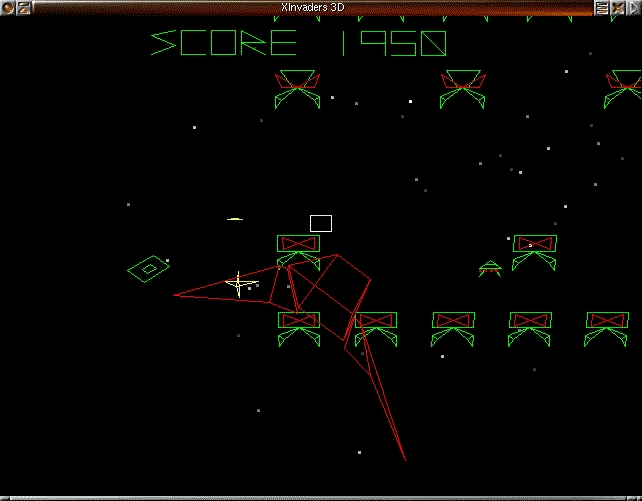
Figure 1. XInvaders 3D
XInvaders 3D (see Figure 1) from Don Llopis is Space Invaders with a twist, a warp, a new dimension. Yes, that's it, a new dimension: when the aliens come at you, they come at you. If you were a fan of the original, you'll be amused to no end by this one. The game is fairly new, so it's not perfect; for example, the graphics don't scale automatically to the size of the window, and there isn't music yet (I suspect a MOD soundtrack just might be on the way). Other than that, it's an awesome take on a classic design. Just wait for the filled vector graphs, texture maps, real-time ray tracing. See www.fiu.edu/~dllopi01/xinv3d.htm.
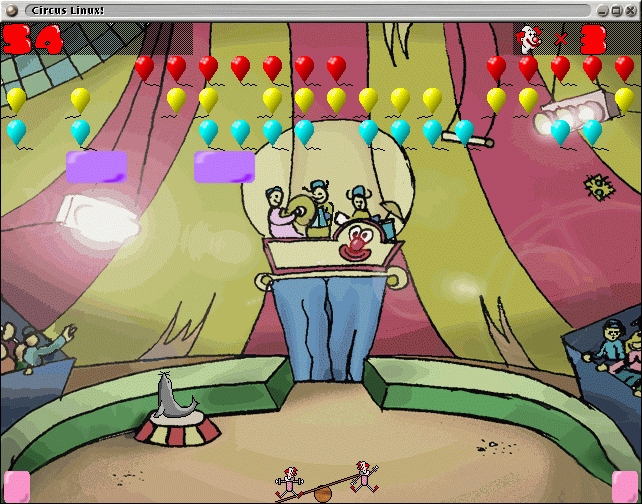
Figure 2. Circus Linux!
Another antique to take a look at is Circus Linux! by Bill Kendrick of New Breed Software. Bill is an interesting fellow who has developed a ton of games for Linux including BoboBot, Defendguin, Gem Drop, ICBM3D & ICBM3D/2, Mad Bomber, 3D Pong, VidSlide and X-Bomber, so I suppose we'll be hearing his name a lot. Circus Linux! is his latest, a Linux remake of the classic (?) Atari 2600 game Circus Atari. You launch circus clowns from a teeter-totter, pop colorful balloons and catch the poor flying fellows, lest they be ill-affected by gravity. Check out http://www.newbreedsoftware.com/circus-linux/ for clowns, balloons and so much more.
a print of King Tut himself or do you have exciting Egyptian graphics, especially Tut, spiders, flies, and other beasts?]
Tutanchamun is a very boring game—just kidding! Actually, Tutankhamen was one of my favorite games on the old Atari. The Atari's chip set is notoriously difficult to emulate, but fortunately we're spared the effort. David Kastrup brought Tutanchamun to Linux. There's an added bonus: David never actually played the original, so what we have is a new interpretation rather than a direct port, a game where the idea was passed from one person to another and morphed into something new, similar to the way urban legends are thought to form. This one is really cute, with the rough, low-resolution graphics and simple game play that fire up the imagination. The Tutankhamen meme mutates and lives! You can get it from metalab.unc.edu/pub/Linux/games/arcade/tutanchamun-0.1.1.tar.gz.

