
Office Wars: Applixware and StarOffice
We humans love glowing boxes. Monitors, TV sets, suns, moons, lanterns, candles—it all goes back thousands of years, when we sat around in tribes staring into the fire. Computers? As long as we're comfortable while staring into the glowing box, it matters little what exactly we're doing. The light is comforting, hypnotizing. Still, some crazy person got this idea that computers ought to have a use, nay, a killer app. Now we're cursed with spreadsheets, word processors, databases, development tools, office suites, mathematical packages... Well, Scott McNealy doesn't want your money (at least not right away), so we might as well make the best of it.
I must admit, the “warring office suites” cover has an air of commercialism to it, but it's not far from the truth. At the same time, it doesn't tell the whole story—Sun and Applix have their minds on bigger things. It is true that on one level, we have a price war in a particular market (cross-platform office suites for Linux/UNIX), but Sun's plans for StarOffice and Applix's ideas for Applixware are fixed on a less immediate horizon. Before we look at the offerings of these respective packages, it's worth the effort to find out where these products are heading.
Sun acquired StarOffice last August and has been giving it away free of charge. It's not open source, not guaranteed to always be free, and it is proprietary software replete with generic licensing nonsense—still, you can now download all 65MB of it without paying a fee. You can also order it on CD for $10 or $40 if you want documentation and support. The question is, where is Sun going with this? A typical cynic might expect Sun to dump StarOffice on the market, drive out the competition, and then start charging for the updates—typical rent-seeking behavior. However, Sun's plan is a bit more visionary. Remember web-based e-mail? Sun wants a web-based office suite.
StarPortal will be the name of this “portal computing” office suite, but since it's first-class vaporware, we don't know how it will be implemented (well, Java). Still, everyone wants to cash in on the falling cost of bandwidth. StarPortal will have many obstacles to overcome (stability, security, accessibility/availability, even the client/server implementation itself), but at least Sun has the size and capital to pull off this kind of project as far as it can go, and Sun owns Java.
Applix, not to be left behind, in fact to be in front with software instead of vaporware, is also expanding into the thin-client office suite market. Anyware Office, Applix's answer to the portable office problem, is an 800K Java applet which allows a user to have office suite access from within any Java environment (Netscape, IE, JavaOS, etc.). You need to have Applixware on your home machine, of course, but if you've got this much, you can set up a home office and contact it from any terminal whenever necessary. It's quite a clever model, one both Applix and Sun are pursuing. One difference in strategy is that Sun hopes to have StarOffice accessible even from PDAs (personal digital assistants with their half-functional web browsers) while Applix, at least for now, is staying solidly on the functional web-browser level.
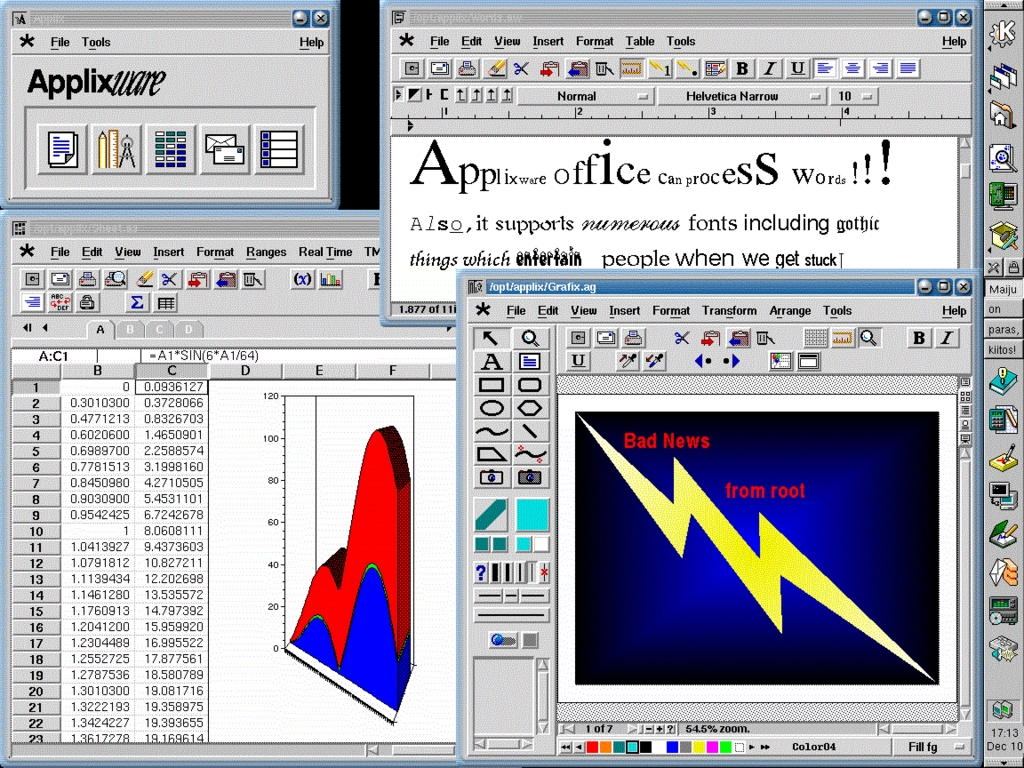
Figure 1. Applixware Screenshot
Another issue is the use of Java. Years ago, when asked for my opinion of Java, I said it was not a serious language, but only a distraction, trendy and not worth the effort. Nowadays, Java has grown in popularity, not entirely on its own merits but because of C's memory management issues and C++'s tendency to produce memory-leaking monstrosities (well, low-level languages do expect you to deal directly with memory). Java has been quite successful on the Internet and intranets and is enthusiastically supported on account of its attempt at platform independence. However, developers must be aware that Java is a proprietary language. The specification is open: anyone can write Java programs, compilers or interpreters, but Sun owns the rights. It's probably not a good idea to become dependent on proprietary languages, and much better languages are available, but Java is nevertheless where our Linux-based office suites are headed.
Now we know where these office suites are going, so how do we choose between them? This assumes, of course, that we are willing to rely on commercial software. It's mildly difficult to get by without using commercial wares from time to time, so if you can, maybe you are a saint, or at least truly clever. Office suites are often the justification for getting a computer, and if you've been in school recently, you know exactly how much of your otherwise pleasant life is spent in front of a word processor. Likewise, science types may often find themselves chained to spreadsheets and need to have a fast, stable package with all the formulas and graphing functions that might come up. In any event, if you want to use a computer with only one OS on it and expect to get something done other than hacking, a word processor is a good idea.
Precisely what is included in an office suite varies from one vendor to another. Applixware and StarOffice provide many of the same applications, but each offers a couple of things the other does not. StarOffice has quantitatively more offerings, although one is well-advised to consider quality over quantity. And of course, the real question isn't “who's best?”, but which one makes you happiest. To complicate matters, StarOffice is free of charge at the moment while Applixware costs $100, so there is definitely a price incentive to go with StarOffice. At the same time, office suites are like office chairs; you should be sure you have the right one, because you're going to be spending a lot of time with it. Also, there is something to be said for the danger of letting larger businesses affect Microsoft-style price wars (<\#224> la Internet Explorer), but one wants to go with the best product either way, and Sun may adopt a semi-open-source policy at some point. Regardless, Table 1 is a summary of the similar offerings from Applixware and StarOffice.
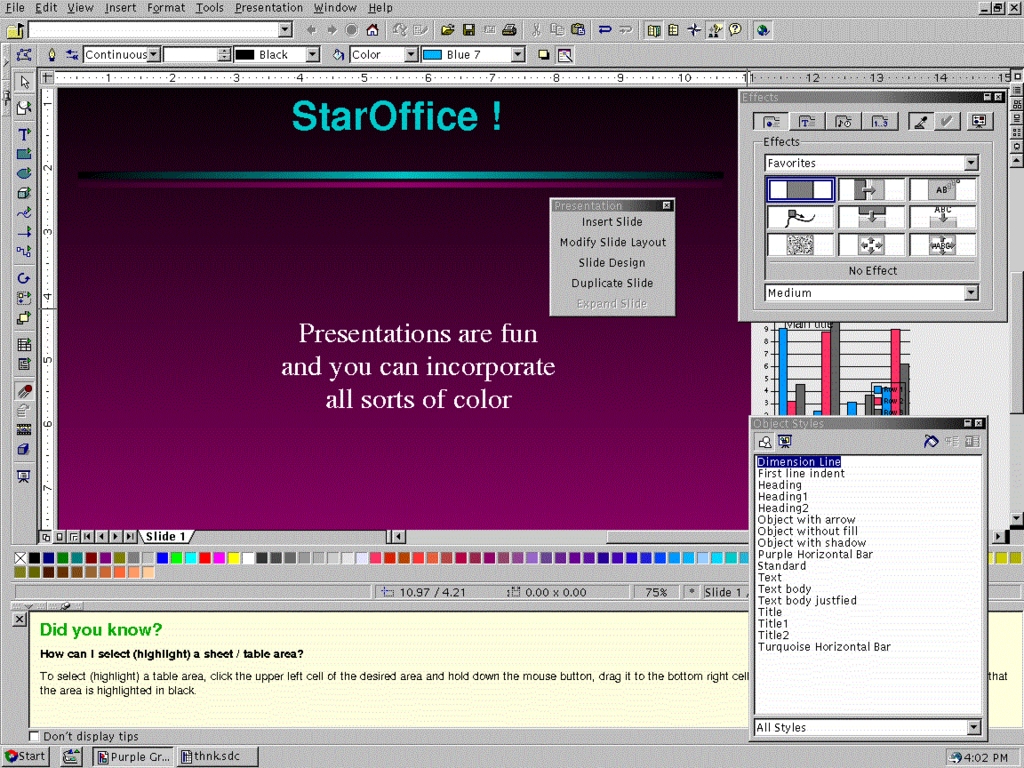
Figure 2. StarOffice Screenshot
Superficially speaking, the look-and-feel difference between StarOffice and Applixware is that StarOffice features itself as having a self-contained, uniform office environment, all in one window (see Figure 1), whereas Applixware's components are integrated but have individual windows operating within the window manager's environment (see Figure 2). The advantage of StarOffice's approach is that users have a complete office environment they can use on any platform with any window manager, without having to deal with anything unfamiliar. Likewise, the advantage of Applixware's approach is that it gives more flexibility to the user to manipulate the windows in whatever ways happen to work best. Hence, the disadvantage, if you call it that, is users will need the brainpower to cope with a window manager. Still, it must be said that window managers for Linux have become nothing short of amazing, while StarOffice's environment does not look as nice or work as well as any of our typical window managers or desktop environments. In fact, StarOffice's habit of restricting everything to one window loses the benefit of virtual desktops and can lead to several layers of clutter. However this is entirely an issue of personal taste, and while I prefer Applixware's flexibility of windows, many people will prefer StarOffice's self-contained environment, and none of this should really matter compared to the capabilities of the suites.
The word processor may be the most popular computer application and consequently has become a flagship product in office suites. Corel, for example, is planning to deliver an office suite for Linux based around the strength of WordPerfect. Word processors don't actually do anything phenomenal and they're very similar these days, so as a result of an effort to improve word processors that are already just fine, they have become overrun with gratuitous functions, while it seems some basic areas are given less attention than they might deserve.
An important consideration for Linux users who want to purge MS Word from their life, but need to read and write .doc files, is how well a Linux word processor can import and export different file formats. StarOffice Writer and Applix Words both export and import MS Word files and RTF (Rich Text Format), but Applixware supports more import/export formats including WordPerfect, Frame MIF and various ASCII formats, while StarOffice has very strong support for export formats but less support for importing. “It's not us vs. them, it's us and them” says Applix's web site, and this consideration is taken more seriously with Applixware. Sun probably doesn't see things this way and has the capital to make this an “us vs. them” struggle. In fact, Sun has developed a program to wean people from MS Office and get them trained for StarOffice. Still, cooperation is nice, and these processors would benefit from increased support of standards like PostScript and PDF. The existing support for importing and exporting document formats is not quite perfect in either, and there seems to be some resentment on all fronts to keep up with everyone's formats. However, documents are less complicated than spreadsheets, so you can expect things to be all right here.
As for the gratuitous functions, both Applix Words and StarOffice Writer are loaded. Obviously, these days you can easily import whatever you want into your document, especially anything created with any other component of the office suite. This is exceedingly useful, but a host of other features go a bit over the top. Both suites can make all sorts of formatting contortions, format automatically, correct errors, offer thesaurus support, insert all kinds of objects and fields, sort, merge and manipulate whatever you like. And, of course, there's clip art—lots of it. Word processing has become synonymous with desktop publishing, and now it's moved into the new territory of the Web.
For your desktop web-publishing needs, Applix offers HTML Author, a variation of Applix Words designed specifically to create web pages. StarOffice Writer, the word processor, is likewise equipped for producing web documents. Already you can include hyperlinks in normal text files, but with these packages, you can create and format documents for the Web. After all, it's the most logical extension of desktop publishing, since web content can reach an enormous audience while consuming practically no resources (compared to the tree-slaughtering, postal-service-dependent printing press). It seems a bit like cheating to use these visual web programs instead of just writing the HTML yourself, but WYSIWYG can be more appealing than the trial-and-error (type this and see what happens) approach. The HTML capabilities are more of a convenient extension of desktop publishing functionality than a substitute for Netscape (or preferably just learning HTML), although you can also browse the Web with them; StarOffice Writer works much better for this. Also, there's no clever caching as in Netscape, so you're best off with Netscape/Mozilla or KFM for web browsing with graphics.
If you want serious graphics, you need either the GIMP or to wait for CorelDRAW. For any small or medium-size drawing projects especially producing objects for your documents, spreadsheets or presentations, the Applixware and StarOffice drawing applications can do what you need quickly and easily. Applix Graphics looks simple on the surface, like X Paint, but has much to offer including support for many graphics formats. It is simple and easy to use, but not exactly full-featured. In contrast, the StarOffice Draw and Image programs are well-designed for graphics components in an office suite (the phrase “almost engineered” comes to mind). There is a good assortment of brushes, effects and functions, all of which are quite flexible. The brush control is particularly nice. It's a bit complicated to get around, but if you can figure it out, you can produce usable graphics without much effort.
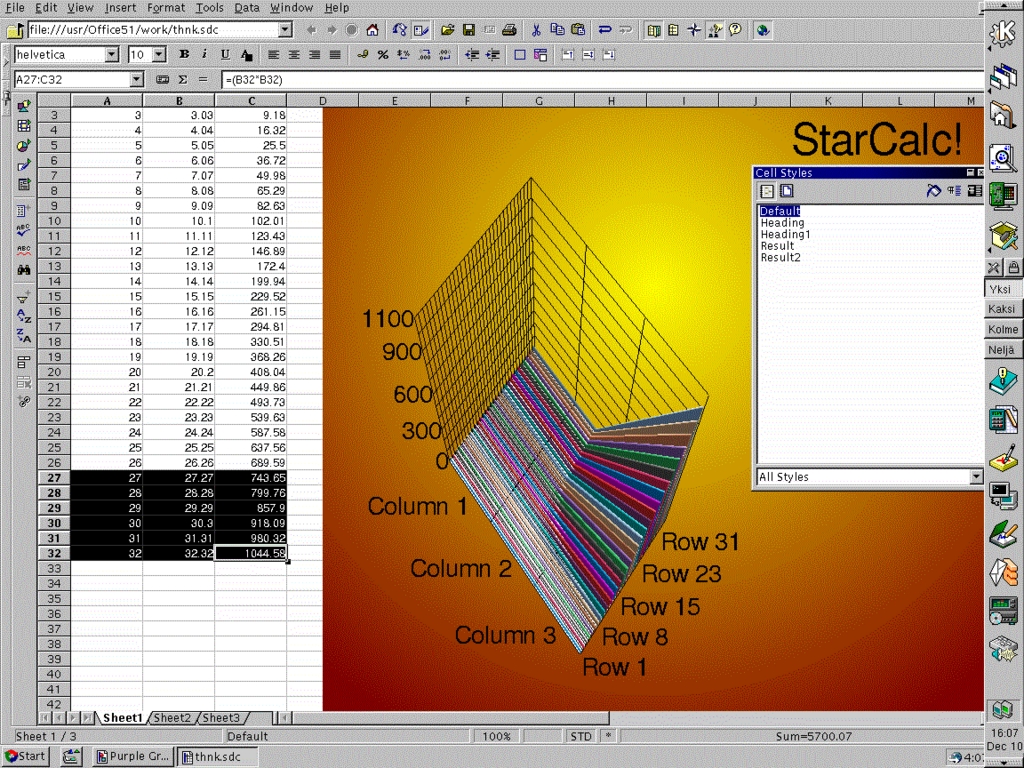
Figure 3. StarCalc Screenshot
The spreadsheet was once the killer app of the computer world, and maybe it still is. As useful as word processors are, it is the spreadsheet that best exploits the computer's number-crunching capabilities. From office workers to statisticians, scientists and students, it seems we're all on spreadsheets at one point or another. Spreadsheets can dig into databases, crunch enormous amounts of information, spit out colorful and elegant graphs, and provide answers for our mathematical and statistical curiosity; hence they're quite popular. However, spreadsheets are tricky. There are so many different functions and syntaxes to support, it becomes very difficult to give comprehensive support to numerous popular spreadsheet file formats. The Applixware and StarOffice spreadsheet programs are quite good in their own right, but still have compatibility issues. Of course, Excel doesn't exactly support Applixware and StarOffice formats, either.
Cross-platform support is a big problem with Applixware Spreadsheets and StarCalc. While supporting word processor formats is not so difficult, the complexity involved in formulas, arrays, titles, graphics, tables, relationships, etc. makes it excruciating to program a spreadsheet that can deal with so many formats. If you import complicated spreadsheets, expect to find some titles missing and some functions listed as unimportable.
Ideally, you will be running your business on Linux/UNIX machines, so you shouldn't have to put up with Windows formats on a regular basis. There is a growing awareness of Linux as a business platform, and we can all help this along by taking the leap to break away from our dependency on non-native spreadsheet formats.
As for the spreadsheets themselves, they're fast and high quality, the difference being that StarCalc (see Figure 3) has far more to offer in terms of functions while Applixware Spreadsheets is fast and easier to use. Applix says Wall Street brokers use their software, and it's pretty good in the financial department. However, Applixware is missing too many formulas for it to be useful for serious statistical work (without having to program your own formulas, which can be done), whereas StarCalc is well-endowed, which can also mean a higher success rate in importing formats. Applixware is also quite inaccurate in its current incarnation in dealing with discrete floating-point operations. Worth considering is the excellent Xess spreadsheet from Business Logic, very fast and full of formulas, which I will review next month. If spreadsheets are crucial to you, check this one out before deciding.
The graphics on both spreadsheet packages are fine. The computer will generate color graphs of your data, rotate it, label it, and let you decide all the details of how it will look. This is typical of spreadsheets, but these actually do a good job of it. StarCalc is more thorough and offers some nice 3-D functions. Applixware is a bit funny; it uses chi as the formula icon, but then doesn't have chi stat formulas.
There is little to be said about e-mail. It's not hard to implement, so it works. Both Applix Mail and StarMail are fine for sending and receiving e-mail, supporting MIME, Sendmail, POP3, folders, etc. These actually seem a bit dull, and I'd prefer to use mutt with all its colors, but they're integrated components and that's what' important. StarOffice even has its own threaded newsreader called Discussion.
Presentation software is important for people who make presentations. If you are one of these people, you can use one of these packages. As is typical in the Applixware/StarOffice comparison, Applixware is simpler while StarOffice is more thorough. I found Applix Presents to do well for informal affairs (probably just on account of the nature of its templates), while StarImpress would be better suited for formal presentations, although this is a bit categorical. StarImpress has a nice collection of templates and a well-designed drawing program, so with some resourcefulness, you can put together quite a decent presentation. Applix Presents will also do for most circumstances and it's quite easy to use, but seems a bit less flexible and the included templates are not as beautiful. Since presentation software is so bureaucratic and businesslike, it fits in with the office-culture scene, but I have my doubts as to its value. Still, it's fun to play around with.
In the LJ Readers' Choice poll, many people asked, “Who needs databases?”, and honestly, they can be a bit dull. In any case, StarOffice has a database with drag-and-drop and relational-link capabilities between several tables. Applixware in turn has more or less the same thing, to spare you the effort of learning SQL. ODBC (for example, MySQL and ADABAS) should work fine, so if you feel the need to bother with databases, you can choose either of these tools. Not being a database connoisseur, I don't have a preference.
A key element of Applixware Office is ELF, the Extension Language Facility, a scripting language with interactive interpreter, compiler and debugger. The idea is to allow rapid prototyping, so there are over 3,300 macros included, as well as typical user-interface design tools such as a menu editor, bitmap editor, drag-and-drop/dialog editor, a TCP/IP socket interface and an SQL database interface. Applix says the Applixware Office suite is written largely in ELF, so clearly it's capable of something. Although it was once proprietary, ELF has been detached from Applixware and is available under LGPL as SHELF. Inside of Applixware, the giant advantage of ELF is that it rapidly allows users to extend the functionality of the suite. Businesses each have their own peculiar demands, and this kind of flexibility and extensibility is said to have popularized Applixware. ELF is a composite of Elisp and BASIC (sounds promising, eh?), but apparently ELF is more like an evolved awk or sed.
Applix Builder is the integrated development environment for designing and debugging ELF programs. The ELF library is LGPL and can be dynamically linked. The applixware.org web site is devoted to the open-source exchange of ELF software. It's an interesting attempt at utilizing the open-source phenomenon to increase the value of a product, and it may actually be working. In any event, you can incorporate C, C++ and CORBA into your ELF code, so it's fairly powerful.
StarOffice has a unique offering, an office-scheduling program which is a lot like those big white calendar sheets people put on their desks—only digital and a bit more organized. Control freaks can chart out their days, weeks and months and keep track of projects, meetings and the usual business events. PDA enthusiasts may find this quite useful, as StarOffice Schedule will synchronize data with PDAs such as the PalmPilot. I think plan is good enough, but at least you've got this scheduler around if you feel inclined to use it.
By including so many components, Applixware and Sun haven't made it easy to quantify their office suites. First, the filters. There are a ton of them, and they work well enough to get a file loaded into your office suite. However, there are far more filters than importers, and filters take things away. That means you can bring a document, spreadsheet or presentation across, but umprocessable data will be removed and you'll have to fill it in by hand. Exporting is a bit easier to implement, especially for simple files. In general, the less fancy the file, the easier it is to move. The more advanced the formatting, the more likely it will be mangled, er, filtered.
StarTools are components of the individual programs in the office suite. StarOffice Image, for example, is part of StarDraw; Chart is part of the spreadsheet; Math is a formula editor; Gallery is for navigating clip art and other multimedia bits; HelpAgent is the on-line help; Navigator is your typical GUI; Stylist manages the templates. Ultimately, they're just necessary components. For advertising purposes, Sun catalogs its accessories while Applix catalogs its filters, although both packages have components. It's generally true that StarOffice is better on accessories and Applixware is better on filters, but both are fairly well-balanced.
The question on so many minds is how to set up a productive Linux desktop, and preferably, how to do it inexpensively. StarOffice is free of charge right now, so if you have the bandwidth, you might as well download it. It has a slightly steeper learning curve than Applixware, but once you have it down, you should be able to do anything. The point is, it's free, so if it's good enough for you, there's little sense in spending money unless you are worried about Sun gaining market dominance and not trusting what will happen afterwards. If you plan to spend most of your time writing, I'd opt for WordPerfect. Likewise, if you are going to be dependent on a spreadsheet, at least consider Xess before making a decision.
Applixware has its advantages. It's much faster than StarOffice (which has a habit of crashing and leaving tracers), and the interface is easier to negotiate. The feel is quite UNIX, and it's been a standard for a long time. Probably most, if not all, programs in Applixware are easier to use for anything basic, but when you find yourself wanting those weird, hard-to-do things, you'll probably have a higher success rate with StarOffice. Businesses could definitely take advantage of ELF, so I would recommend they consider Applixware Office, while I would suggest a download of StarOffice for individuals who just want to save money.
Linux office suites are not quite as easy as on other platforms. The features aren't all there, but if you're the slightest bit clever, you can do anything. A large part of the fun of using Linux is roughing it. “I'm not supposed to be able to do this, but look—I did it anyway!” is a defiant thrill, a key part of the Linux experience. The time when everything will work perfectly and there won't be any obstacles to office work is not far off. In the meantime, enjoy the mild challenges that come up when you have to do something weird that isn't quite supported; in the future, it's a recreational activity we might not have.
The market itself is a curious issue. Software's free nature has enabled the Open Source movement, but has also delivered to the commercial software industry the incantation for Armageddon, the ultimate price war. Applix is a strong competitor with unique offerings and intelligent strategies and should survive this full scale assault. Applix launched smartbeak.com, a web site devoted to the open-source exchange of ELF programs, and more recently acquired CoSource.com, a web site that matches free source developers with funding (truly a more modern development model). Nevertheless, the free-of-charge tactic exposes another fundamental defect in the already failing Cathedral-style, proprietary model. Without intervention, the commercial software industry might burn itself up, but with intervention it could strangle itself with more and more regulations imposed to support an arbitrary and inefficient development model, especially considering the impracticality of enforcing arbitrary “intellectual property” laws which are already considered illegitimate by many. With the new weapons of free-of-charge price wars, look-and-feel patents and reinforced hard-core digital copyright laws, this is a trip-wire and land-mine industry.
One thing we do know is this: Linux is completely ready to be your one and only desktop OS. We've got two excellent office suites, with more on the way, as well as individual components such as Corel WordPerfect and the Xess spreadsheet. Abolish your DOS partition, and put Linux on your secret Macintosh. What was once a hacker's project is now a completely viable system for home users, corporate users, government and public institutions, scientists, researchers, high school and college students; and yes, it's still the strongest magnet of brainpower in the computer world.

