
upFRONT
The Collaborative Virtual Workspace by Stephen Jones gives us a look at office meetings of the future: held over the network in a virtual meeting room. Mr. Jones' current project involves developing this virtual space so that it gives more meaning to social interactions and allows participants to pass around documents and pictures. The software for this project is being made freely available.
AppSwitch 2000: Network Switching with Ada by Ann S. Brandon relates how this product was developed using Linux, then converted to GNAT. All programming was done in Ada rather than C, and Ms. Brandon tells how and why management made these controversial decisions. This article is as much a product review as it is a salute to ADA and Linux. The AppSwitch analyzes network application traffic and enforces quality of service policies automatically.
Writing an Alphanumeric Pager Server for Linux by Eric Max Francis gives us all the information we need to do just that. Mr. Francis covers protocols, profiles, devices, filters, server and clients, then tells us how to put all the pieces together whether we support a single or multiple devices.
Linux and Banking by Josip Almasi is a “Linux Means Business” column about a small bank in the country of Croatia. Mr. Almasi tells us how they came to choose Linux as their operating system, and the benefits, such as GNU tools, which Linux has brought with it.
Perl Annotated Archives by Paul Dunne is a book review and delivers just what book reviews should: a look at what's in the book, and information to help you decide if it is worth reading.
Core PHP Programming: Using PHP to Build Dynamic Web Sites by Allen Riddell reviews this book on the popular web scripting language PHP. Everything you need to know, or a waste of time? Read the review to see.
Place of Swedish among the languages spoken in Linus' home: #1
Percentage of Finns for whom Swedish is the mother tongue: 5
Length in hours of Linus' honorary doctoral award ceremony at the University of Stockholm: 3
Number of times the two mountain bikes in Linus' garage have been used in two years: 2
Elevation of Santa Clara, where Linus and his family live: 94 feet
World to which Linus says he sometimes thinks Silicon Valley belongs, due to its absence of good electronic banking: 3rd
Hosts per 1,000 people in Finland: 52
Position of Finland in hosts per thousand among the 20 most industrialized countries: #1
Number of U.S. cities that have achieved greater than 50% Internet penetration: 5
Internet penetration of Washington, D.C.: 59.9%
Washington, D.C.'s position among most-penetrated Internet cities: #1
Position of Pittsburgh, PA: #64
Internet penetration of Pittsburgh: 30.8%
Household debt as a % of income in 1999: 98
Household debt as a % of income in 1998: 80
Amount borrowed by U.S. households to fund stock purchases in 1999: $179 billion US
Increase in borrowing for stocks over previous five years: 3 times
Room capacity for the Linux for Suits panel discussion sponsored by Linux Journal at Fall Internet World featuring Linus Torvalds: 350
Approximate number of attendees at the event: 400
Number of pages in the January 1999 issue of LJ: 100
Number of pages in the December 1999 issue of LJ: 132
Number of complaints concerning the discussion of religion in the November LJ interview with Linus Torvalds: 7
The latest expected release date of Windows 2000: 2/17/00
Approximate number of employees at Windows Magazine: 35
Number of employees working on Linux Journal: 14
Average number of days the male emperor penguin fasts during courtship and incubation: 90-120
Percentage of body weight lost during fasting: 41%
Percentage of time spent asleep during fasting: 70
#1-3 and 6: Linus Torvalds
#4: San Jose Mercury News
#5: Career.com
#7-9: Matrix Information and Directory Services
#10-13: Scarborough Research
#14-17: Business Week
#18-22 and 25: Jason Schumaker, Linux Journal
#23: ZDNet, October 26, 1999, Mary Jo Foley
#24: Windows Magazine
#26-28: The Penguins by Tony D. Williams
Gains by Linux are old (if not Red) hat by now. Still, it's gratifying to see the numbers. Here are the latest (April 1999) from The Internet Operating System Counter (http://leb.net/hzo/) in graphical form.
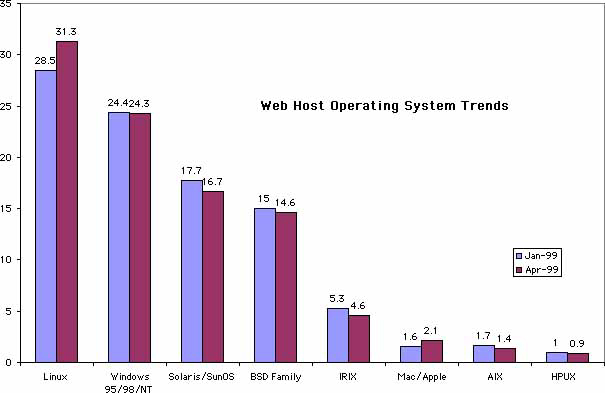
Figure. Linux Numbers

User Friendly
O'Reilly & Associates has published their first cartoon book, User Friendly by Illiad. This is a collection of the very same cartoons printed each month in Linux Journal. It offers funny, offbeat and original comic strips to tickle the funny bone of all computer users, and Illiad is a supporter of Linux, too. Get your copy today.
Another quarter, another major advance in Linux' move to the desktop—at least if we judge from service calls. Last September, we reported that Linuxcare noticed a 27% increase in the number of desktop incidents, while service calls for file, print and web servers went down. Now we have the third-quarter numbers, and the trend continues. To show the dramatics, here's a graph.
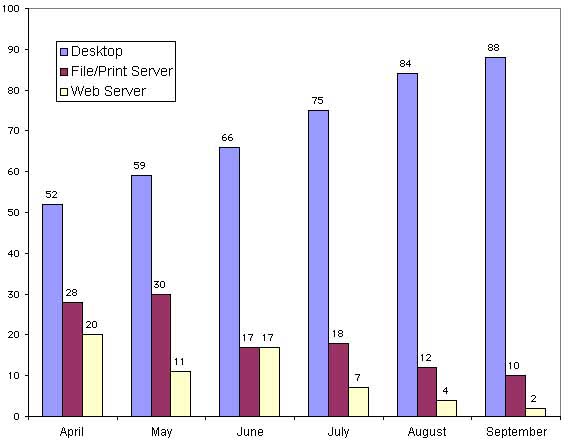
Type of Service Calls Graph
Source: Linuxcare
The press loves a David & Goliath “war” of any kind. Bill Gates has played the Goliath role for quite a while, of course, but the Davids come and go. For most of the late 1990s, David was played by Netscape's Marc Andreessen. Now Linus Torvalds has been cast in the David role.
Thus, the headlines read like a play-by-play fight between Linus and Bill, or Linus and other big/bad tribal chieftains. Here at Linux Journal, we found ourselves supplying material for this sports story when we hosted “Linux for Suits: The Linux and Open Source Executive Forum” at Internet World on October 6 last year.
Headline:
Torvalds swings at Linux wannabes: Linux inventor dismisses moves toward open source by Sun, Microsoft... —ZD Net story, October 6, 1999
Actual Words:
Question: Microsoft has been talking a lot about opening up their own code. Whether or not they actually do that is a big question; but if they should do that, what does it mean for Linux?
Linus' Answer: I'd like to start off by saying talk is cheap, and I think this is a fairly theoretical question. However, as a theoretical question, I'd be more than happy to see more and more people open up their source. I'm not convinced, for example, that the Sun community license is a very good license. But it still makes me very happy to see that Sun is opening up and making their knowledge available to others. And if Microsoft were to open up, I'd be more than thrilled. I don't think it is very likely, or if it does happen, it will most likely be in niche markets. People think there is more of a Microsoft bigotry in the Linux community than there really is. I'm more than happy to use Microsoft products. It is just that I am selective about the products I want to use. For example, I've always liked PowerPoint, and I've always thought that Visual Basic was a good product. It's just been hard to use them because I've always thought the platforms they run on aren't good enough. I used to do my slides with PowerPoint for the longest time with a Windows Installation package. This is true, I find of all the developers I'm in contact with—that maybe we take up Microsoft as a bad example in specific areas, but we're not as anti-Microsoft as the press makes us seem.
Find the full transcript here —or listen to the whole day's proceedings at the ON24.com site. Go to www.on24.com and find it among the Linux search listings.
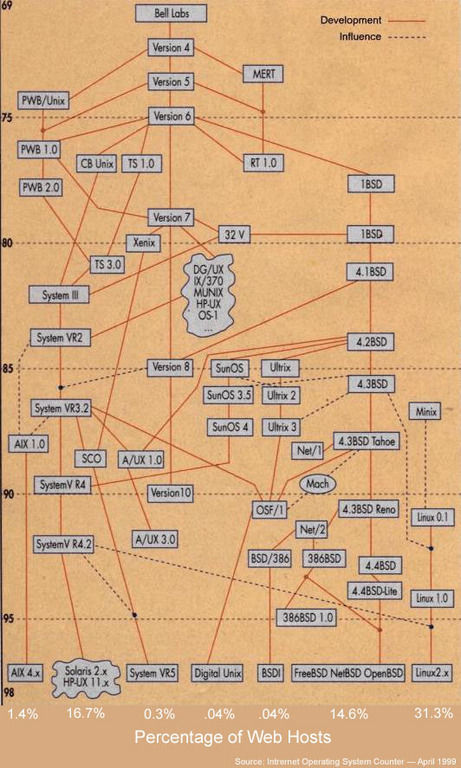
UNIX Systems Diagram
One of the old objections to UNIX was there were so many variants. The fact that lex, yacc, vi, troff and other commands ran uniformly across all of them didn't cut the ice. The plate of spaghetti here represents most of the variants and the cross-fertilization. Minix shouldn't be free-standing: it arises out of V7 from Bell Labs. I miss Dell UNIX, the best n86 version of SVR4.
The really important thing is the fact that every one of these streams is used for web hosting, and that the UNIX+Linux systems total a remarkable 64% of all sites. In other words, just about two-thirds of the Web is powered by UNIX or Linux.
Not bad for an upstart.
—Peter Salus
After I took part on a panel at the FreeBSD conference in October, an attendee invited me to test the honesty of both Linux Journal and its community by looking at exactly which operating systems hosted the most popular Web sites. So I did. The server and host columns below contain exactly the data yielded by Netcraft at its “What's That Site Running?” page (http://www.netcraft.com/whats/) on October 26, 1999.
The source list of top 25 sites (in the U.S.) comes from Media Metrix, which is the primary source of web-site popularity figures.
Indeed, the results look good for BSD (5). They look better for Solaris (10). They perhaps look best for Bill Joy (18), whose genius is behind the Berkeley, Digital (3) and Sun breeds of UNIX. Although only Real Networks and Angelfire were found to be running on Linux (2), Netcraft informs us that other Linux sites include Deja.com, eToys, Go2Net and The British Royal Family (we knew those folks had taste).
Since we're being utterly fair here, Microsoft's NT (5) doesn't do too badly, either.
Next, the necessary disclaimer. “There's no sure way to tell what OS a host is running,” says our top tech wizard, Dan Wilder. “Indeed, there are lots of ways to fool people about what host is running. OS names are easily spoofed. We used to spoof them here at SSC, to foil hackers.” To find a fun hack on the supply side of this information, look at the server finding for Real.com, below.
Consolation: as we see elsewhere in this section, Linux is gaining rapidly overall and now hosts about one-third of all web domains (according to The Internet Operating System Counter).
—Doc Searls
ALS '97 had about 20 vendors and a few hundred attendees.
ALS '98 was like reverse time travel. It had both the atmosphere and the feeling of USENIX conferences before the mid-80s, with about 40 vendors and over a thousand attendees. (Atlanta USENIX in 1986 had 1200 attendees.)
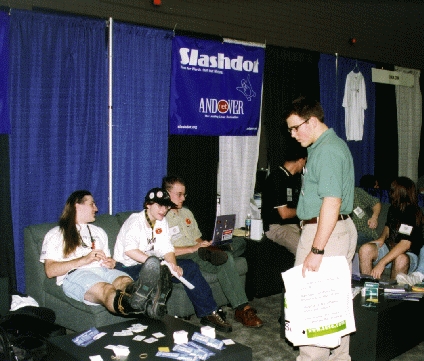
Slashdot Booth
ALS '99 was still full of talks and demos and corridors and dinners. But now, after only three years, there was active cooperation between the Atlanta Linux Enthusiasts and USENIX: it had two days of technical tutorials; the show floor was over double the size of what it was in 1998; and there were 3,000 attendees.
The discussions were intense; the atmosphere was friendly; more got done in the hallways, bars and lounges than in the sessions. There was a feeling of intellectual ferment.
Eric Raymond was there. Maddog was there. This was the Linux geek event not to miss. My favorite hardware display was Compaq's Beowulf cluster; software was from Hummingbird Communications, Ltd., (http://www.hummingbird.com/), a Linux version of their Fulcrum search server and OpenSales (http://www.opensales.com), a neat e-commerce solution.

User Friendly Booth
But I have to admit that the product of choice was Raymond's The Cathedral & the Bazaar, just published by O'Reilly (see my review in this issue of LJ).
Marc Torres and his crew did a splendid job. I hope they invite me back next year.
—Peter Salus
A while ago, Linux Gazette editor Mike Orr and I considered founding an organization dedicated to the proposition that each user should have his or her very own distribution of Linux. That would make for several million new versions of Linux, a number we're steadily approaching. Here is one of the newer, more interesting distributions; quite exciting, n'est-ce pas?
kha0S—better living through extreme paranoia—aims to be the most secure Linux system ever. It's so paranoid, in fact, that right now it has stateside distribution “issues” on account of cryptography protecting privacy which is disagreeable to a certain government. kha0S is in version 0.99 right now, very close to the magical 1.0. Although it has no pretension of displacing market leaders (kha0S is expressly not a commercial project), it is vastly more secure and may raise standards across the board while filling its particular niche. This is a project not necessarily for people who need security, but for people who are intellectually fascinated by it. The kha0S team has surprisingly strong credentials for a fringe project like this, so they're probably going to turn out something rather impressive. It's nice to see brain power for Linux existing in areas which aren't Linux-specific, such as cryptography.
Kha0S employs a low-level-up approach: each component is tested to make sure it is completely free of security holes, then the kernel itself is hardened. Security packages to be integrated by default include the Cryptographic File System, Kerberos, IPsec, IPv6, VPN, ssh/lsh and others. The Cryptographic File System is one of the polishing stones of the kha0S project and should provide transparent encryption of files on the system (hopefully encrypting swap as well).
I suppose there's a limit to how secure a system can be, but the fun is in the project anyway, isn't it? It's a lot like hacking in reverse (or cracking in reverse, if you prefer), although I wonder what these folks were up to in their teenage years while becoming such security experts.
For more information on this exceedingly cool distribution, check out http://www.kha0S.org/, especially if you're very good at breaking encryption schemes (they may want you). I wonder how quantum computers will affect the kha0S project—I probably won't have to worry for a very long time.
—Jason Kroll
The first time I saw Windows, I thought it was a joke; I actually laughed. I didn't look at it again until I bought a PC to install Linux. That's when I noticed something horrid on my keyboard: little keys with Windows on them. Well, now Linux has its own keyboards—magical custom hardware—without those Windows logos.
Linux CoolKeyboards' flagship product, featuring the uber-ubiquitous Tux, is a keyboard appropriate for mainframes. It is serious, heavy, and it clicks, a genuine “Old Skool” design from the days when machines were machines and coders ate pizza (wow, it seems like only yesterday). It is slightly oatmeal in color, with a 70s brown hard plastic dustcover (which I recommend removing or decorating) and lots of keys. The keys are quite perky, among the least gummy in history. The feel is a question of taste: do you prefer, for example, Mac keyboards, soft-touch keyboards, laptop keyboards, etc.? If you believe the only real keyboards are ones with key-punch, microswitch action, this is just your thing. Ah yes, the Linux point of this keyboard is the penguins—two penguins and a Linux logo—replacing the Windows keys. As an added bonus, all twelve function keys are labelled twice (once on the keys and once on the keyboard, so you can bring it to parties as a conversation piece) just like in the “old days”, but then again there's a Euro mark on the 5, a sign of changing times (along with our dear penguins). I'd like to see non-oatmeal colors and a more specialized Linux setup (change caps-lock to control, etc.), as well as rubber on the feet which are lethally sharp.
Consideration for the DVORAK layout would also be nice. All in all, though, CoolKeyboards is on to a good thing (and trying to patent it for whatever reason). Now, on to smaller things.
Happy Hacking Keyboard Lite—you've seen those very happy people; this is why they're so happy—it's a tiny keyboard, with only 60 keys, optimized for Linux users. This means that control replaces caps-lock, escape is next to 1 where ~ usually is, delete/backspace is large, the number pad has been removed, and the weird keys (function, cursor, page keys, etc) are accessed with a special Fn key (as found on laptops). Specialized configuration of keys can be achieved by way of dip switches and a paper clip. Few people will realize how tiny this keyboard is until they see it; the keys are full size, but the board itself is even smaller than those found on laptops. Strangely, everything fits! This has got to be the cleverest keyboard design going, especially for vi and Emacs users. It's much more elegant than a traditional keyboard, but it also relies heavily on the right hand. The key action has been described as “silky”, and is actually very soft, and again not gummy. The keys are quiet enough, though not quite as perky as on a laptop or the aforementioned board. As for layout, PFUCA says DVORAK will be a critical issue for the power user, but there are no plans for one as yet. PFUCA is delivering a black HHKL soon (what about translucent purple?), which would be nice paired with a flat-screen monitor and a tiny computer like a Netwinder (ah, StrongARM). Good for apartments where space is at a premium and for people who like small things. No Windows keys, and no penguins. (Try your local aquarium or zoo for penguin stickers, and go on a rainy day so there aren't so many people scaring the animals.)
If you've worn out your space bar from too much ZBlast, not to mention what you've done to your cursor, (ALT), and CTRL keys on account of Quake, maybe it's time for a new keyboard (and/or a joystick).
—Jason Kroll
In keeping with the theme of world domination, it's time to indoctrinate Linux users in our quest by beginning their training in various ways of taking over the world. Strategic conquest, of course, is horribly addictive, and ever since the first world-conquering games started appearing several years ago, take-over-the-world power gaming has practically taken over the world. Indeed, it seems as if the two genres of computer games these days are strategic war games and 3-D Wolfenstein descendants. Since we're so sophisticated, let's have a look at the former.
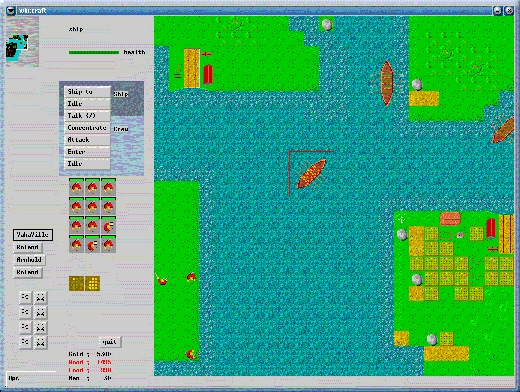
One day can actually change the course of your life. For example, a bit too much to drink, a quibble with your chief, and suddenly you find yourself out to found a new nation with two of your drinking buddies. Craft author Uwe Breyer adds, “since you are obviously even too lazy to work, your companions vote you to be King.” So that's how it happens—the path to world domination begins with three drunken Vikings. Craft features up to four players, human (with network support) or computer, wandering about in a world which is a bit Warcraft, a bit Civilization, but rather less cluttered and faster-paced, with a minimal learning curve. You've got access to knights, archers, scouts, workers, merchants, scientists and pawns, as well as town halls, farms, camps, mills, smiths, universities, forts, markets, docks, ships and catapults. All in all, you can really go nuts killing things if you like (and if you want to win). This game is a Linux gem, fast-paced (real-time as opposed to turn-based) and it doesn't degenerate as quickly as so many strategic conquest games. Look for it at http://borneo.gmd.de/AS/janus/craft/.
Open-source developers are truly amazing. This time, they've managed to create a free and improved Civilization I/II for Linux that's more fun than the originals. The graphics are really nice, a bit on the dark side, and the game feels more serious. FreeCiv supports AI and network play with 32 nations; the newest release should support an infinite number. Maps can range in size from very small to very large, and one could, if so inclined, devote a weekend or longer to a massive clash of civilizations over the Net. There are 47 different units available, as well as several different tile sets, so that you can choose your graphics (even in different sizes). It's a typical client-server model, easy to set up and play. Here it is, only one download away—you don't even have to buy it: http://www.freeciv.org/.
Anachronism is Nikos Vasiliou's contribution to Linux gaming, made when he felt Linux didn't have enough games. If steep learning curves are discouraging, check out this one. There's very little to worry about except for troops and killing, so you can concentrate on war. It has rendered graphics (characters and terrain), two civilizations with ten armies, multiple scenarios (and a map editor), multiple player support, sound effects and music. The happypenguin.org site says, “just take your troops and slaughter.” Quite right. Find it at students.ceid.upatras.gr/~nbasili/anachronism.html.
Developers who hope to contribute to global conquest might want to get in contact with the Boson development team. Released under the GPL, Boson is a real-time strategic war game with absolutely fantastic graphics, only it's not quite playable yet. Right now the developers are looking for more people to help with graphics, documentation and the like. It looks really neat, especially the machinery: http://aquila.rezel.enst.fr/boson/.
TUD (The Urgent Decision) is another very promising game which may need some developers. It's another take-over-the world game, but it's network-playable and has a very military approach. For example, if you want to lead Viking settlements or win a victory of civilization by controlling all elements of society, Craft and FreeCiv are for you, but if your brilliance is limited to the military sphere (or you just like it better—fast planes, heavy machinery), TUD might excite, as it's quite mechanical and very close to that magical 1.0 version. Check out the web page, maybe it's just the project you're looking for: www-ti.informatik.uni-tuebingen.de/~thiele/tud.html.
We all know we're already geniuses (just look at what OS we use—our IQs must be over 2000), so now we're ready to go out and conquer the world (a tad gruesomely at that). There are dozens of strategy games for Linux; these are only a few highlights. All these games and more can be found, as usual, on http://happypenguin.org/, or you could try http://linuxgames.com/ for general gaming information.
—Jason Kroll
On November 15, Red Hat announced they were buying Cygnus Solutions for a reported $674 million (US) in a stock-for-stock merger. I don't think anyone was surprised to hear that Red Hat was acquiring a company. Ever since the IPO, people have wondered who it would be and when it would happen. After all, what else were they going to do with all that money? Plans consisting of building a bigger and better portal and nothing else is certainly not the way to inspire confidence in your investors. However, I for one was certainly surprised that Cygnus turned out to be the company Red Hat bought. Of course, I had recently heard the rumor and hoped it would prove to be false.
Cygnus Solutions has been in business for ten years now. They are successful. They market good products based on open-source software, mainly the GNU tools such as gcc and gdb. Recently, they have marketed an integrated developer tool, called Code Fusion, which won our Editors' Choice Award for Best New Application for the Developer. They have always been vendor independent, ensured all their products ran on all Linux distributions and given back to the community. Their improvements to GNU tools have always been open source, giving everyone the chance to benefit from the advances rather than just those who could afford to pay for them. For these reasons, they have held a high standing in the regard of all those in the Open Source community. They have held this same high regard in the business community, because they have shown that you can indeed make money from open-source software.
Now that Cygnus is owned by Red Hat, what will happen? Will Cygnus products become vendor specific? Will upgrades always be available to Red Hat first? Will they continue to give back to the community? At least for this last question, I don't think we have cause to worry. Red Hat has been good about giving to the community too—I don't think that is going to change. But I do worry about the first two. Now that Red Hat has stockholders to report to, changes are inevitable—a definite market edge must be demonstrated and profits must be made. Red Hat's commitment to the Open Source movement is going to be put to the test.
They have bought a good, strong company, one that will help them show profits and continue to grow. It was a good business decision on their part. Still, I wish they hadn't made it so soon. I have no doubt that Cygnus is only the first company to be bought by Red Hat—there will be others. I feel it would have been best if they had first acquired a company that was not as strong; that is, one that would have benefited more from the merger. Let's not kid ourselves; Cygnus doesn't need Red Hat to be successful.
This merger looks like a bid for money and market domination, not a step taken to further the future of free software. Still, only time will tell if the Linux community has actually been slimed or if it just feels that way.
—Marjorie Richardson
Corel announced an alliance with PC Chips to bundle Corel Linux with more than 20 million PC Chips motherboards. PC Chips will also ship Corel WordPerfect 8 for Linux and WordPerfect Suite 8 OEM for Windows with its motherboards.
SuSE, a distributor of the Linux operating system, announced an agreement with IBM to distribute, market and support selected IBM e-business software solutions for the Linux platform. SuSE is working with IBM to meet the demands of its customer base for software products running on the Linux platform. Initially, SuSE will concentrate on the following IBM and Lotus technologies for the Linux platform: Lotus Notes/Domino, MQSeries, Transaction Series, Component Broker, IBM Data Management Software, Websphere Family, IBM Electronic Commerce Software, VisualAge, San Francisco Framework and SecureWay.
Motorola announced the appointment of Metrowerks' two most senior executives, Jean Belanger and Greg Galanos, to strategic roles within Motorola Semiconductor Products Sector (SPS) and the appointment of David Perkins as President of Metrowerks. The changes in these executives' roles were made to expand Motorola SPS' software expertise and accelerate the integration of Metrowerks and SPS. Belanger, Galanos and Perkins all remain on the board of directors of Metrowerks Inc., which became a wholly owned subsidiary of Motorola on September 24, 1999.
Caldera has announced they have chosen Multi User Solutions to be their first Authorized Support Center. Multi User Solutions has over nine years of experience in supporting the UNIX environment, and currently supports over 10,000 sites nationwide. They offer a unique solution covering both OpenLinux and hardware support, and thus will be able to give Caldera customers the extensive coverage they need in phone, e-mail and on-site Linux and hardware support.
Ariel Corporation announced that the source code for its Linux remote access drivers is now freely available to the public through the Open Source Initiative. The drivers make it easy for service providers, OEMs targeting service providers and corporate enterprises to add high-density V.34, 56K and ISDN remote access to a broad range of PCI- and CompactPCI-based Linux systems.
Linuxcare announced an agreement with TurboLinux to partner on enterprise support, services, training and hardware certification and testing for TurboLinux software, including TurboCluster Server. Linuxcare also announced it will be providing technical support in Japanese for Linux software developers at NEC Software.
esoft Inc., a developer of Linux-based Internet appliance solutions for small- to medium-sized businesses, announced a distribution agreement with IT Resources Pte Ltd., a Singapore-based distributor. IT Resources will distribute the TEAM Internet family of products and will be selling them to value-added resellers throughout Singapore and India.
Intel Corporation announced it will bundle the Red Hat Linux operating system with its server platforms marketed through its recently created Internet Service Provider program. The inclusion of Red Hat Linux with Intel's ISP program offers customers the power of open-source software in the demanding Internet server environments in which it performs best. Comprehensive services and support will be provided by both organizations.
Activision, Inc. and Loki Entertainment Software announced they have joined forces to bring more PC and Macintosh games to the Linux platform. Loki will be developing, publishing and supporting the Linux ports of five Activision games, including Heretic II and Heavy Gear II, over the next two years.
National Semiconductor Corporation has appointed INFOMATEC AG/IGEL Technology Labs to serve its Asia Pacific customers. INFOMATEC/IGEL will develop Linux-based firmware to port to National's set-top box and thin-client platforms, providing highly integrated solutions for the information appliance market.
TurboLinux announced that Sanyo Electric Co. in Japan will be using TurboLinux as the base operating system in 20,000 Newve medical workstation products expected to ship over the next four years.
SMC Networks, a manufacturer and supplier of LAN products for small- and medium-sized networks, announced they will be providing a complete TurboLinux workstation solution to North American resellers and end users with every SMC single-pack network adapter purchased.
SCO and TurboLinux announced a worldwide services initiative to provide TurboLinux customers with Linux Professional Consulting Services from SCO. SCO will support TurboLinux customers in planning, cost analysis and deployment of their systems. SCO will also develop specific service offerings for the newly announced TurboCluster Server.
Dell Computer announced it is shipping its Precision WorkStation series in Japan bundled exclusively with TurboLinux. Customers can also purchase Linux support services from TurboLinux through Dell's DellWare program.
Covalent Technologies, a supplier of commercial software for the Apache web server platform, announced the availability of several commercial support options for the Apache web server.
Fujitsu Ltd. announced it will be distributing Caldera OpenLinux 2.3 (and future versions) on many of its servers, including the GranPower series. Both companies will work to provide a comprehensive hardware certification program for OpenLinux products on Fujitsu systems.
Red Hat announced an expansion of its services program that will provide the consulting, and support enterprise organization's need for nearly all popular, powerful, open-source software applications. As the first step in the program, Red Hat's worldwide services group will immediately offer expanded Service Programs for popular open-source software solutions, including the Apache web server, Sendmail and Postfix.
Quote: I am basically a very lazy person who likes to get credit for things other people actually do. —Linus Torvalds (The Cathedral & the Bazaar by ESR)
Factoid: Pierre Laffitte, a French senator, has proposed a law that would make the use of open-source software mandatory for most government use! (Slashdot, October 28, 1999)
Joke: Windows 2000 is set to debut February 17, 2000—Groundhog's Day. If Windows sees its shadow, expect six more weeks of beta testing! —Patrick Hair, Panama City, FL.

