upFRONT
Every few months, we take another look at Alexa Internet's stats for Linux-related web sites. These charts follow the last set by 100 days, and the trends are interesting. The most noteworthy items:
Woven Goods for Linux had the highest increase of “Links In” among the resource sites: 226%. Freecode was second, with 192%. Linux Today was third, with 154%. The increase for the whole group was 112%.
For resource site visits, Linux.com led the way with a 164% increase. Freshmeat was second with 112%. The increase for the whole group was 18%.
Among the Distribution sites, the leading gainer in both “Visits” and “Links In” was SuSE, with 99% and 77%, respectively. The increases for the whole category were 52% and 25%, respectively.
As for the rest, you can draw your own conclusions. Bear in mind the following disclaimers. These numbers were gathered on August 21, 1999. Links In are current and updated constantly by Alexa's 'bot. Visits are totaled over the preceding 6-month period. Since Alexa's client software lives only on Windows and Mac machines, visits do not (yet) include Linux or UNIX clients (see the LJ Index for some working irony on that subject). “SSC sites” include the Linux Journal, Linux Gazette, Linux Resources and ssc.com sites. Linux Journal and Linux Resources were combined during the survey period. Linux.com also started in late May and was not in existence through much of the survey period. The Slackware numbers below include all of http://www.cdrom.com/ (of which Slackware puts up the biggest numbers). Caldera also split into two sites (and two companies) during this period.
—Doc Searls
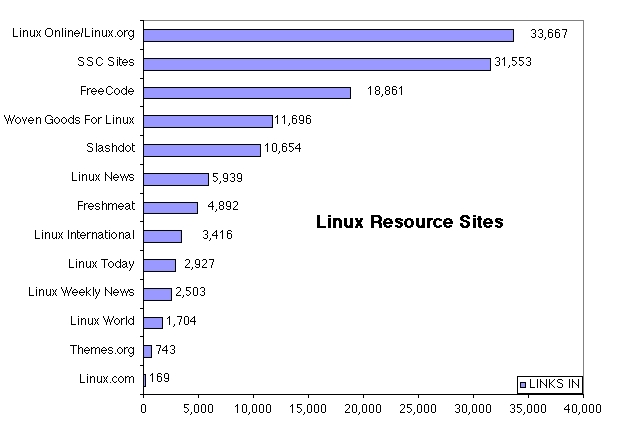
Links In for Linux Resource Sites
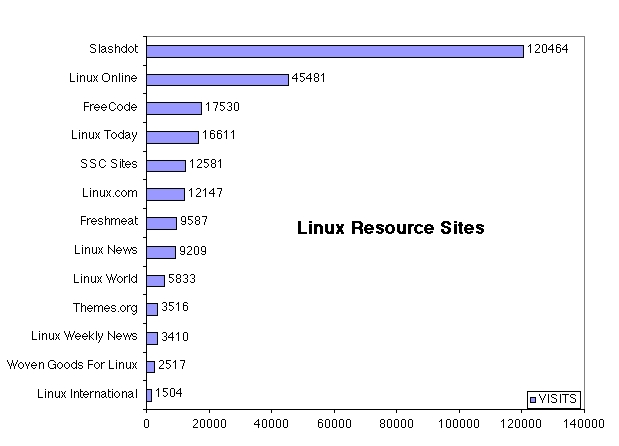
Visits for Linux Resource Sites
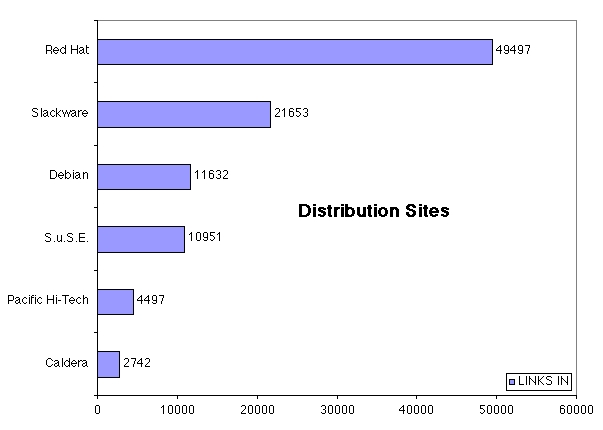
Links In for Linux Distribution Sites

Visits for Linux Distribution Sites
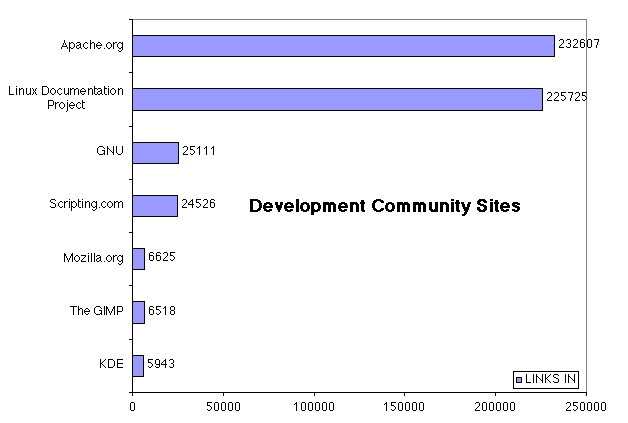
Links In for Development Community Sites
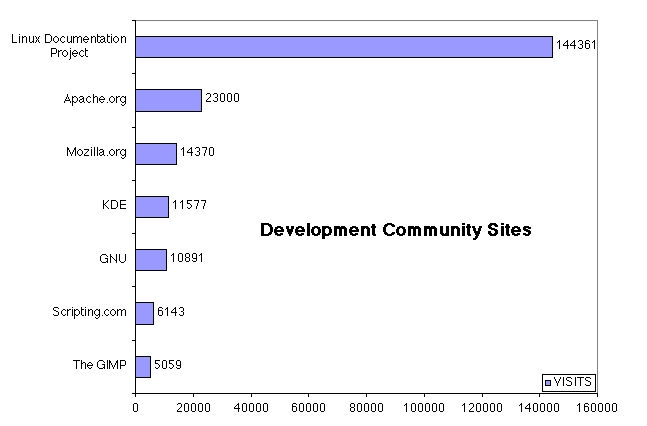
Visits for Development Community Sites
Number of Red Hat shares released for sale in its IPO: 6,000,000
Number of shares retained by Red Hat after the offering: 66,835,104
Percentage of shares in which the trading price determines 100% of Red Hat's full market value: 9%
Offering price for Red Hat's IPO shares: $14 US/share
Red Hat market capitalization (market cap) at its initial offering price (all shares times price): $935,000,000 US
Top Red Hat share price within its first week on the market: $90.69 US
Red Hat market cap at its top first-week share price: $6,061,275,581.76 US
Red Hat 1999 (fiscal year ends February) sales: $10.79 million US
Red Hat 1999 net income: -$90 thousand US
Estimated size of the Linux-based server market in 2003: $3.8 billion US
Estimated Linux server licenses in 1998: 750,000
Estimated non-Linux UNIX server licenses in 1998: < 750,000
Size of the Internet access market in 1999: $2 billion US
Estimated size of the Internet access market in 2002: $16 billion US
Number of web pages with links to the Linux Documentation Project: 225,725
Number of Alexa Internet client visits to the Linux Documentation Project over a six-month period: 144,361
Number of Alexa Internet client visits to Red Hat over the same six-month period: 102,806
Percentage of Linux clients in both numbers above: 0
Number of web pages in Alexa's Archive: 1.2 billion
New pages added each week to Alexa: 120 million
Length of time for the Web to double in size: 8-9 months
Current size of the Web: 7 terrabytes
Number of Red Hat shares owned by first person to achieve billionaire status as a result of Linux stock: Frank Batten Jr. (15 million)
Price per share of Red Hat stock that would make Marc Ewing and Robert Young billionaires: $110.11
Number of Penguin Peppermints eaten by LJ staffer David Penn, in a recent employee “contest”: 71
Number of grams of caffeine per mint: 16 milligrams
Number of work days missed by Mr. Penn as a result: 3
Number produced after converting Bill Gates III into ASCII code: 666
Number produced after converting Windows 95 into ASCII code: 666
Number produced after converting MS-DOS 6.31 into ASCII code: 666
Amount of money donated by ex-Microsoft employee Bruce McKinney, to help legalize marijuana in Washington state: $100,000 US
Number 1-9 are from forms filed with the SEC and public stock trading data.
Numbers 10-12 are from Dataquest, quoted in Computer Reseller News: http://www.techweb.com/se/directlink.cgi?CRN19990823S0058.
Numbers 13 and 14 are Dataquest and Merrill Lynch numbers quoted by Motorola Computer Systems.
Numbers 15-22 are from Alexa Internet.
Numbers 23-24 are from Linux Today.
Numbers 25-30 are from Jason Schumaker, LJ Staff.
Number 31 is from The Seattle Times.
As we go to press, it still isn't possible to make full sense out of the Red Hat IPO. But we can report that the folks at Prosthetic Monkey Consulting (http://www.prosthetic-monkey.com/) have used some expert Python to wring maximum irony out of Red Hat's instant billions, through a web instrument called the Red Hat Wealth Monitor (http://prosthetic-monkey.com/RHWM/).
“If you use this information to flame Red Hat, then you're misusing it,” writes Kendall G. Clark, the author of the site. Bettew to lightly roast the company, which the RHWM site does rather well. To wit:
Last updated on Wed, Sept. 15 1999 12:10:00. Updated every 15 minutes during NASDAQ trading. Trading at $96.84375 US:
Shareholder | Number of Shares | Present Value |
Shares Set-Aside for the Community | 800,000 | $77,475,000 US |
Maximum Set Aside Shares Per Developer | 400 | $38,737 US |
Bob Young | 9,081,826 | $879,518,086 US |
Marc Ewing | 9,088,476 | $880,162,097 US |
Frank Batten, Jr. | 15,005,888 | $1,453,226,466 US |
William Kaiser | 8,723,866 | $844,851,897 US |
Greylock IX Limited Partnership | 8,723,866 | $844,851,897 US |
Benchmark Capital | 5,815,910 | $563,234,534 US |
Intel | 3,005,058 | $291,021,085 US |
Matthew Szulik | 2,736,248 | $264,988,517 US |
Eric Hahn | 171,522 | $16,610,833 US |
Not bad for free software, huh?
Credit where due. “We've obviously stolen Phil Greenspun's idea for the Bill Gates Wealth Clock (http://www.webho.com/WealthClock/) and applied it to Red Hat,” Clark writes. “We share Phil's opinion about Bill Gates, but we're not anti-Red Hat. We just want to see them spreading some of their newfound wealth—which is not equal to their market capitalization—around to those who helped them acquire it; particularly in the form of R & D funds to the Community.”
We might add that on this same day (August 23rd), the Bill Gates Wealth Clock put the man's worth at $97.6121 billion US. That sum, however, was recently reduced by a chunk of change given to the Bill and Melinda Gates Foundation, making it, at $17.1 billion US, the largest charitable foundation in the United States.
So just how much did Mr. Bill give? Try $6 billion US. Or, by today's reckoning, just a few hundred million more than one Red Hat.
—Doc Searls
Doc Searls with Don Harbison, Marketing Manager, Notes/Domino Product Marketing, at Linux World Expo in August
Doc Searls: Why Linux now?
Don Harbison: Customer demand. When our president and CEO Jeff Papas announced at our Lotusphere event in January that we were adding Linux as the newest platform to the Domino stable of platforms, he got a standing ovation from 10,000 business partners and customers in this Disney World ballroom. It was huge. If you go to our site, you'll find that now is the first time we've made code publicly available.
Doc Searls: What's the difference for you, now that you're overlapping with the open-source world?
Don Harbison: In the open-source world, the technical community has the ability to influence the direction of the OS. So the tool kit is not hostaged by one entity. This also gives us a new model for rapid development of innovation. It's exciting!
On Bill Gates' tombstone: “This man has performed an illegal operation and has been shut down.”--BBC Radio 4
Start-ups are all in the same business—selling promises to venture capitalists. And what a business it is. In the second quarter of this year, VCs spent $2.13 billion dollars US on 227 start-ups in the Bay Area alone. That's nearly double the money spent in the same period one year earlier. Most of the recipients were in the “Internet space”, and at least two were Linux-related. One was VA Linux Systems, which received $25 million US. The other was Google, which received another $25 million US. (Source: San Jose Mercury News, Wednesday, August 11, 1999.)
If the amount of ink being spilled on a subject is a good harbinger of investments to come, look for Linux to be a prime attractor of VC money very soon. Right now, the only thing holding the VCs back is the same question that kept them from investing in those Internet companies a few years back: “If it's free and nobody owns it, how can you make money at it?”
We're sure you can think of an answer.
—Doc Searls

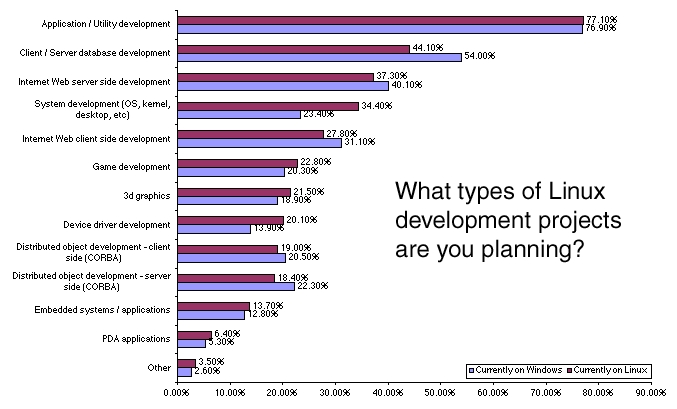
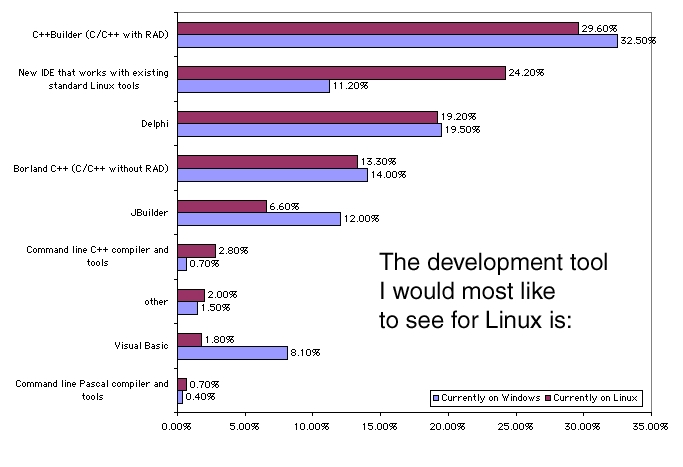
For most of this past July, the Borland Developer Solutions Group at Inprise ran a Web-based survey on Linux development, which they promoted from links at Linux Journal, Slashdot, Linux Today, SuSE and Borland.com. It was the largest survey of its type in the company's history, generating over 24,000 unique survey submissions. There are pages and pages of results, which you can read at http://www.borland.com/linux/. But none make side-by-side comparisons of responses from programmers currently using Linux or Windows as their primary development platform. The results are pretty close (hey, they both want to work on Linux). One take-away is a shared appetite for Rapid Application Development (RAD), Integrated Development Environments (IDEs) such as Borland's own Delphi, and—especially important to the Linux natives—IDEs that work with existing standard Linux tools.
—Doc Searls
EVENTS
WebNet99, World Conference on the WWW and Internet, http://www.aace.org/conf/webnet/advprog.htm, October 24-30, 1999, Honolulu, Hawaii
USENIX LISA, the Systems Administration Conference, http://www.usenix.org/events/lisa99, November 7-12, 1999, Seattle, WA
COMDEX Fall/Linux Business Expo, http://www.comdex.com/comdex/owa/event_home?v_event_id=289, http://www.zdevents.com/linuxbizexpo/, Nov. 15-19, 1999, Las Vegas, NV
SANS 1999 Workshop on Securing Linux, http://www.sans.org/, Dec. 15-16, 1999, San Francisco, CA. The SANS Institute is a cooperative education and research organization.
“Well, [the IPO] certainly looks like a success! [Red Hat] raised a good bit of capital, which is going to help us scale our business, so from that standpoint, sure.”
“We offered approximately 5,000 open-source developers with an opportunity to be involved. Of that, 1,300 people expressed an interest in being involved, and of those, basically 1,150 of them were able to become Red Hat shareholders.”
—Donnie Barnes, Director of Technical Projects for Red Hat, to Marjorie Richardson, September 7, discussing Red Hat's IPO. (Complete interview can be found at http://www.linuxjournal.com/articles/conversations/004.html.)
The man on our September cover is Terry Burkhardt, co-owner of Burk's Creole Cafe in the Ballard area of Seattle, Washington. Right around the corner from SSC's building, Burk's Cafe is a favorite place for LJ employees to dine. We thank Burk, a great cook and a good model, for allowing us to photograph him.
We had several entries with the correct answer and chose one at random. And the winner of the Palm Pilot is Grant Ranlett of Seattle, Washington. No surprise—he lives in Ballard.
It is entirely possible that someone, somewhere might have wondered how soon the “Linux: For IQs above 2000” T-shirts would show up. While I still think this has a nice ring to it, Linux has become easier and easier, while the user base has gotten larger and larger. One could know literally nothing about Linux, buy a machine from VA, Penguin, ASl, Linux Laptops, NexTrend, Pogo, Telenet, DCG, HiTech or whomever, and have it up and running in a matter of minutes. However, if someone accidentally clicked the little “terminal” icon (or, by some slip of the fingers, hit ctrl-alt-f1), how would he know what to do?
Cyber Station's EX Linux has the answer. This company is producing reference cards, mousepads and even software exclusively for educating Linux users. The mousepad, for example, houses dozens of key Linux commands for so many important things that practically everything is covered. EZ Linux's software is an electronic reference card, quite expanded from the mousepad, and full of all kinds of things that will help you do anything you want on Linux.
If you're past the point of needing a reference card to help you mount and repair file systems, configure X and set up your network, but you can't yet coordinate yourself well enough to buy a Linux CD or do an ftp install, fezbox.com has the answer.
fezbox.com is an automated Red Hat installer on the Web. It's just like installing from a CD-ROM, only the interface sits on the Net and you get your files from an NFS server. It's still beta, and you have to specify an NFS server, but there's probably a future in web-based software installation. Maybe other distributions would like to be represented on-line in this way.
Linux has been getting easier ever since its inception, and now that the user base has expanded, it seems there is a demand to make things even less difficult. Not so long ago, we saw the birth of RPM, KDE, GNOME, easy auto-probing installers and numerous XF86 configuration utilities. Today, even kernel recompilation has an easy-to-use graphical interface. Really, what's next?
—Jason Kroll
Artificial intelligence is one of my favorite topics in computers—at the very least, it's a science-fiction fantasy which inspires the imagination more than kernel development. A particularly exciting subset of AI is robotics, which, when coupled with some creative mishaps, leads to futuristic happenings as seen in countless stories, films, computer games and toys. Computer people often know the movies (maybe line for line), and probably remember the computer games (such as Andrew Braybrook's immortal Paradroid). Maybe we even had toy robots as children, though disappointingly, they didn't go crazy and take over the house/neighborhood/school/planet nearly as often as we might have liked.
Hacking, <\#224> la Hollywood, is another topic we've seen treated in books, movies and computer games. The mystique of dark hackers, clad in black, hiding in basements while performing nefarious deeds and drinking Jolt (although I have it on good authority that real hackers drink fruit juice) probably draws many people in (but what to do once we've dressed ourselves in black and gone to the basement with soda pop is quite another matter). If we can't start a global thermonuclear war (just try playing “wargames”), at least we can write a virus. Failing that, we'll have to play computer games.
Fortunately for the Linux-using, aspiring ne'er-do-well, there are a number of games available which allow us to do dark and mysterious things like program robots to blow each other up and code viruses to battle for RAM domination.
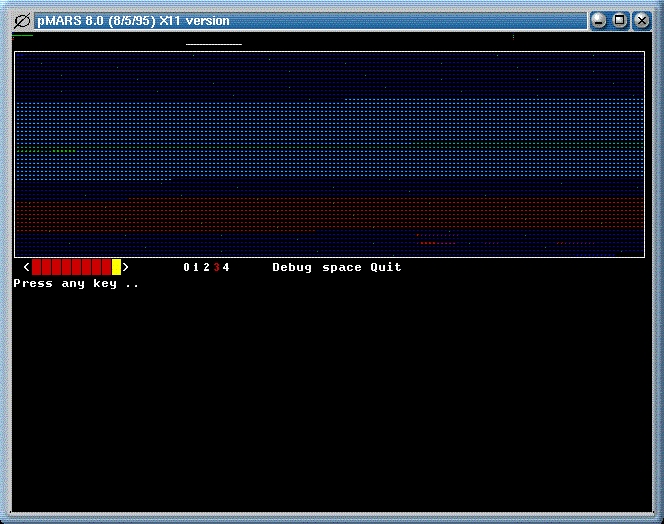
Virus enthusiasts might enjoy this game, first developed by the well-known computer scientist and author A.K. Dewdney in the early 1980s as discussed in Scientific American. In Core War (or Core Wars, as you like), two or more assembly code programs battle against each other in memory with the purpose of killing off all the enemies' processes by forcing them to execute a certain command. The assembly code is called Redcode, which is rather simple yet wholly adequate, and the virtual computer which runs the cores is called MARS (Memory Array Redcode Simulator). Memory arrays can range from tiny to enormous, and several cores can battle at a given time.
Like many pursuits, learning to play is simple, while strategies quickly become clever and complex. I spent a great part of my thirteenth year of life on this game, carrying a calculator with me to work out algorithms, so be warned—it can become an obsession. Also, it's good for young people, an easy way to teach assembly code to kids (well, you can't let them grow up without knowing asm, can you?).
The standards of Redcode have changed significantly since the 1980s (the initial version ultimately became rather exhausted) and now allow for much more complex programs, although the basic strategies remain the same. There are on-line tournaments running all the time, so you can try your cores against the world's best. A while ago, a friend found some of our old cores on a disk (which should tell you how old they are) and I tried them against the net-warriors—our cores got terminated, so it appears the standards have improved. Assembly-code devotees should do very well at this game.
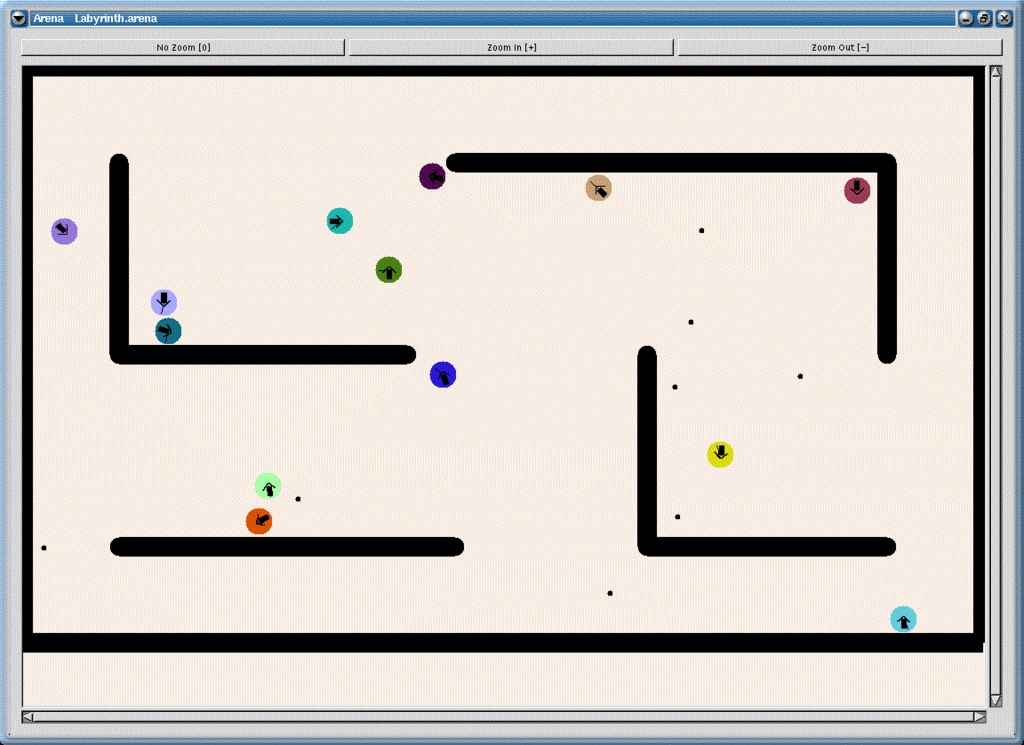
If robots inspire your fancy more than viruses, RealTimeBattle by Erik Ouchterlony and Ragnar Ouchterlony may be more to your liking. Essentially, you program a robot to battle other robots in real time. One thing that distinguishes it from many programming games is that you can use any language you like to program your robots, since they communicate to the server through STDIN and STDOUT. The use of real languages allows for more legitimate intelligence in the machinery.
Robots are physically identical and have energy, scanners, cannons and movement devices. The world in which they operate has gravity, friction, air resistance, bouncing, skidding and the like. Combat arenas can be large and open or filled with walls, and can accommodate up to 120 simultaneous robots.
Though already entirely playable, this software is in a state of continual development. Already I can see many possibilities for this one, such as an on-line server, massive multi-level maze-like arenas and so on. Anyone who remembers games like Crobots on the Amiga or RobotBattle on the unmentionable OS will probably find this game quite an improvement.
There comes a time in everyone's life when a squadron of robots isn't enough. You want an army of robots, designed and programmed by you. Fine, with Automata Zero, you can have them—literally an army. And, you not only design and program the robots, you can program them to respond to real-time commands from your terminal, and you can change code on the fly. Automata Zero's graphics are much more advanced than those of Core Wars or RealTimeBattle and feature aesthetic landscapes with grass, water, trees and futuristic mechanical structures. The robots themselves look like Mechs. The development team says graphics are a low priority, but that's hard to believe when they look so nice. Zed is the name of the programming language, which doesn't feature dynamic memory allocation, floating-point operations, threads or pointers, but does have arrays, functions and scoped variables; it is a fairly simple mixture of C, BASIC and Matlab. Automata Zero is still under development and needs more developers. You can visit Automata Zero's home page at http://www.andrew.cmu.edu/~sand/ to learn how to contribute or just play the game. It's a little closer to your typical strategic conquest-of-the-world game than the others. Presumably, if you lose, the world will be overrun with enemy robots who will come to your basement and blow you up, along with whatever soda pop you may be harboring. Good luck! (May the bitstream be with you?)
—Jason Kroll
Stop the Presses: So why is Red Hat worth more than Laos?
Six months ago, Red Hat was a “free” software company that lost money on less than $11 million in sales in its last fiscal year. By late summer, it was worth upwards of $7 billion US. (Perspective: the gross domestic product of Laos is less than $6 billion US, according to the World Factbook.)
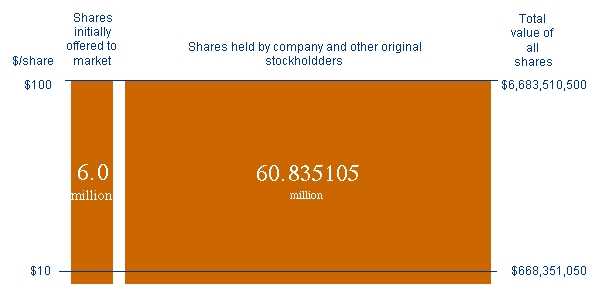
Don't waste your time wondering if Red Hat's valuation is “real” or deserved. We're talking about a real market here: the market for shares of a company. If that market says the smallest piece of Red Hat is worth exactly $100, well, it is. Multiply that by all 66,835,105 equal-sized pieces of Red Hat, and you've got a company that's worth exactly $6,683,510,400 US. That's the obvious part.
What's not so obvious is that only 6,000,000 of those shares were put on the market in Red Hat's IPO (initial public offering) in August. That's less than 10% of all the stock issues by the company. The rest were not released to the market. When there's a lot of demand and highly constrained supply, the price goes up. And with that price goes the value of all the company's shares. Neat, huh?
Now think about all the other Linux-related IPOs that should be coming up. We learned about Cobalt Networks and Andover.net in September, when there were also rumors about Caldera and VA Linux Systems. If these companies do even half as well as Red Hat, think of what that will do for the value of every Linux business.
Welcome to the New World!
—Doc Searls
NoSQL Tutorial by Giuseppe Paterno presents a good, long introduction to this open-source database for small- to medium-sized tables. NoSQL is a database system that was designed to get the most from a UNIX system, using commands that combine various standard tools.
Interfacing Relational Databases to the Web by Will Benton offers the instructions for building a database-backed web site using Apache, the PHP3 module and the PostgreSQL relational database. Information on installing the tools, setting up PostgreSQL, PHP3 basics, database connectivity and design considerations is included. A simple guest book program is used as an example.
The ACEDB Database System by Joe Nasal describes how to make easy work of local area network management using Linux and the object-oriented database, ACEDB. The article covers not only the ACEDB basics, but also gives information on Arpwatch, a program that collects network data, and AcePerl, the Perl interface to ACEDB.
How to Install and Configure Oracle by Greg Flannery gives a step-by-step walkthrough of the Oracle installation program, including all the nitty-gritty details. If you want to use Oracle on Linux, this article will show you the way.
Linux in Education: Buy One, Get One Free by R. Scott Gray, Luke Pargiter and Phil Pfeiffer tells us how the Computer Science Department at East Tennessee State University configured Linux as a dual-purpose user environment. The two needs were general classroom use and experimental laboratory use. This article explains how they set up the network to allow the students to experiment with the system source code without interfering with others.
Mastering Linux is reviewed by Bob van der Poel. This very large book was written by Arman Danesh and published by SYBEX Inc. Read the review to find out what it covers and if it is a book you need.
Linux in the Tropics by Rodrigo Bernardo Pimentel gives us the scoop on Linux user groups in Brazil—what they are accomplishing and how they are growing in popularity. See the web page for the National Group they have set up at http://www.linuxsp.org.br/.
Linux Conviguration & Installation, Edition 4 by Bob van der Poel is a book review of the latest edition of this classic book. Do you need a new copy? Read the review to find out.
Amdahl Corporation (http://www.amdahl.com/) announced it will provide full enterprise-class support for the Linux operating system on the Intel architecture-based Fujitsu teamservers. This support includes factory installation of the Linux operating system on Fujitsu single and dual Pentium III processor model teamservers, and professional services for setup and customization of Linux and associated open-source products such as the Apache web server.
Rogue Wave Software (http://www.roguewave.com/), a provider of software for creating enterprise systems with object-oriented component technology, announced support of the Linux platform. The company will start by shipping versions of NobleNet RPC, Tools.h++, DBTools.h++, Standard C++ Library and Money.h++.
Debian (http://www.debian.org/) has, as the result of a GIMP Logo contest (http://contest.gimp.org/), chosen a new logo. The logo was selected by a vote of the Debian developers. The winning entry was submitted by Raul M. Silva of onShore, Inc. and can be seen on the main Debian web pages. Licenses and conditions for use can be found at http://www.debian.org/logos/.
Hummingbird Communications Ltd. (http://www.hummingbird.com/), an enterprise software company, announced it has entered into a co-marketing and strategic development alliance with Caldera Systems, Inc. (http://www.caldera.com/), a provider of Linux-based business solutions. The new relationship will give Caldera's Linux users access to all of Hummingbird's desktop client connectivity products including Exceed, HostExplorer, NFS Maestro Server, NFS Maestro Client, NFS Maestro Gateway and NFS Maestro Solo.
Terra Soft Solutions (http://www.blacklablinux.com/) announced the formation of a reseller relationship with MacMall (http://www.macmall.com/) for the purpose of selling Yellow Dog Linux software (http://www.yellowdog.com/). The MacMall catalog has a circulation of up to two million, reaching end users, small to medium businesses, government and education markets.
Deja.com is the new name for DejaNews. This site is a consumer information exchange, providing consumers with the opportunity to consult the opinions and experiences of other consumers regarding specific products and services. Deja.com rebuilt their site using TowerJ from Tower Technology (http://www.towerj.com/). According to independent industry benchmarks, TowerJ on Linux/Intel is the performance-leading Java deployment platform (see http://www.volano.com/report.html).
Network Concierge (http://www.nc4u.com/) and Motorola Computer Group (http://www.mcg.mot.com/) announced a partnership to deliver networking solutions. Powered by Network Concierge software, the SLX series offers Motorola OEM customers reliability and service. The SLX network appliances require no operating system, networking or server expertise and can be deployed in less than 15 minutes.
Linux System Solution Ltd (LSSL) and INFOMATEC-IGEL Asia Ltd have formally announced their cooperation in the Internet device, Thin Client and Networking arena. IGEL Asia LTD (http://www.igelasia.com/) will endeavor to market and educate customers toward a complete Linux-based Thin Client/Server solution based on TurboLinux's products complementing IGEL's Firmware. LSSL will help support and develop application solutions and services in the use of Thin Clients for corporate, commercial and educational use. LSSL and IGEL will cooperate in the localization and development of Chinese applications and solutions.
Linuxcare, Inc. (http://www.linuxcare.com/), a provider of technical support, consulting, education and product certification for all distributions of Linux, announced it has reached an agreement with IBM to offer support services and training for the company's RS/6000 servers. In addition, Linuxcare Labs, the product certification arm of Linuxcare, entered into an agreement with Macmillan Computer Publishing to provide technical editing and certification services. Linuxcare also announced it had reached agreement with Sun Microsystems, Inc. (http://www.sun.com/) to provide a range of enterprise-class services for Sun's recently acquired StarOffice productivity suite on Linux. Under the agreement, Linuxcare will provide a comprehensive suite of enterprise services for StarOffice on Linux. These will include end-user and developer technical support, custom development, enterprise integration, migration and rollout, and customized training.
sourceXchange, the open-source development marketplace, went live on August 10 (http://www.sourceXchange.com/). At that time, more than 1500 developers had already registered with sourceXchange. Seven RFPs were presented from founding sponsor Hewlett-Packard. sourceXchange provides a dynamic forum where sponsors who need open-source programmers can contract with qualified developers for specific development projects. Developers can also submit proposals to the sourceXchange Wish List, soliciting the talents of their peers in the Open Source community for projects that contribute to the common good.
The White Camel Awards were presented to three leading activists in the Perl community at O'Reilly's Perl Conference 3.0 in Monterey, CA on August 23. Tom Christiansen, Kevin Lenzo and Adam Turoff were recognized for their extraordinary contributions to Perl Advocacy, the Perl Community and Perl User Groups, respectively. The White Camel Awards were created to honor individuals who devote remarkable creativity, energy and time to the non-technical work that supports Perl's user community. The awards are sponsored by Perl Mongers, http://www.pm.org/, a not-for-profit organization whose mission, along with O'Reilly and sourceXchange, is to establish Perl user groups.
Factoid: If you care to send Linus a gift, why not send him some Guiness, his favorite beer, which he only drinks from a can! Send to Linux Journal, c/o Linus Torvalds :)