SuSE Linux 6.1

Manufacturer: SuSE GmbH
E-mail: info@suse.com
URL: www.suse.com
Price: $49.95 US
Reviewer: Jason Kroll
Hailing from Nuremberg, Germany, SuSE Linux 6.1 is SuSE's latest release (SuSE Linux 6.2 will be available by the time you read this) featuring the new 2.2 kernel, custom SuSE software, commercial packages (Netscape, StarOffice with personal license, Applixware Office, Corel WordPerfect 8.0 and many others), five CD-ROMs' (and a disk's) worth of software, a 440-page manual and a green chameleon sticker. This is a serious, high-performance distribution which is more complete than practically any single distribution, and at the same time is clean and fast due to effective configuration and intelligent design. Much attention has been paid to the details in this release (as in past releases), and the production gains a lot from SuSE custom software and configuration. Although SuSE is the top Linux distribution in Europe, and the 1998 Linux Journal Readers' Choice for “Best Distribution”, it has not been particularly successful in the U.S. The reason for this is not clear (perhaps someone in marketing knows), but if word gets out about this distribution, the situation is likely to change.
Yet another Setup Tool is SuSE's software for installation, de-installation and maintenance. Once a system is installed, YaST stays around to help with many configuration tasks, and updates system files accordingly. (For example, if you want to change networking configuration, YaST asks what changes you want and automatically updates all files.) YaST is also the tool that installs the whole system in the first place.
Installation of SuSE is quite easy and extremely flexible, although not entirely automated—SuSE begins with a default (base) package and allows you to modify package selection to suit your needs. You can also load a few pre-configured selections (with the usual server, workstation, and complete installation options), though one ought to customize even these configurations. It is easiest just to have three or four pre-configured installations (as with Caldera), but SuSE probably has a number of reasons for taking the custom installation approach. For one thing, SuSE is more complete than most other distributions (five CD-ROMs is a lot of software, and the new 6.2 apparently has six) and customization makes more sense when dealing with so much software. Also, SuSE does not aim to be “Linux for Idiots” and would lose much of its flexibility were it dumbed down for people who can't decide what software they want.
One benefit of SuSE's devotion to custom installation is that SuSE has developed a system which incorporates many packages into the menuing system of KDE. In addition, YaST knows what dependencies the packages (numbering about 1000 for 6.1 and 1300 for the brand-new 6.2) have, and can automatically install these dependencies. YaST keeps track of redundancies to warn a user against installing software packages that are too similar or would be unused. Also, YaST has good descriptions of the software packages, so you always know what you're going to get (well, except for the occasional !! HIER FEHLT DAS LABEL !!). In these areas, SuSE is unique. For example, Red Hat offers far fewer packages and mostly does not incorporate selected programs into menuing systems. Caldera also offers fewer packages, and while it effectively incorporates programs into KDE, it offers four installation packages and no custom option. However, Caldera's installation program, Lizard, is probably the easiest.
Installation can take place in over a dozen languages (English is second on this list). Before installation begins, you have to load any special drivers you might need. Secretly, I wish SuSE would autoprobe, and in fact there is an automatic detection for necessary modules which actually works, but you have to find it first. Once the modules are taken care of, proper installation can begin.
Ultimately, installation is straightforward and easy to navigate, but, like Red Hat, often requires you to know what hardware you have. I would prefer more probing and perhaps more complete default installations (I had to select so many packages, it took a while), but there were no technical hang-ups, freezes or crashes. Manual configuration of networking was just like most distributions, and the system was booted and on-line fairly quickly.
SuSE Advanced X Configuration Tool (SaX) is a graphical interface for configuring X (and we all know how much of a pain that can be). You can navigate its menus with the mouse or the keyboard, and all you have to do is choose your mouse, graphics card and monitor from a few lists and an XF86Config file is created. I noticed that the lists were not as long as I have encountered elsewhere, and some older hardware was missing. SaX configures your keyboard and mouse as well and offers many expert configuration options.
Once you have finished with basic configuration, SaX allows you to test the video modes and make real-time adjustments, rather like xvidtune but graphical and easier to use. You get to see the standard X test pattern for a little while, and that's nice, but I would still prefer keeping it up all the time to get a better idea of how well the screen is configured. It's very simple to use, and if it doesn't work, you can always try the xf86setup or xf86config. Even after your system configured, you can use SaX to update your configuration in case you would like to use higher resolution, a new video card or a new monitor. This is unlike other installers which configure once during installation and require the use of external software or manual modifications afterwards. Once the XF86Config file is created, it's time to try out X.
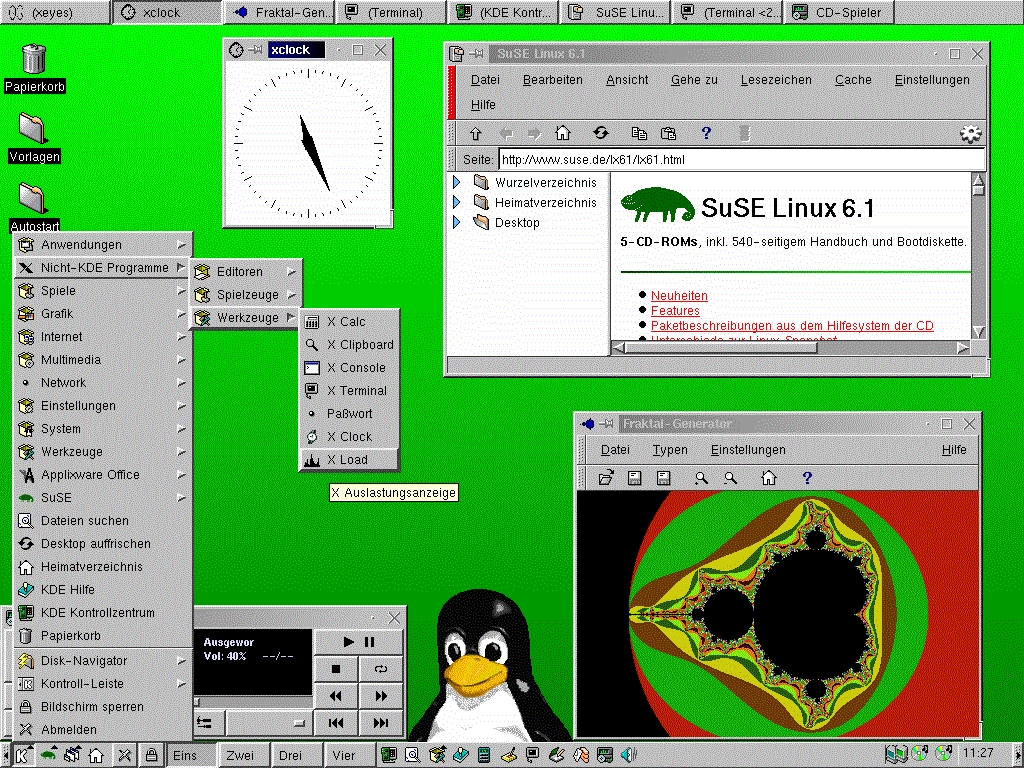
The default window manager on SuSE Linux 6.1 is KDE, which has, in addition to its standard menus and KDE software, a SuSE menu housing entries for many of the various packages installed by YaST. Also configured in the menuing system are the various Applix programs, though at the moment they insist the license is out of date. (I hope this is corrected in 6.2.) SuSE's custom menus have more to offer than the custom menus of most other distributions, even though some menu options don't work and many installed software packages are not incorporated into the menuing system. Still, it is a clever idea to have YaST configuring KDE's menus during installation in such a way as to have optional packages included. If SuSE had more time to devote to going over the packages and making sure they all were properly collected into the menu tree, the system would be really neat. (The next step would be automatic real-time updating of the menu trees to correspond with the software on the system...)
On the whole, SuSE's window manager works just fine. You might have to know enough during installation to select the right XF86 server, however. SuSE's menuing system looks quite neat, and for the most part, files seem to be in the right places. No menu selections I found led to core dumps or worse, and although many of the packages I installed did not get entered into the menus (and some selections didn't do anything), you can do a lot with KDE as installed on SuSE. If you like GUIs (I, for one, vastly prefer consoles), KDE is very functional.
It is difficult to say anything bad about a Linux distribution; after all, they're all based on Linux and GNU software. Nevertheless, concerns sometimes arise over the decisions made about which programs and versions are used, and sometimes things just don't work. Where installation is concerned, auto-installers are nice when they work, but probing often crashes the system. On the other side, many people have no idea what hardware is inside their system and what IRQ and DMA values they ought to enter. Preconfigured package collections are convenient but lose flexibility, whereas manual selection of packages takes forever. Experimental software usually has enhanced functionality over stable software but often fails unexpectedly, as many of you know who simply must run the latest kernel/library/compiler, even when parts of it aren't working.
The choices to be made by a distributor can be difficult, and the practice of targeting a specific audience guides distributors in their decisions. Although I've recently been recommending SuSE when asked by newbies which distribution to install, I am aware it's not for computer illiterates. At the same time, it is easy to install and use and is rather well-endowed. It appears to be an ideal distribution for the middle 68% of Linux users, often choosing ease-of-use and stability over the cutting edge, while at the same time favoring maximum functionality and flexibility against oversimplification. The installation and configuration utilities (YaST and SaX) are examples of the latter, while the choice between gcc and egcs is an example of the former and latter, respectively.
I tried compiling a number of “problem” packages, sources that have always “bugged out” when I tried to compile them in the past, and every single time, SuSE compiled without error. Obviously, SuSE must have functional libraries in the right locations. (This was a problem with certain distributions years ago.) The kernel has never been one of those problem packages, and recompilation/installation went very smoothly. SuSE has a KDE menu item which starts up the kernel recompilation—another clue that SuSE is geared towards non-neophytes. Upon reboot, everything was in the right place and all the modules worked. This probably has more to do with kernel developers than with SuSE, but someone truly clever could have contrived a way to stop a kernel and its modules from working. In any event, kernel recompilation worked even better on SuSE than on Red Hat (which had some complications involving modules) and Caldera (which isn't targeted at kernel hackers anyway), although Slackware has never presented me with any problems.
SuSE Linux 6.1 has a lot of small things going for it, such as a different color scheme for the ls command, syslog messages logged to alt-F10, a first console which does not clear the screen on logout/login (so you can still read system messages from startup, etc.) and various other details. Unlike Red Hat, SuSE does not stick its logo all over the desktop (or on every single window, as many of you may remember). On the whole, SuSE has a cool, modern feeling to it—it isn't obnoxious. SuSE has not bent over backwards to make system configuration easy for the command-line impaired, so the system itself is not overly complicated or obtuse, yet it still works. And if it doesn't work, there's always support.
The general failing of most distributors is poor support. However, Linux firms have recently been putting increased effort into providing better support, and third parties such as Linuxcare are raising standards in the industry. Support from SuSE comes not only as “tree-ware”, but as 60 days of e-mail/phone support. If, after 60 days, you can't get your system installed, buy a Mac or try one of the new pre-installed systems. I have not yet heard a complaint about SuSE support, and I expect that SuSE must be competent in this department—SuSE claims 35,000 business customers (including Mercedes-Benz), and businesses have a low tolerance for bad technical assistance.
The best support in my opinion is an excellent manual, and SuSE has done a superb job here. Just like SuSE's custom software (and the distribution itself), the manual is a product of thoughtfulness, attention to detail and cohesive design. The book is 440 pages, but quite dense—nothing is watered down, and even simplifications have footnotes explaining what the reality is. An example of this simplification and explanation approach is that the installation guide has a section for “quick install”, as well as an in-depth section on the whole installation procedure and its options. The book is also not condescending, and I find that refreshing.
The manual is divided into eight parts: Introduction, Install SuSE Linux, Network Configuration, The X Window System, Linux and Hardware, The Kernel and Its Parameters, SuSE Linux: Update and Specialties, and Security and Hints. The last of these chapters actually contains an introduction to Linux as well as the immortal line, “natural disasters such as lightning strikes, floods and earthquakes can damage your computer”. There is a bit of humor and some math in the book, and a noticeably “green” feel: the computer system in the book is named “earth”, and the manual says of the free books included in PostScript format, “If you don't care about trees, you can print them as well.”
SuSE Linux is a complete Linux distribution aimed at non-neophytes or perhaps neophytes who are good with computers. Although the price might suggest it is worth less than a copy of Windows (or some very expensive Linux distribution), it is quite difficult to do better for the money. Like any Linux distribution, there are menu options which don't work and software that's missing from the menu selections. The default package collections are good enough, but it's worth the time to step through every package and decide whether or not you want it. If you're going to get a commercial Linux distribution, you'll do well to consider SuSE—at the very least, you get several CD-ROMs' worth of software, good news if your CD-ROM drive is faster than your Internet connection. When the new SuSE Linux 6.2 arrives (with the 2.2.10 kernel and a whole bunch of new software), it will definitely be one to check out.