
Stop the Presses
Having just returned from back-to-back trade shows, COMDEX Spring and ISPCON, I can confirm what you already know—the IT community has not only heard of Linux, but is also embracing it. A major reason for this is the growing prominence of Linux at trade shows. In Chicago, there were about 15 Linux-related exhibitors, a respectable number for a non-Linux-specific show. Most ironic was the location of VA Research (now VA Linux Systems) directly across from Linux Hardware Solutions. The following week, the former acquired the latter for an undisclosed price. Any cautions given at the show by Kit Cosper, President of LHS, to put off purchasing decisions were well-heeded.

Crowd at Linux Pavilion; Mark Bolzern is on the left
Linux Journal and Linux International sponsored an impressive pavilion and theater, with informative presentations from companies such as Caldera, Cygnus and the always entertaining “BRU Guys”. Also presenting was Jon “maddog” Hall, who wasted no time in challenging the FUD (fear, uncertainty and doubt) that was leaching from the Microsoft area of the show. All of these talks were broadcast live on “The Linux Show”, an Internet-based radio show about Linux (http://www.ttalk.com/). Linus Torvalds drew an enthusiastic crowd of at least 300 while being interviewed by Jeff Gerhardt, host of “The Linux Show”. Kudos to Jeff for asking Linus to autograph his Linux Journal hat.

Linus with Sonny Saslaw of Ziff Davis and your intrepid reporter
Obviously afraid of offending their largest exhibitor, the folks at COMDEX were on a non-committal tightrope walk that proved discouraging, and at times, offensive. As Doc Searls mentions in his Open Sources review in this issue, the drawing power of Linus Torvalds' keynote speech was obviously underestimated. A standing-room-only crowd of 1200 included not only those who wanted to learn more about Linux, but an impressive number of media people who were there to cover the event as well. The concept of the Gates keynote being pitted against the Torvalds keynote was more a blatant effort on the part of COMDEX to draw attention to the show than actual rivalry, although the idea of showing up in a penguin costume during the Gates keynote crossed my mind. With any luck, the lessons COMDEX learned from this show will improve their treatment of the Linux crowd this fall in Las Vegas.

Compile the kernel or the Penguin gets it!

Norman Jacobowitz shows Linus and maddog his WANpipe technique
ISPCON was just as exciting as COMDEX, but with a more Linux-friendly and knowledgeable crowd. Linux Journal sponsored a “Linux Luncheon”, with Phil Hughes challenging the crowd of 500 to answer Linux-related trivia questions. Phil also moderated a discussion panel with representatives from VA Linux Systems, Cobalt and Rebel.com's (name subject to change) Netwinder division. It was good to see hardware vendors getting along so nicely.

Linus with his beautiful family—Tove, Patricia and Daniela.

Birthday cake!
The untold story behind all these trade shows is the folks lucky enough to work them. Sure, they are grueling and expensive, but at the same time, they give the feeling that you are a part of something larger than yourself, an ambassador or spokesperson to the uninitiated, unwashed masses. The Linux “trade show circuit” has engendered family of its own, and always, for some unknown reason, results in daily hangovers, not entirely caused by “virtual” beer. What do we talk about after discussing Linux all day? Linux, of course, and the nice part is that we are getting paid for it—truly a dream job. Chicago also allowed me the opportunity to have dinner with Linus Torvalds not once, but three nights in a row. I will always remember, although a bit hazily, sitting in Trader Vic's with Linus and maddog, drinking some obnoxious concoction from a two-foot-long straw. What I can draw from this experience is: don't challenge maddog to a drinking contest—he will always win; $8 drinks should be bought only on a company expense account; and the earliest we can expect to hear something from Transmeta is this fall.
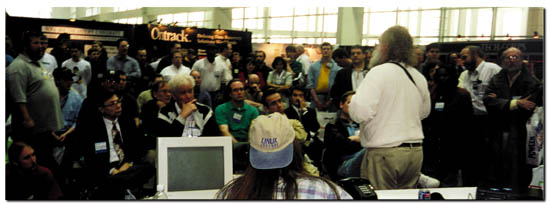
maddog speaks at the Linux Journal-Linux International Presentation Theater

Dean Taylor demonstrates the Caldera 2.2 install in the Linux Journal-Linux International Presentation Theater
My fear for the future is that the growth of so many Linux-related companies will result in less communication among the people who drive each of them. The presidents and CEOs of these companies are being replaced by self-proclaimed “booth bimbos”. There is something to be said for an evening I spent at a restaurant in Chicago. Joining me were folks from Red Hat, SuSE and Caldera, all of us sharing a pitcher of beer. Trade shows are, in a sense, the only chance we get to have a Linux “company” meeting. It is my hope that with the growth of these companies, the importance of the trade show in maintaining and promoting a feeling of community will not be lost.
Matthew Cunningham does marketing and trade shows for Linux Journal. He can be found in the LJ booth passing out Penguin peppermints, or contacted at matthew@ssc.com.
