
MP3 Linux Players
MP3 (Motion Picture Experts Group audio layer 3) is an audio file format capable of storing near CD-quality audio in relatively small files (as little as 1/10 the size of comparable WAV files). A four-minute audio track recorded at 44KHz requires about 4MB in MP3 format, while the same audio track recorded in WAV format can occupy over 40MB. MP3 has received a great deal of attention lately. According to searchterms.com, a site that ranks the most frequently used search terms, “mp3” is number one. That's right—it's even ahead of “sex”, which is number two.
The Recording Industry Association of America (RIAA) is concerned that MP3 will make it difficult to sell music on-line, as MP3 has no mechanism for preventing illegal copying. In December, RIAA announced its Secure Digital Music Initiative (SDMI) to encourage technology companies to create a new specification for on-line music. RIAA also sued Diamond Multimedia in October, attempting to prevent the sale of Diamond's RIO PMP300 portable MP3 player. Fortunately for Diamond and MP3 fans, RIAA lost the suit.
In February, Lycos and FAST launched a search site for MP3 files on the Internet. The site contains a database of over half a million links to MP3 files. While the site is a great resource for finding MP3 files, it immediately caused concern about illegal MP3 files. Search for one of your favorite artists, and you may find links to illegal MP3 files. In March, the International Federation of the Phonographic Industry (IFPI) began legal action against FAST for its role in the MP3 search site. IFPI members include BMG, EMI, Sony Music, Universal Music International and Warner Music. In a statement on their home page, IFPI Director of Operations Mike Edwards said:
The Lycos/FAST search engine should be promoting opportunities for the many start-up businesses that are pioneering legitimate electronic delivery of music over the Internet. Instead, however, this search engine is doing the opposite: it is providing a service where virtually no authorized files can be found. This is a threat to the companies who want to build a flourishing legal electronic marketplace.
IBM has introduced its Madison project to allow cable modem users to purchase music on-line, download it and save it onto CD-ROM (provided they have a CD-R or CD-RW drive). The CD can then be played on any CD player. IBM claims the technology will prevent users from making illegal copies. The project has the backing of IFPI.
Sony has also proposed another way to distribute copyright-protected music. This system includes MusicGate for recording and playback and OpenMG for use on computers. OpenMG would require hardware installed on the computer's serial port to prevent illegal copying.
Quite a few MP3 players are already available for Linux. The console-based mpg123 is popular. You can use it from either the command line or one of the many applications that use mpg123 as the MP3 decoder, and have a nice GUI for song playlist management. GQmpeg is an excellent MP3 player with a customizable GUI using “skins”. You can also try one of the many MP3-capable GUI-based applications that don't use mpg123 as the MP3 decoding engine, such as FreeAmp or X11Amp. Some of the MP3 players also support streaming MP3 (called Shoutcast), similar to Real Audio.
MP3 players are not particularly useful without some MP3 files. MP3.com has a wide variety available for download. Many users are creating their own MP3 files from their personal CDs. This is legal for personal use only. You cannot redistribute audio tracks you copy from one of your CDs. The process of copying the audio data from a CD is typically called “ripping”; applications that do the work are “CD rippers”. A good tool for this on Linux is cdparanoia, which will read from both SCSI and ATAPI CD-ROMs. The CD rippers typically save data in WAV format, which must then be converted to MP3 with another tool such as mp3encode or bladeenc. An increasing number of console and GUI tools are available to automate this process by looking up the track names on the Internet with CDDB and then using external rippers and encoders to do the work. You put the CD in your CD-ROM, select the tracks to encode and wait.
Some issues must be considered before converting all your CDs to MP3. The process can be quite time-consuming for both CD ripping and encoding. The reading of an audio CD is handled much differently than a data CD, and the process can take hours. This is especially true if the CD has scratches on it. Encoding the WAV files into MP3 can also take hours. This process is best done when you're not otherwise using your machine. In fact, many Windows-based encoders have options to power down your machine when finished. Once your MP3 files are ready, there is still one last issue to consider. Playing MP3 files can use up a good deal of your system's CPU cycles. It is typical for MP3 players to use 20% or more of your CPU cycles on a 200MHz Pentium. That's not a big deal if you're browsing the Web or using a word processor, but it certainly is if you're recompiling the kernel.
Diamond Multimedia was early to market with the Rio portable MP3 player. Weighing in at only 2.4 ounces and selling for around $200, Rio can hold 40 minutes of music and play for 12 hours on a single AA battery. Because the Rio has no moving parts, the player won't skip like a CD player when subjected to movement. The music is stored in 32MB of flash memory, and you can purchase an additional 16 or 32MB of flash memory. MP3 files are transferred from your computer via the parallel port at a rate of ten seconds per megabyte. The software provided with Rio is for use on Windows 95/98, but a few different Linux applications are under development which can be used to manage Rio's files (see Resources).

Figure 1. Installed Empeg Player
Empeg is at the cutting edge of MP3 technology with their car audio player. The unit uses a 220MHz Digital/Intel StrongARM processor with 8MB of memory and runs Linux 2.2. The player can handle all types of MP3 files and includes an FM radio (but no AM due to interference problems). Additionally, you can connect any standard CD player, tape deck or radio to the player as long as it has line-level outputs.
Like Diamond's Rio player, you manage all the files on your Empeg player from your computer. The Empeg player slides out of the docking bay in your car so you can connect it to your computer (or to your home stereo via RCA jacks). The standard interface will be a Windows 98 application that helps manage your audio tracks via the USB port. For those without USB (or Windows 98), a version will be available for Windows 95 and NT that uses RS-232 rather than USB. Linux tools will also be included and available as source code. You can expect a group of enthusiasts to help further develop and improve the Linux tools. The user interface is written in Python and should allow developers to change the UI.
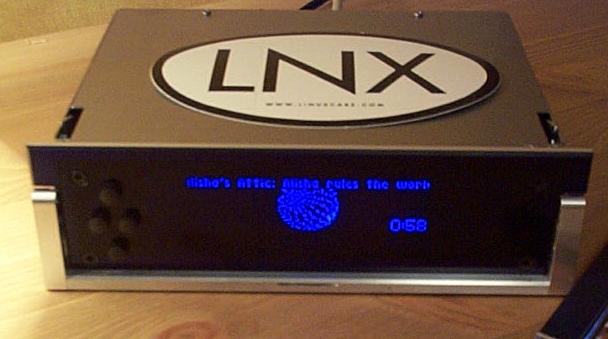
Figure 2. Empeg Player
The Empeg player is not something you can build at home. “It's a 100% custom hardware and software effort: there aren't any off-the-shelf parts in there (there simply isn't room),” said Empeg's Hugo Fiennes. Asked why Linux was chosen, Hugo replied,
We needed a powerful, flexible OS to support our applications: the Empeg does much more than just play tunes—it has an integrated database, and uses glibc threads and IPC (interprocess communication) quite heavily. As the Empeg is hugely overpowered for its current task, we wanted an OS that would allow hackers to add their own code to the system.
Pricing starts at $999US with a 2.1GB disk capacity that can store approximately 37 hours of music. A 28GB version will also be available. The unit should be shipping any time now, and will initially be available only directly from Empeg (http://www.empeg.com/). Distribution sales will be considered after satisfying their backlog of 6000 interested parties.
Much of the interest in MP3 is not a result of the specific file format, but in what it allows one to do. Why else would people be excited about something that produces lower-quality sound than CDs 15 years after CDs were introduced? MP3 returns some of the power back to the music enthusiasts, who can now listen to a custom selection of their favorite singles. With the help of a computer, MP3 allows people to create their own personal commercial-free radio station.
It can also be said that MP3 is forcing the recording industry into the on-line music business. The industry giants seem content with their current business model. With full-length CDs accounting for 74.8% of music sales according to RIAA's 1998 Consumer Profile, they're making a lot of money. The future of on-line music sales is not in selling CDs from an on-line music store. It will involve selling digital audio and delivering it over the Internet. Users will be able to buy only the music they want, not forced to pay $10 or $15 to get the one or two songs they like. Even if something other than MP3 takes us there, it will still be a good thing.
Craig Knudsen (cknudsen@radix.net) lives in Fairfax, VA and telecommutes full-time as a web engineer for ePresence, Inc. of Red Bank, NJ. Craig has been using Linux for both work and play for three years. When he's not working, he and his wife Kim relax with their two Yorkies, Buster and Baloo.

