Cost-Effective Services for the Office
Aerofil Technology had been using cc:Mail to support internal e-mail needs for about a year and a half when I joined the organization in 1995 as an Information Services Technician. The IS manager at that time had implemented cc:Mail along with a major upgrade of computers to Windows 3.11. Networking was installed to allow connections to a Novell server for file and print services as well as access to the corporate accounting and manufacturing software.
Around my first year, the computer inventory, user base and cc:Mail usage grew, requiring the purchase of additional licenses. In 1996, my boss left to do independent consulting and I was given the opportunity to run Information Services. A one-person department has its advantages; in particular, I could make all decisions regarding technology. It also has its disadvantages, such as limited funding for projects and necessities like software licenses.
During this time, our local phone company began providing Internet service and Aerofil signed up for the corporate option, including 20 e-mail accounts which were quickly issued to a privileged few. No grandiose plan was in place with the initial sign-up, but once a few employees had Internet e-mail, everyone wanted it. Also, more and more of our customers wanted to communicate in this way. Having the ISP maintain 70+ e-mail accounts would obviously be costly, and we would not have control over the accounts. The ability to change passwords was important. So, I asked for help from our ISP in obtaining a domain name and in hosting that domain for the company.
Because so many users required access to e-mail, I set up a Linux machine with diald and IP masquerading and named it “Gatekeeper”--an Intel P133 with 32MB of RAM. This machine was a vast improvement over the previous configuration in which certain individuals had their own modems, plus we had a modem server that didn't allow more than one person at a time to access it. With Gatekeeper running, everyone had equal access. Whoever accessed it first would initiate the dial-in, but once connected, everyone had instantaneous access. Typically, once I had my e-mail client running, the connection was up all day. This was not a problem for our ISP, since their heaviest usage occurred between 8 PM and 10 PM. We were on-line only between 7 AM and 5 PM.
With the Linux machine in place, I investigated setting up fetchmail so that we could handle all of our own e-mail accounts. At the same time, I also began looking at ways to gain more control of our web site maintenance. Our ISP required that any changes be e-mailed to them for implementation. They eventually set up a configuration to do this using Samba, but it was still troublesome due to name-mangling problems.
Once our ISP began offering DSL (Digital Subscriber Line) service, I decided to wait until DSL could be implemented before pursuing direct e-mail and web site account management. Our IS budget would not allow us to implement DSL as a solution until January 1998.
In the meantime, in order to enable TCP/IP on our network, I set up a second Linux machine, appropriately named IPkeeper, to act as the DHCP (Dynamic Host Configuration Protocol) server—an old Intel 486SX33 with 16MB of RAM. This allowed us to specifically assign IP addresses by hardware address or simply from a set range of addresses. I set this up on a separate Linux machine in order to simplify the Apache configuration on Gatekeeper and to segregate the Intranet from the Internet.
In January of 1998, I placed the order for the DSL connection and added an additional Ethernet card to Gatekeeper for the DSL equipment connection. By February, Aerofil had a 128K connection to the Internet. Testing showed the connection speed to be adequate for hosting our web page. I then notified the ISP to make the necessary changes to DNS to reflect our domain location at Gatekeeper. I moved all of our web pages down and set up all the e-mail accounts that had existed at our ISP, as well as adding additional accounts for the other users who required e-mail. At this time, the company drafted an Internet and E-mail Usage Policy to discourage inappropriate use of the service. In hopes of conserving bandwidth, Internet access was restricted to those users with a justified need. This was accomplished by modifying the IP masquerading rules on Gatekeeper to allow access to specified IP addresses.
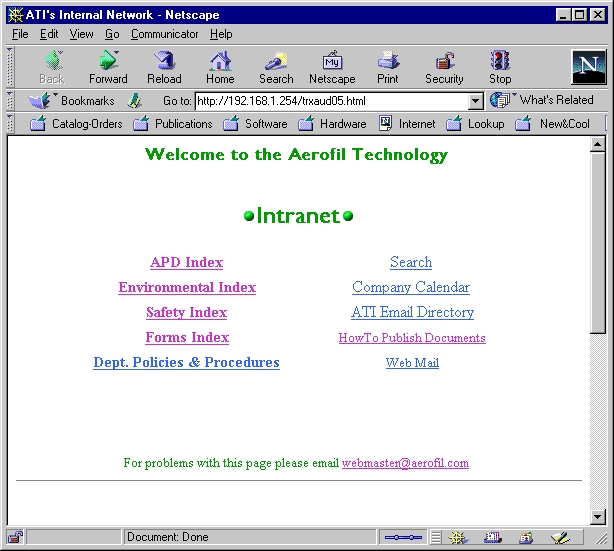
With IPkeeper on the network, even more opportunities were available to us. Ongoing discussions had been held to decide how to “computerize” corporate documents and make them accessible to every PC on the network. A variety of software solutions for Windows NT were looked into and found to be too expensive for our company. Instead, I used existing Internet technology and set up IPkeeper to host our Intranet, upgrading it to an Intel PII-233 with 32MB of RAM.
In June of 1998, the company hired a college student for the summer to assist in getting our existing documents on-line. Some of the documents were in a word-processor format, some were flowcharts done in Visio, and some existed only in paper form. Several methods were used to get this information onto the computer: scanning, converting to PDF format and coding in HTML. Basically, I set up various user areas to segregate the documents, such as Human Resources, Information Services, Aerofil Process Descriptions, Quality Control, Safety Process Descriptions, etc. Each area had security set up to ensure that only designated users could add or modify the information contained in it.
In order to add more functionality to the Intranet, I implemented the search utility HT://DIG on IPkeeper. It has proven to be one of the most useful features I have added. It allows our users to type in any keyword and instantly see a list of corresponding documents. I am also currently evaluating the Cyberscheduler application for calendar and scheduling services.
An LDAP (Lightweight Distributed Access Protocol) server is being implemented for internal use on Gatekeeper so that users who are using Netscape Communicator can get to a company e-mail directory and utilize company mailing lists more easily.
Samba has also been enabled on both Linux machines, and I am setting up home directories in order to lessen dependency on the aging Novell server.
The company has been investigating computer archive solutions for old report data and converting report files from the business accounting and manufacturing package to HTML so that the files can be indexed and viewed with a browser. The plan is to set up a system which will automatically process the report files, eliminating the need to print monthly or weekly reports as they will be easily accessible through the browser. Seth Golub's (seth@cs.wustl.edu) txt2html program is being used to convert the text report to an HTML file. The most likely solution for indexing will be to index only the report headers, which contain the necessary information for locating a particular report.
Kim Henderson has been involved in Information Systems for nine years in both financial and manufacturing businesses. She has been involved with her husband, Darrin, even longer and owes much to him for his love and support. Kim spends her free time renovating their 40-year-old home, coordinating activities for the East Missouri Linux Users Group and maintaining a basement computer network with her husband and their dog, Linus. She can be reached at kim@mo-biz.com.