
Betting on Darwin

Evolution is not a force but a process; not a cause but a law. It is not enough to do good; one must do it the right way. No man can climb out beyond the limitations of his own character. —John, Viscount Morley of Blackburn
Only two operating systems are growing in market share today. The one we all know is Microsoft Windows (both NT and 95). The one most of us don't know is Linux. After reading the mainstream press (or listening to politicians like Orrin Hatch or to professional haranguers like Ralph Nader and Gary Reback), it seems clear that Microsoft, that evil monopoly, is making Windows the requisite operating system for every computer-like device in the known universe.
But there is a constituency that won't let this happen. It's the growing community of hard-core technologists, an increasing number of whom now rely on Linux. A case could be made that the only technologists who aren't into Linux remain with another OS for practical or business reasons.
Today, Linux is the technologists' OS. It's a bad idea to bet against them. It's a good idea to bet with them. That's exactly what Netscape did when they released their source code to what everyone suddenly calls the Open Source community, but for years was the Free Software movement. Significantly, Linux is free. But more significantly, Linux's source code is open. Anybody can look at it, tweak it and share their tweaks with friends—which is exactly why Linux is so popular with techies. Quite literally, it's theirs. They made it.
“All the significant trends start with technologists,” Marc Andreessen says.
Lest we forget, the Internet was created by technologists, and its explosive growth is far more an expression of rampant hackery than of commercial activity, personal expression, massive archiving or whatever.
Consider this: over half of all the web pages on the Internet today are produced by free web software—mostly Apache—running on Linux operating systems. Windows NT is gaining, but not necessarily at Linux's expense. In fact, Linux is gaining too, mostly at the expense of commercial systems.
Even many commercial sites use Linux. According to a Commerce Department report released today, the volume of information being processed over the Web is doubling every sixty days. The mind boggles.
If even half of that growth is happening on Linux, the population of supportive techies is at critical mass or better. Netscape knows this, which is why they're betting the farm on Linux, just like they bet the farm on the Net four years earlier, when they changed the whole software business forever by freely releasing their first browser to anyone in the world with an FTP client, and by making development partners out of a ubiquitous user base.
In fact, the farm metaphor is an apt one, because releasing the browser source code on March 31 amounts to a bet that spring is here, the ground is tilled, the seeds will grow, and the crop will be abundant. It's probably not a coincidence that Marc Andreessen grew up on a farm.
He knew in his bones that releasing the Netscape browser source was the “Right Thing” to do, so did many other farmers out there in the hacker community. Chief among these was Eric Raymond, who earned some notoriety when he edited The New Hacker's Dictionary a couple of years ago, but whose fame really caught fire when his essay “The Cathedral and the Bazaar” (http://sagan.earthspace.net/esr/writings/cathedral-bazaar/cathedral-bazaar.html) caught the attention of the Netscape folks, and spread from there.
By Eric's metaphor, significant software was traditionally built like a cathedral, “carefully crafted by individual wizards or small bands of magicians working in splendid isolation, with no beta to be released before its time.” But a new model was brought to the world by Linus Torvalds, the creator of Linux: “release early and often, delegate everything you can, be open to the point of promiscuity.” The result was a vast community of techies that “seemed to resemble a great babbling bazaar of differing agendas and approaches (aptly symbolized by the Linux archive sites, which would take submissions from anyone), out of which a coherent and stable system could seemingly emerge only by a succession of miracles.”
The cathedral and bazaar metaphors seemed apt for the worlds that surrounded the code. The corporate world was formal and contained, while the open source world was informal and open.
Not that the bazaar lacks formalities of its own. (A detailed analysis of these formalities can be found in “Homesteading the Noosphere” by Eric Raymond, http://www.catb.org/~esr/writings/homesteading/.) Every society has its protocols, and the hacker community is no exception. The open source world is a society of peers. “You're not a hacker until somebody else calls you one,” Eric says. What you get out of this society is not just great code written by the best programmers in the world, but massive peer review and an equally abundant source of support.
I found myself pulled into this world when (Linux Journal publisher) Phil Hughes told me I ought to be talking with Eric, since for years I've been a kind of Johnny Talkyseed, spreading the notion that markets are conversations, rather than battlefields. Phil thought the bazaar metaphor was at worst a corollary and at best another way of saying the same thing.
Over the next month, I got a lot of great hang-time with Eric (he was a house guest for a week). I also intercepted Jim Barksdale at an industry forum and turned that conversation into an interview with Netscape co-founder Marc Andreessen and Mozilla.org's new captain, Tom Paquin. I attended the Silicon Valley User's Group (SVLUG) meeting where Marc and Tom together announced the open source move and addressed the Linux community on their thinking for the first time.
In brief, here's what Marc and Tom told that community:
The timing is right, because both open source and Linux energy have reached critical mass.
Releasing the browser source and joining the open source community is a return to roots, both for Netscape and for Marc personally.
There's an opportunity to catalyze open source development, not only in the Linux community, but inside two cathedrals: commercial software developers and their corporate customers.
If Sun doesn't open Java's source code, it'll happen anyway, outside Sun's cathedral. The open source community should work to bring Sun to a “more enlightened” place.
Sun, Oracle and other mainstream developers need to adopt Linux as a Tier One reference platform. Netscape already has.
Linux has a couple of problems its development community should address. One is scalability. The other is mission-criticalness. In time, it should be able to run on multi-processing servers and clusters and handle heavy-duty transaction processing, for example.
Marc also made some predictions:
Linux will get discovered by the mainstream press within a year.
Linux will consolidate the UNIX market and expand beyond it.
Netscape will bundle Mozilla with Linux.
Mozilla will become the GUI of the future—“the user environment where people can live and work on the Net.” Here it will naturally go “hand in hand, or hand in claw, with Linux.”
When mainstream vendors want to start adapting Linux to their particular hardware, they're going to run up against the Linux GPL. Something needs to be done about that, or Linux adoption will be slowed down.
Doc: Why release the browser source now?
Marc: Today we're at an inflection point, a trigger point, when there's an alignment with the energy of growth. Linux is hot. The technologists have adopted it, and it's growing fast all through the open source community. This gives us confidence that we couldn't screw it up if we tried. And now we can't de-commit. This thing has been set in motion. Even if we do nothing, there's no stopping what's going to happen. It's going to be fun.
Doc: A few years back, somebody at Netscape called—maybe it was you—and said, without meaning insult, that the OS is “just a device driver.” Is Linux well suited to that role?
Marc: Yes. Linux is evolving naturally to do what an OS does best, while Windows is constantly adding non-OS functionalities as part of a vertical strategy to take over layer after layer above the OS. This looks a lot like what IBM did first and Apple did all over again on the IBM model. It has made Microsoft much more vulnerable to a grass-roots technology movement like Linux, and is one of the reasons Linux is the only non-Microsoft OS that's gaining market share. It's amazing that these companies make the same mistakes over and over again, but they do.
Doc: There is an irony here. One of the reasons why PCs rather than Macintoshes were established in companies, was that, although everybody agreed Macintoshes were better, the technologists would rather work with DOS because they could easily write DOS programs that addressed a specific problem. In the same way today, the technologists would rather work with Linux. What you said at SVLUG about customers using Macintoshes and PCs at work and Linux boxes at home isn't just a joke. There's something going on here.
Marc: Absolutely. Technologists are driving progress, and it's easier to drive with Linux than with anything else.
Doc: Tell me more about your role in the Linux movement.
Tom: What we want to do is give Linux critical mass so it hits a crossover point. There's a huge development community that's growing bigger every day. And it's an efficient one relying on massive peer review that you can't replicate inside the corporate world, although the two overlap a great deal. So we're betting on Darwin here—natural selection. All we're doing with Mozilla.org is helping create conditions that give evolution a hand.
Marc: It's the exact same thing I saw with the Net. Before it hit critical mass, the Internet had a million plus users. People were using it every day, and all of them were technologists. But the Net was also unapproachable and not understandable to people outside that community. They'd scratch their heads and wouldn't get the point. The crossover point came with e-mail and the Web—though I think e-mail was the bigger driver. Suddenly it became relevant to everybody. But first it had to reach a critical mass in the technologist community. Linux is there today, and it's ready to cross over. But it requires specific catalyzing events, just like the Internet did.
Doc: And releasing the Mozilla source may be just the event.
Marc: Right.
Doc: You say you are looking for Linux to obtain a scalability to support a lot of database transactions and large-scale information processing that Solaris, AIX and those other UNIX variants perform. It seems to me the kind of guys who hang around Linux are not the kind of guys who want to do that kind of programming. Is that true?
Tom: You mean put SMP (symmetric multi-processing) into the kernel?
Marc: Right.
Tom: All you need is a couple or a few people who can steer and many other people who say “Oh, that's an issue? I'll deal with it.” And competent programmers will be all over it.
Marc: Especially since this has already been done multiple times.
Tom: That's my point. This is not uncharted water. Companies have done it. They know where the problems are.
Doc: But it's uncharted water outside of companies, and Linux is sort of this extra-corporate thing. Does the Open Source community sit around caring about this sort of issue?
Tom: If you asked this question six or seven years ago, then you'd have a hard time finding a large and broad enough variety of people who have spent time making, for example, SMP kernels work. In 1998, that's no longer true. You can scoot up and down the street and find people who have done it. A lot of those guys go to the Linux Users Group meetings and are interested in getting SMP in the machine they've got at home. It's just not that remote of a science anymore. So I think your characterization is no longer valid. Marc, do you know Linus's position on this? He thinks it's time to do it, right?
Marc: Right.
Doc: So then it's done. It's going to happen.
Tom: That's right.
Doc: Would you dedicate any internal resources to making it happen?
Marc: Not currently. If there was something specific we could do to help, maybe. But I'm not suggesting Netscape should take more of a leadership role in determining the future of Linux. That seems to be working just fine. Of course, in any case where we can help, we'd be interested in figuring out how.
Doc: I'm trying to figure out how this larger community works. Some of these guys are working at this on their day jobs and some aren't.
Marc: Typically they have very relevant day jobs. At least one person in every technology company on the planet is in this community; so again, this is the same thing that happened with the Internet, and why it broke into the mainstream. It infiltrated itself into all these companies through resident technologists who were interested in it.
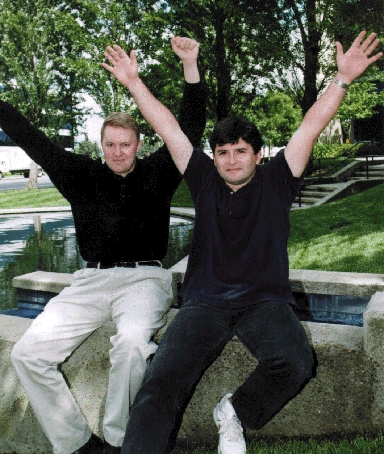
Marc Andreessen and Tom Paquin believe in the future of Linux “this much”.
Doc: What's your role in the browser conversation now, with Mozilla.org?
Tom: We're hoping to steward that conversation, but there's no compulsion here. They have the source and can choose to go their merry way. We're all better off if there's a lot of coordination and cooperation, and the community recognizes that. So it's not that they're going to be dragged kicking and screaming into it. We don't have to offer free donuts to get them to come to the party. On the other hand, if they don't like our stewardship, they don't have to cooperate. So we have to act in the traditional open source responsible manner—in a way that will make them want to play. Somebody will steward this, whether it's us or not. If they don't like us, they'll find someone else to do it.
Marc: Again, we can't de-commit.
Doc: I've always thought the best kind of marketing amounts to arson. You set fires and stand back and watch what happens.
Marc: (Laughing) Right. I'll enjoy watching this one.
Doc: The open source world, it seems to me, is already a very active conversation. Great kindling, as it were. Already the browser conversation has changed: Whoosh, it's different.
Marc: Right.
Doc: Yet the press will still play this as a war over a battlefield, no matter how much it looks like the Big Bang, and no matter how non-territorial it is.
Marc: Exactly. What's really happening is new vendors constantly opening up new spaces where new things happen. Everybody gains. That's the real story.
Doc: And, once you have a firestorm of interest going on around Mozilla, it will do what LDAP did two years ago.
Marc: Sure. Same pattern.
Doc: What has surprised you, in just the week since the source went out?
Marc: A lot of our programmers have been surprised by the level of interest and activity. We've cured a lot of skepticism in the last week.
Tom: You're going to dislike the things that surprised me, because in truth we expected this to take off in exactly the way it has. We got a bunch of memory bug fixes that I thought were great. I was a little surprised at how strong the Macintosh community jumped on. They were really in there. We got a localized version that happened fast: a crypto plug-in from the crypto-weenies in Australia who hacked it together in seven hours hacking time, fifteen hours real time. Speed was impressive too. I expected people to spend more time digesting, but they piled right in.
The skeptics are surprised, of course. “Well, gee, we see some evidence here that Netscape is serious about this and not abandoning the browser business.” That kind of stuff is what's truly surprising.
Marc: There was skepticism in engineering as to whether people would be able to understand it enough to make changes. And they've absolutely been able to do so. It hasn't been an issue.
Tom: Yeah, the difficulties haven't been difficult.
Doc: Marc, you said at the SVLUG meeting that you could see Mozilla becoming the GUI for Linux. What are you talking about there?
Marc: I don't want to overreach and say Mozilla has to be the GUI for Linux. It makes perfect sense for Mozilla to be in a window running on an X desktop or anywhere else. But the thing we think is happening—and has been steadily happening over the last five years—is that we are all spending more and more of our time doing things on the Net as opposed to doing things on the local system. That should lead to a major interface change we're only beginning to see, equivalent to the shift from text to GUI.
The next shift should be from a GUI-centric or desktop-centered interface to a net-centered interface, one that takes into account the virtues of the network. Because the fundamental difference is that there's a million or a billion times as much stuff out there that we have access to and therefore may have to deal with at some level, than was ever on an individual desktop system. And so, the interface has to change radically to whatever the Net opens up. The scope of that means Mozilla is positioned to become that GUI, that breakthrough, through community effort.
Doc: The network interface?
Marc: Exactly, the network interface. If you think of Mozilla as a full-screen environment that is inherently a network interface, it is heavily oriented to filtering and managing the huge amount of information out there, and being extraordinarily personalized for the individual user. There are all these resources to draw out of the Net, which increasingly represent the needs of the user to the Net; thus, resources become smarter in a sense, doing more useful stuff for the user, and finally will, no doubt, include the contents of the user's own machine.
Doc: So your local machine becomes a subset of what's in the networked universe, but your view is through a Net-oriented interface.
Marc: Exactly. The local box is a very, very small subset, but the Net is the context.
Doc: We already see people adapting the way they work to the Net context.
Marc: Now, we see lots of documents, reports and messages are being typed in e-mail that previously would have been typed in a word processor or on a typewriter. You see the emergence of the navigation center in the code that's up there now, providing a view of the Net. Maps of web sites, plus bookmarks, plus directories, plus e-mail messages—basically everything you have access to, in a single place.
I can easily imagine Mozilla, within a year or two or even sooner, will have an interface mode that gives you sort of a full-screen experience that happens to provide everything you need to manage your local desktop but is specifically focused on being a very effective interface for the Net. This is going to be a very fertile breeding ground for a lot of innovation in user interfaces. There has been a huge amount of work in computer science labs and in the larger community on next generation user interfaces. Historically, it has taken decades for any of those innovations to make it out. Windows and the Macintosh are known for technologies invented 25 years ago. But while it takes a long time for this to happen in the commercial marketplace, it can happen much faster in the grass roots world that will grow around Mozilla. You will see grad students doing radically advanced user interfaces as their Ph.D. theses, implemented in Mozilla. One of those will be the interface we'll all be using a few years from now.
Doc: I have this notion that who you are is more a matter of where you come from than any other factor. It's the anchor point for the vector of your life. You can change your name, your job, your whole résumé, but you still come from the same place. And this is true of companies as well as people. It's the source of character. Apple will always come from Steve Jobs' aesthetic. Sun will always come from The Network. Netscape will always come from wherever you, Marc, were at when your team created Mosaic. Was that UNIX?
Marc: There were UNIX guys, but a lot of PC and Macintosh guys as well. Essentially, where we came from was a commitment to a heterogeneous universe. We also go back a long way with this. We had connections in the open source community before Linux really existed. Back then, the open source community was a lot smaller. The projects they were focused on were things like Emacs, FreeBSD, C compilers and so on. Now that community is larger, more involved with the Web and growing very fast. That's why the timing is so right for this move. It wouldn't have been a few years ago.

Social Computing
Doc: A while back it seemed to me that the next stage beyond personal computing would be social computing. It seemed a natural progression, from the one to the many. But there is a difference in kind between the personal and the social, between the user interface to a personal computer and the user interface to the Net, which is where we find computing's society. What you're talking about is making Mozilla a social interface.
Marc: Right.
Doc: Maybe it's a stretch, but the Open Source society is very different than the company that's trying to build the ultimate personal computer.
Marc: Right. Microsoft is trying to put all this stuff back in the box, right? They're trying to take this whole world and squeeze it down.
Doc: If I look for analogous concerns in the real world, my most personal space is maybe my closet, because I know where my shoes are, and my shirts and belts and so forth.
Marc: Same for your bookshelf.
Doc: Yet, society is nothing like my closet or my bookshelf. But the presence of a computing society in my life means I don't write in a word processor anymore. I write in e-mail and a text editor. I wrote my questions today in BBEdit, saved it to the a42 server at Linux Journal in Seattle, reviewed them with Phil Hughes, wherever he was, and printed it out in my office. The browser was there for all of it, of course. And the interesting thing is that all this is far less feature-rich than what I used to do on a word processor and print out at home. But it's far more social, and far more useful.
Marc: It's social publishing.
Doc: Right. Now, here's where I'm going with this: we are each willing to yield a lot of personal choice to get along with society. Hey, maybe I like to race cars, but I won't do that on a highway. But I behave the way I do on a highway because that's a social place.
Tom: That's incredibly true of your social life. All of your manners are necessary to get along in society.
Doc: The irony of personal computing is that you can't see the social from the personal. I can't abstract the organization of the world from the contents of my closet. I can't understand traffic from the perspective of racing a car. I can't see more in terms of less. Yet there are concerns and functions inherent in social computing that don't show up in personal computing. What I'm suggesting is that you guys live at the social level and have lived there all along.
Marc: That's right.
Doc: So you're coming from the social, and Microsoft is coming from the personal. Which is why I think you're not surprised, Tom, when the society you know best acts just as you expected when you released the source code.
Tom: Right. And somebody who lived in the other world might be asking all these questions about, “Why would these people want to help you?”
Marc: Or “Why isn't this just going to fragment?” That was the big question we got from the press, and we had to carefully explain why there are tons of reasons it won't fragment, not the least of which is the centrifugal force where, if you want to fragment, you take upon yourself the burden of pulling in all the changes everyone else is making into your own version. There are always issues like this that actually make things work. That's why Linux works.
Tom: Who wants incompatibility? The problem is, I could say this to a room full of people and they'd all have the same answer. The guys up north want to sell tools that are the only tools in the business that can operate on the data... Then I say “Ah, okay, sorry, I wasn't thinking about that. I think compatibility and open interfaces are good things.” So we don't communicate because we're not operating at the same level.
Doc: Is Sun going to open Java?
Marc: There are eerie parallels here between what Sun did in 1982 and what Linux is doing in 1998. In many ways it's the same technical community. It's a community that's very focused on free versions of UNIX, running on commodity hardware, appealing initially to a very technical audience and eventually with a much broader relevance. Sun, in 1983 and 1984, totally and uniquely had an understanding that you could harness all this energy around BSD and commodity hardware and just get it out the door to this technical community. SGI and many other companies didn't get it back then, but Sun did.
Now they've done a complete 180. If you think about it, they are now a proprietary verticalized systems vendor: doing their own chip, their own complete systems architecture, their own software, their own operating system, their own applications in many cases, their own storage devices and so on. When they think of Java, they think, “we really need to control this.” Wrong answer. Because the alternative is that there will absolutely be multiple implementations. There need to be Javas defined to lead naturally in the open direction. Sun is going to force them to emerge and to flourish by not opening Java up.
Tom: It's like what AT&T did in the UNIX market.
Marc: Right. If you think about it, what's so 180 is—well, look—I like Alan Baritz a lot. But Alan's from IBM. In 1982, Sun would not have put someone from IBM in charge of something like this. Now they would, and that's a mind-set change. And so that's one reason this is so fascinating. They play a very strong marketing battle on the one hand about why Java is open, and on the other hand, they're not open at all.
For our part, we can make a practical observation that if we can't build Java source code into Mozilla, there will be a Java implementation that will end up in Mozilla. It'll be Sun's or someone else's.
Tom, should I pre-announce something here?
Tom: Go ahead.
Marc: We are at work on a next-generation Java runtime, internally code-named Electrical Fire. It should be on the Net shortly. There are multiple efforts already launched here. This is not a complete Java runtime in and of itself, but it's technology around which to build a very high-performance Java runtime. And we're going to put it on under MPL (the Mozilla license).
Doc: Are engineers starting to beat your door down to work here? One of my hacker friends wants to know that.
Tom: We're seeing fewer people saying “Hire me, hire me” than those who are saying, “I want to play.”
Marc: We're hearing from people who want to do some particular project and ask if Netscape would be willing to subsidize it. And we could potentially use some number of those things, but I'm not sure it would be that good for Netscape to try to fund some of this stuff because it gives the wrong impression and offers the wrong incentives at that point. But I don't know. It's complicated. Also, from a practical standpoint, there's a limit to how much we can fund.
Tom: I like the Darwinian approach. Let natural selection occur.
Doc: Say, “If you've got such a good idea, go get your own funding. Start a business.”
What is this going to do to the server side of your business?
Marc: Indirectly, it benefits. Let me explain why. The server side of the business is strong and healthy to the extent that there is a competitive client marketplace. If there were a noncompetitive client marketplace and Microsoft had 100% client penetration, we would have a difficult time in the server market for obvious reasons: Microsoft would use its advantages. But now, because there is a competitive client marketplace, not only does Microsoft lack a dominant share, or even a majority share, they are forced to implement open interfaces and open ABIs, such that our servers actually interoperate with their clients. They are forced to do that by the market. As long as there is a competitive client market, their customers will demand it or they won't stay customers. If that market persists, our server business does great. If that market collapsed down to where Microsoft is the only competitor, our server business—and everyone's server business—is in a lot of trouble. That's why, for example, we're not going to try to get features built into Mozilla that only work on our servers. Open browsers guarantee an open server market.
Doc: Do you have any concern that this Open Source community will go create free server software that competes with your commercial server software? Apache equivalents for security, management and the rest of it?
Marc: Those exist now, in most cases. Freely available mail servers, security solutions, Kerberos, directory systems, University of Michigan LDAP. We're comfortable competing with all that. We sell $75 million worth of web servers every year, in a market where both Apache and IIS are free.
Doc: And you've got Caldera bundling your stuff with Linux, and there's a market for that.
Marc: Sure.
Doc: So you're saying that the world is exploding at a sufficiently rapid rate that it's going to suck your stuff into it at least as fast as anyone else's.
Marc: We'll sell more web servers this time next year in spite of the fact that more free ones will be out there. We sell software to businesses. Individuals are fundamentally looking for a different set of things.
Doc: You've been trying to establish an object model built around IIOP (Internet Inter-ORB Protocol) and CORBA (Common Object Request Broker Architecture), versus Microsoft's DCOM (Distributed Common Object Model). Does this Open Source release play in that at all?
Marc: Good question. Tom, we took the ORB (Object Request Broker) out, didn't we?
Tom: I don't think it's there.
Marc: That's interesting. [We] made the client ORB-free in source form.
Tom: It's going to have an ORB; I can't tell you exactly when. I don't think the world is going to tolerate a vacuum in this space for very long. I've seen a few proposals. All the existing popular options have some kind of fatal flaw in the eyes of part of the community. The DCOM guys have a problem with this part of an ORB. And this CORBA group has a fundamental problem with the portability or interoperability of some part of DCOM. There are just wave after wave of these concerns. We've had arguments within Netscape about the best way to address the question. I'm looking for Darwin taking over on this one, too. I think it might be a spirited debate, and educational for me. I am not an objects guy.
Doc: I was talking to Phil Hughes about this and he said the same thing. But he added that it all depends on your generation—when you grew up.
Tom: It's true.
Doc: He said, if you go to the schools now, everybody's talking objects. Maybe not so for the older guys.
Tom: Some of those older guys have evolved into objects people. Their arguments are very interesting. I follow them, but I can't generate them. In any case, I think it's going to be interesting to get this out in the open.
Marc: I bet we'll have native IIOP built into Mozilla in source code form within a year. From somewhere.
Doc: Meanwhile, there seems to be faith that the world is going to be made of objects, and there will be an enormous conversation in objects between clients and servers all over the world. I don't know to what extent evolution toward that state is constrained by the presence of two rival object models.
Marc: As an issue, it's not pragmatically useful or important to enough people yet. The results may be what you describe, but the object people get confused between the way the world's going to look in N years versus what it's actually going to take for interest to pick up and carry us there. This is why it was so hard to time the adoption of LANs. In retrospect, it took time for all this technology to connect before it made more sense to print over the LAN as opposed to carrying floppy disks. To get to the current state of the Internet, we had to get technology to a point where folks wanted e-mail accounts in order to write to their kids in college. I think this applies to programmers too. What's the trip-over point where all of a sudden it really matters? Personally, I think it's going to happen when people build more sophisticated multi-tier applications. Then they're going to need smarter communication between clients and servers than they're able to get today. And they're already going to be developing a lot of their logic on the server in the form of objects because they're using C++ or Java, and also off the client. And so, they're just naturally going to start to interconnect those two.
Doc: Directory service is going to play in a really huge way here. You've got a directory server.
Marc: A damn good one.
Doc: That seems to be optimized for this. Would you tweak it to match what's going on in the outside world? Let's say you put the ORB in the browser, watch what happens, see who's trafficking in objects, how it looks and who needs a directory.
Marc: Absolutely. A lot of what we do in the servers will be influenced by what happens with Mozilla. It's sort of always been that way. Fundamentally, there's a chicken and egg problem with some of these things that involve all kinds of servers, and it usually requires you to get some amount of user action or adoption going on before lots of stuff starts to happen on the server. I'll bet that's exactly what's going to happen in this case.
Doc: I like your faith. But your critics have said “It's a desperate move, and they didn't have any other choice.”
Tom: That's driving me crazy. Any business decision is going to look vague when the costs and risks versus the opportunities and benefits are highly balanced. The teeter-totter teeters. In this case, the cost of releasing the source to the Navigator plummeted in the last nine months or so. Now, it's a no-brainer—time to pursue a new opportunity.
Marc: The flip-over point was when we made the binaries free. After that, releasing the source made perfect sense.
Tom: The benefits and opportunities have always been strong. It's just that the costs have been high. Well, they have not always been strong. I have to be fair. In 1994, there weren't many developers out there who “got” the Web—whose heads operated in that space. And if you invited everybody to come and play, the signal-to-noise ratio would have been zero. Since then everybody has come to know about the Web, and they have attitude and interest and ideas, so for some time the opportunities and benefits have been on the strong side. But when the costs plummeted, then suddenly it was a lot easier decision to make, regardless.
Marc: Those statements usually come from people who are typically not involved in businesses. Or at least not businesses of scope. There's a natural decision-making process businesses go through to try to maximize their economic opportunity.
Doc: I liked the way Jim Barksdale put it when he said, “We had to get revenues low enough, so we could make this choice.”
Marc: Right! We had to walk it all the way down to zero. Along the way, we used that revenue to subsidize all these other products and services that now generate revenue.
Doc: Change goes on all the time anyway. All products have a life. Either they change completely in order to live, or they die.
Marc: Yep.
Doc: That's true of Windows, of browsers, of all kinds of things.
Marc: Which is why it's ridiculous to criticize a company for changing.
Tom: The criticism is, we're in power and we have competitors, so we've got to be desperate to give all this power to our competitors.
Marc: To some people it's “Aw, they're desperate.” And it's obvious they haven't even thought it through any more than that. It's a pointless comment. Jim Barksdale abbreviates this to “They haven't ever run a hot dog stand. What do they know?”
Doc: The problem with the press is that when you're running a sportscast, you have to fill the air with sounds of competition even when there's nothing going on.
Tom: You're really right about them using war terminology, using that chest of war words, and when things don't fit that model, the brains break. The stunning thing is their unwillingness to put that box away and break out a new box.
Marc: It's especially interesting when you think about it, because there are so many different sources of media now—so many different voices out there, striving for unique coverage and unique angles. You've got an inherent unwillingness by a large number of them to actually do anything unique.
Doc: Part of it is time pressure: you have to say something. Another is the story principle. Stories are the fundamental unit of consciousness. Conflict is interesting, and most stories are about conflict. No story starts with “And they lived happily ever after.” What keeps them turning pages is the conflict that's going on, and it will still be going on after they turn the page. That is inherently interesting to human beings. The Great Harmony is not interesting. A bunch of people hacking on something for the pure fun of it and for peer review is not as interesting to the press as the “Great Browser War”.
Marc: Right.
Doc: Eric Raymond told me today that you're not a hacker unless somebody else says you're a hacker.
Marc: That's true. He's absolutely right.
Doc: There is also a peerage among the Dilberts of the world that is invisible to those further up the corporate hierarchy.
Marc: That's true.
Doc: So there is all this interesting stuff going on, but it doesn't involve conflict so it isn't that interesting to the press.
Marc: Now there are more people in the technologist community than there ever have been. More people are comfortable with technology now at every level than there were five to ten years ago—just a huge number more.
Doc: Anything else you want to add before we wrap this up?
Marc: I think over the next six months we'll have an explosion of activity. What pops out of this new system will be interesting. You can view it as an amazingly complex system or organism or computational device on a large scale, with its own set of rules and organizing principles. Stuff is bound to pop out. By definition, what pops out will be the right set of stuff. It will be self-fulfilling.
Doc: This brings to mind John Seemly Brown's matrix, where he puts social computing in context. He says there are some things that only we know. They emerge in the social space, rather than the personal. And most of the shared knowledge is tacit rather than explicit. Tapping into this tacit dimension is what you have in mind, I think.
Marc: Absolutely.
Tom: Domestically, among the people here at Netscape, I've been explicit, saying, “Look, I'm not going to explain to the Open Source world how open source works. Build it; they will come.” If they need to be sold, they're too much work for me anyway. As long as I believe there is a large community out there—that will come, based on tacit communication—I'm in business. And the rest of the people can learn how this thing works. For some people, however, I have to be clear: “I'm expecting this behavior.” This allowed Mozilla to say, “We're just kind of doing this,” and expect Open Source behavior to run with it. Yeah, absolutely. At the tacit level, the Open Source people totally get what's going on.
Doc: In a way, you're saying “We have built it, now they'll come and rebuild it.”
Tom: Oh yeah. We build the place where source lives, and give them an opportunity to get in there and get their fingers dirty, and no one will be able to keep them away.
Doc: Like a free Home Depot for developers.
Tom: Yeah!
Marc: Right. We've got a few things we think we can stock it with on top of Mozilla. I'd like to see what the community does with Electrical Fire.
Tom: The list of things like Electrical Fire is about seven, eight, nine, ten items long, all of which are majorly interesting. So, we've got some stuff. We can set some fires.


