Linux Journal Demographics
Do you ever wonder who else reads Linux Journal? “No” you say? All your best friends and buddies already have their two-year subscriptions? All those friends live not necessarily in your neighborhood, but all over out there in Internet-land?
Well, we know that at least a few of you are curious about those other folks. (And besides, it's a chance for us to put some colorful pie charts on this page and dazzle you with statistics!)
The distribution of Linux Journal as of the October Buyer's Guide issue was 30,000. Our readers include subscription-holders as well as those who buy the magazine in bookstores and other retail outlets.
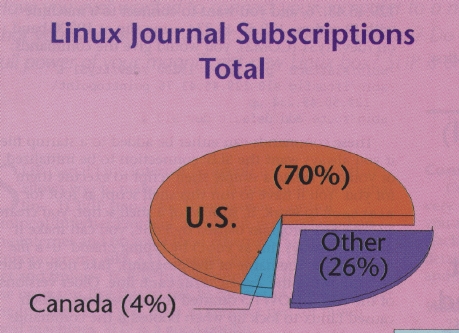
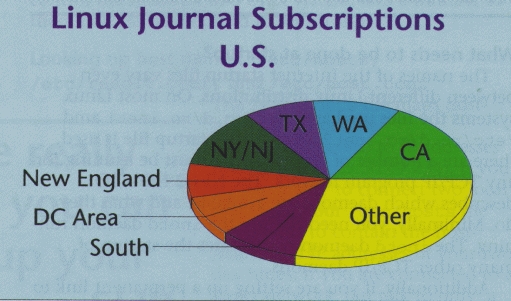
Of our subscription-holders, 70 percent are in the United States, and 30 percent are non-US. Inside the U.S., most magazines get sent to the famous area of the country known as “other”. Our next-largest subscribership is the state of California with 17 percent. Washington state has a large percentage because we threaten all of our friends to help keep us employed! We had to put Washington D.C. on the chart because people are always getting us mixed up with them.
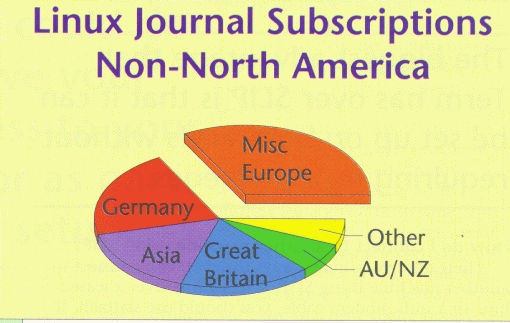
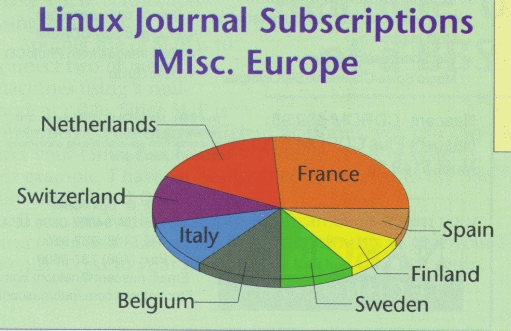
The non-North America pie shows Great Britian, Germany, and Asia each at approximately 17%. Australia and New Zealand have a surprising 7 percent. Miscellaneous Europe lets us know that there are plenty of people in the Netherlands to go to the International Linux Symposium which will be held in Amsterdam in December. (See related story in the Linux Events section, page 10.) Their 14 percent is second only to France's 22 percent.
So, we hope that this gives you a little better picture of the demographics of Linux Journal subscribers. Oh, and don't forget to get an extra subscription for your Mom for her next birthday.
LJ Non-North America Subcriptions
Laurie Tucker is the assistant editor of Linux Journal, cover designer of the September issue, and sysadmin of ssc.com; a Linux system. She hides out at llt@ssc.com.
Laurie Tucker (llt@ssc.com) is the assistant editor of Linux Journal, cover designer of the September issue, and sysadmin of linuxjournal.com; a Linux system
Realizing the promise of Apache® Hadoop® requires the effective deployment of compute, memory, storage and networking to achieve optimal results. With its flexibility and multitude of options, it is easy to over or under provision the server infrastructure, resulting in poor performance and high TCO. Join us for an in depth, technical discussion with industry experts from leading Hadoop and server companies who will provide insights into the key considerations for designing and deploying an optimal Hadoop cluster.
Sponsored by AMD
Built-in forensics, incident response, and security with Red Hat Enterprise Linux 6
Every security policy provides guidance and requirements for ensuring adequate protection of information and data, as well as high-level technical and administrative security requirements for a system in a given environment. Traditionally, providing security for a system focuses on the confidentiality of the information on it. However, protecting the data integrity and system and data availability is just as important. For example, when processing United States intelligence information, there are three attributes that require protection: confidentiality, integrity, and availability.
Learn more about catching the bad guy in this free white paper.
Sponsored by DLT Solutions
| Designing Electronics with Linux | May 22, 2013 |
| Dynamic DNS—an Object Lesson in Problem Solving | May 21, 2013 |
| Using Salt Stack and Vagrant for Drupal Development | May 20, 2013 |
| Making Linux and Android Get Along (It's Not as Hard as It Sounds) | May 16, 2013 |
| Drupal Is a Framework: Why Everyone Needs to Understand This | May 15, 2013 |
| Home, My Backup Data Center | May 13, 2013 |
- RSS Feeds
- Dynamic DNS—an Object Lesson in Problem Solving
- Making Linux and Android Get Along (It's Not as Hard as It Sounds)
- Designing Electronics with Linux
- Using Salt Stack and Vagrant for Drupal Development
- New Products
- A Topic for Discussion - Open Source Feature-Richness?
- Drupal Is a Framework: Why Everyone Needs to Understand This
- Validate an E-Mail Address with PHP, the Right Way
- What's the tweeting protocol?
Enter to Win an Adafruit Pi Cobbler Breakout Kit for Raspberry Pi

It's Raspberry Pi month at Linux Journal. Each week in May, Adafruit will be giving away a Pi-related prize to a lucky, randomly drawn LJ reader. Winners will be announced weekly.
Fill out the fields below to enter to win this week's prize-- a Pi Cobbler Breakout Kit for Raspberry Pi.
Congratulations to our winners so far:
- 5-8-13, Pi Starter Pack: Jack Davis
- 5-15-13, Pi Model B 512MB RAM: Patrick Dunn
- 5-21-13, Prototyping Pi Plate Kit: Philip Kirby
- Next winner announced on 5-27-13!
Free Webinar: Hadoop
How to Build an Optimal Hadoop Cluster to Store and Maintain Unlimited Amounts of Data Using Microservers
Realizing the promise of Apache® Hadoop® requires the effective deployment of compute, memory, storage and networking to achieve optimal results. With its flexibility and multitude of options, it is easy to over or under provision the server infrastructure, resulting in poor performance and high TCO. Join us for an in depth, technical discussion with industry experts from leading Hadoop and server companies who will provide insights into the key considerations for designing and deploying an optimal Hadoop cluster.
Some of key questions to be discussed are:
- What is the “typical” Hadoop cluster and what should be installed on the different machine types?
- Why should you consider the typical workload patterns when making your hardware decisions?
- Are all microservers created equal for Hadoop deployments?
- How do I plan for expansion if I require more compute, memory, storage or networking?


7 hours 45 min ago
12 hours 12 min ago
15 hours 48 min ago
16 hours 20 min ago
18 hours 44 min ago
18 hours 47 min ago
18 hours 48 min ago
23 hours 13 min ago
1 day 1 hour ago
1 day 6 hours ago