Wireless Networking in Africa
Global connectivity in Africa is in an early stage due to installation costs, insufficient basic infrastructures, low quality of available telecommunication services and limited financial support. The application of wireless technology is an effective choice to overcome some of these problems, at least within smaller areas. This is true even if transmission speeds are lower than the ones achieved by wired networks.
Within a university campus, it is easier to install a radio link system than to place cables or expensive optical fibers in the ground. Furthermore, radio installations are easier to protect from external natural phenomena such as flood, landslide, etc. At first glance, wireless LANs look more expensive than wired LANs, but in the long term they have lower maintenance costs and are relatively easy to configure. The use of Linux and standard radio-communication technologies, in conjunction with the many Linux software applications, makes this task even easier.
With this scenario in mind, the “Programme of Training and System Development on Networking and Radio Communications” was initiated in 1995 at the Abdus Salam ICTP, Trieste, Italy. The objective of this programme is to provide technical assistance and training to academic and scientific institutions in developing countries—institutions with a need for small area computer networks and a connection to the Internet, either directly or through national networks.
The Abdus Salam ICTP in Italy and the Obafemi Awolowo University (OAU) of Ile-Ife in Nigeria agreed to collaborate in the establishment and future evolution of a Pilot Educational and Research Computer Network at OAU. Such a network, based principally on personal computers running Linux, today provides connectivity between several faculties and departments on the campus.
Training technical staff on the hardware (PCs, cabling, radio techniques) and software (network and system administration) took place initially in Trieste. The developmental and simulation work was completed in four months, ending in January 1996, when all the necessary equipment was sent to OAU. The system was installed in April 1996. At that time, staff members of other Nigerian universities came to Ile-Ife in order to benefit from this exercise and be introduced to Linux for the first time. Besides getting acquainted with the new technology, this experience led to further connections to the OAUNET. The campus network has been in operation since June 1996 without any major problems and has proven to be highly beneficial for academic life at the University.
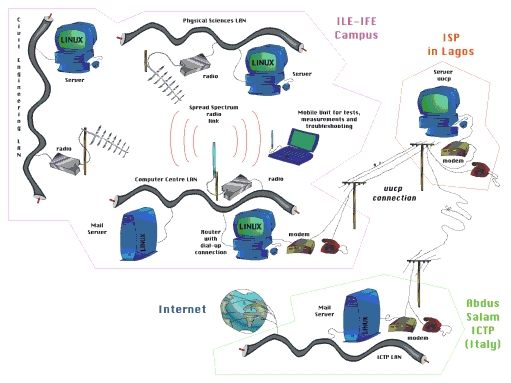
As shown in Figure 1, the wireless campus network (OAUNET) is based on a radio system in the UHF band; it initially involved three separate buildings and had the capacity to be rapidly extended to other university structures. The wireless link uses a spread-spectrum, direct-sequence technique providing data transmission at 2Mbps. The so-called “spread-spectrum” is a digital coding method in which the signal is transformed or spread so that it cannot be received by any receiver except the designated one that understands the transmitted signal code. It minimizes interference to other users and normally does not require an operation license in the ISM (International Scientific and Medical Band), depending on the regulation adopted by the country.
Inside each building, an Ethernet 10-BASE 2 cabling structure is installed in order to keep the initial costs as low as possible (i.e., no hubs, less cable) and to ensure the local availability of spares (BNC), etc. In each of these buildings, a Linux PC acts as “faculty server” and provides mail services for the local users and does routing to the backbone. This strategy has been selected to keep the user-generated traffic local and reduce the access to the main backbone. All services are TCP/IP-based to keep the system as standard as possible with Internet protocols, avoiding future modifications when full connectivity might be provided to the university.
The academic network gateway and the main mail host are located the Department of Computer Science at the university. Due to national regulations and the lack of a permanent connection to the Internet, the gateway is linked on a dial-up base (uucp) using an international direct-dialing line to the ICTP computer network in Trieste, Italy. Software was developed by OAU staff with some assistance from ICTP to refine the basic uucp mail transfer: a custom sendmail delivery program batches mail in intermediate-sized, BSMTP (batch simple mail transfer protocol) formatted files; these files are compressed as much as possible before being transferred over uucp. To cope with telephone line instabilities, a uucp relay was placed in Lagos; the uucp configuration takes care of selecting the path either directly to Trieste or through the Lagos relay, automatically choosing the one that works.
Previous in-house experiences with the UNIX system (SunOS and Sun Solaris) led us to test, within the project, the commercial Solaris 2.4 (x86 version) and Linux. While this version of Solaris required specific hardware components to function on the available (486) PCs, Linux was found to be more flexible than Solaris in terms of hardware compatibility and low memory requirements. On top of that, the possibility of having high-quality free compilers and software applications motivated us to continue using Linux. In 1995, Windows NT was just starting to become popular, so this possibility was not considered. At that time, Linux was also unknown in the Nigerian academic world. The main operating systems available there were MS-DOS and Windows 3.1.
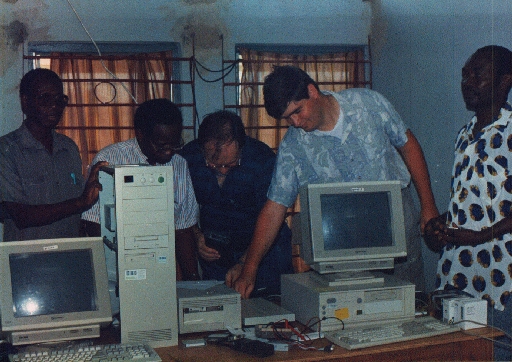
The Linux distribution chosen was Slackware. Although more difficult to install than other distributions, right from the first trials the system configuration (start-up scripts, etc.) was easier to locate, understand, manage and, most importantly, to teach. After a whole cycle of Linux setup experiences and training, autonomous management of all aspects is today a reality. Part of the system installed at the OAU is shown in Figure 2.
In order to achieve campus wireless connectivity, the requirements needed from the system administrator's point of view were to have a network working all day and night, the least amount of human intervention and reasonable throughput (bandwidth). The technology adopted to do this job was, as mentioned above, spread spectrum.
The first attempts were implemented using a direct-sequence, spread-spectrum card supported by the Linux kernel. Most recently, alternative spread-spectrum equipment that does not require Linux kernel support is being tested, not because of Linux unreliability, but because this new equipment has an Ethernet interface instead of an ISA (industry standard architecture) card that plugs into a PC. This configuration makes the installation of a wireless link much easier and more flexible, because you can place the radio unit very close to the antenna (keeping attenuation very low) and connect it to the PC using a UTP (unshielded twisted pair) cable. In the case of an ISA card, the RF output is at the rear of the PC, and it is there that the antenna is connected. Due to the small output power and the attenuation of the cable, it is not advisable to use more than 10m of coax. This new equipment uses a different spreading method called frequency hopping and provides a higher bandwidth.
The possibility of using packet radio technologies, which are well supported and documented under Linux (AX-25 HOW-TO), was analyzed at the beginning of the project. However, due to the specific training required, implementation of this technology was postponed. An advantage of the present spread-spectrum installation (running two years without major interventions) is that it is almost plug, play and go.
The local network is stable and does not suffer if there is a failure of the main power supply, because a standby generator and UPS facilities are available. The number of registered users of the network increased from 150 in August 1996 to about 290 in September 1996 to more than 600 at present.
Campus-wide services such as e-mail, FTP, WWW and NFS are available today within the OAUNET. As connection to the rest of the world is done on a dial-up line, only e-mail exchange is provided freely to local users. There is no limitation on the amount and size of the information being transferred on campus.
Some of the communication applications like TALK or WRITE became important due to poor performance of the local PABX (private automatic branch exchange). For example, after the launch of the network, people who used to walk to another location to speak with an administrative officer or colleague now enjoy a TALK between two buildings located a few kilometers apart. To reduce bandwidth usage, only text-based conference tools are implemented. We will also experiment with voice-over input in the future.
All of these new communication tools are certainly providing a revolutionary change in the local academic life.
The next phase of the wireless network requires the installation of other Internet services on the OAUNET. For example, arrangements are being made to provide connectivity to the library and other faculties such as Agriculture.
The success of the Ile-Ife experience stimulated cooperation with other Nigerian universities. A large program of cooperation with the National Universities Commission for the establishment of a national academic network started in 1996 and is still progressing. Linux is part of the technical basis of this activity. The most interesting applications of radio have been in individual universities. Among these is the Bayero University (Kano) which decided to build a link to connect the new campus with the old campus of the university (about 9 kilometers). This connection was implemented using commercial wireless equipment and two Linux machines as routers, with one of them as the whole university mail server and uucp gateway.
Following these results, a series of additional proposals have been received at our headquarters in Trieste. The first of these new projects, being carried out in Ghana in collaboration with countries such as the Democratic Republic of Congo, Ivory Coast and Morocco, will begin soon.
These initial experiences with Linux in Africa are proof of the success and reliability of Linux.
Any of the authors can be reached at radionet@ictp.trieste.it.
Dr. Enrique Canessa is a theoretical physicist currently working as a scientific consultant at the ICTP. His main areas of research and interest are in the field of Condensed Matter and scientific software applications. He has been lost in the Internet since 1987.
Mr. Fulvio Postagna is an Electrical Engineering student at the University of Trieste and a Scientific Consultant at the ICTP. He has been a radio amateur since high school and has carried out radio and telecommunications studies. He enjoys upgrading the Linux kernel for our wireless communications.
Mr. Carlo Fonda is a Physics student at the University of Trieste, a Scientific Consultant at the ICTP and radio amateur. From time to time he visits our laboratory after long walks in the marvelous Trieste countryside. He also sends us greetings via radio and enjoys drawing.
Professor Gabriel O. Ajayi works in the Department of Electronic & Electrical Engineering of the Obafemi Awolowo University. Besides computer networking using wireless radio techniques, his main research topics include rain attenuation on earth-satellite paths in the tropical regions.
Professor Sandro Radicella is head of the Aeronomy and Radiopropagation Laboratory and coordinator of the Programme of Training and System Development on Networking and Radiocommunications at the ICTP. His interests include, among others, radiopropagation issues and the relationship between social and economic development and telecommunications.