
Graphical Desktop Korn Shell

Portability and pervasiveness are two important characteristics to consider when you are developing code. Using a programming language with a well-defined and stable application programming interface (API) answers the need for portability. A programming language with a large, established installed base provides pervasiveness. Although Perl, Tcl/Tk, Common Gateway Interface (CGI) and Java have large installed bases, they are not suited for some projects. The reason for this is their inconsistent installation base due to the lack of a well-defined or rapidly changing API.
The Desktop Korn Shell (DtKsh) that comes with the Common Desktop Environment (CDE) is built on the ksh93 standard with X, Xt, Motif, ToolTalk and CDE built-in APIs. Unlike Perl and Tcl/Tk, major vendors have built and supported DtKsh through the CDE initiative. Using DtKsh, desktop programmers can develop and/or prototype plug-and-play Graphical User Interface (GUI) applications that are compatible on all CDE-compliant systems without compilation. Although DtKsh applications are interpreted for portability, they can easily be migrated to Motif in C for performance.
Tcl/Tk can be ported to C with the aid of special Tcl/Tk libraries; however, programmers are as disadvantaged with the C Tcl/Tk libraries as they are with the Tcl/Tk shell, because of a not-so-standard application programming interface. DtKsh, unlike Tcl/Tk, provides a well-established API set where the programmer's knowledge transcends from C to shell programming.
In AIX, /bin/ksh is an XPG4-compliant version of ksh88. CDE's /usr/dt/bin/dtksh on AIX is based on the newer ksh93 standard. ksh93 now includes floating-point mathematics, associative arrays, new string operations, hierarchical variables, reference variables, developer-extendable APIs using attached shared libraries and character class patterns.
Floating-point mathematics: Korn Shell variables can be cast, or defined, to various aggregate data types. Floating-point mathematics is a new feature in the Korn Shell that enables the assignment and operation of decimal values. The following example defines the floating-point variable PI, then assigns to it the decimal value of 3.14159.
typeset -F PI # define "PI" as a float
PI = 3.14159
Associative arrays: Instead of using positive integer indices, associative arrays allow elements of an array to be addressed using alphanumeric strings. The following example shows SYSINFO as an array containing information about an operating system. The associative SYSINFO array can be indexed with the alphanumeric string of "os" to find the string value of AIX.
typeset -A SYSINFO # define "SYSINFO" as an
# associative array
SYSINFO["os"]=AIX
New string operations: Six new string operations were introduced in ksh93. These new operations provide substringing and substitution of a string pattern with an alternate. Substringing permits extraction of a smaller string, given an offset indicating where to begin and possibly its length.
A substring of a larger string can be extracted by length at a given starting point, or a substring can be taken by starting at the offset within the larger string and stopping at the end of the string. The following shows a substring of a given length:
${variable:offset:length}A substring of no particular length can be taken by just providing the offset.
${variable:offset}String substitution of a character pattern can be performed for the first occurrence, a repeated occurrence, at the beginning of the string (prefix) or at the end of the string (suffix).Substitute the first occurrence of a pattern with an alternate string:
${variable/pattern/string}Substitute all occurrences of a pattern with an alternate string:
${variable//pattern/string}Substitute the pattern prefix with the alternate string:
${variable/#pattern/string}Substitute the pattern suffix with the alternate string:
${variable/%pattern/string}
BOX= # declare before assigning sub-members
BOX.WIDTH = 80
BOX.HEIGHT = 24
Reference variables: Referencing allows a variable to point to the same value as another variable; both variables reference the same value as shown below:
# name reference
typeset -n FOO=BAR
FOO="Hello World"
# print "Hello World"
print ${BAR}
Desktop built-in commands: Korn
Shell provides some standard X, Xt, Motif, POSIX
internationalization and CDE C language APIs directly built into
the shell. Direct access to these APIs from the shell provides a
significant runtime performance improvement for DtKsh shell
applications. Using the standard X and Motif APIs, with some
semantic changes to the source, makes it possible for DtKsh shell
scripts to be migrated to C and compiled.
POSIX internationalization: Korn Shell provides the shell equivalent of the C language POSIX internationalization APIs catopen and catgets. The internationalization APIs allow the shell program to change its message catalog depending on its language. Internationalized shell scripts enable multilingual support.
Character class patterns: Regular expressions in the shell are enhanced by predefining a set of character class patterns. Now we can easily match certain classes of characters by using the [[:class:]] notation where class can be specified as alnu, alpha, cntrl, digit, graph, lower, upper, print, punct, space and xdigit.
# only print files that
# begin in upper case
print  [[:upper:]]*
# old way
print [A-Z]*
The familiar “Hello World” Motif application, shown in Listing 1, is actually written in DtKsh instead of C. Similar to C, we initialize the top-level shell widget, then start building the GUI application. Listing 1 shows a standard Motif message dialog using the familiar XmCreateMessageDialog API. In DtKsh, handles to widgets can be retrieved, widgets can be managed and unmanaged, and callbacks can be created. Afterwards, the program enters into the Xt Intrinsic's main loop via XtMainLoop where it processes X protocol events. In this case, clicking on the OK button would be an event processed by the event loop.

Figure 1. DtKsh and Motif “Hello World”
The Motif “Hello World” DtKsh application in Listing 1 can be easily ported to C with a few minor changes, shown in Listing 2. By adding some include files, defining some variables, adding some commas and semi-colons, and sprucing up some arguments, we have a C program. The result is that DtKsh shell scripts make the same API calls as the C Motif application.
AIX provides some extra DtKsh help through a GUI builder. Developers can drag and drop widgets onto a canvas, then add logic code to enable the application to do some work. Like any GUI builder, the code is somewhat verbose; however, it is consistent and portable. AIX is the only version of UNIX that offers this feature.
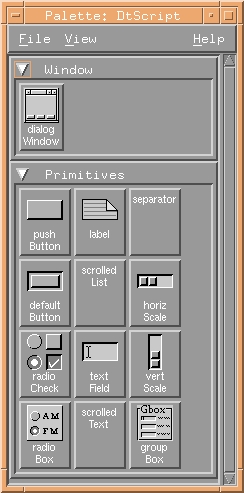
Figure 2. AIX QtScript GUI Builder
Developers can create their own new APIs for DtKsh by creating glue-layer libraries. Glue-layer libraries enable DtKsh to be extended with built-ins for functions such as system management and networking. The performance advantage of using built-in functions rather than calling to an external command is that built-ins execute within the process of the shell script. Commands that are called externally must create new resources in the operating system and run as separate processes. DtKsh glue layer libraries pass arguments between a normal UNIX C library and the DtKsh shell, and they return a success or failure status. The following list provides a few rules for creating a glue layer:
Name the function with a b_ prefix.
Function returns a 0 integer for success, between 1 and 255 for failure.
Function should take argc and argv as input.
Link your glue-layer libraries shared.
Listing 3 shows a DtKsh shell script that dynamically loads the “example” shared glue-layer library. Once the glue layer library is loaded and the new built-in APIs are defined, the script can make direct calls with arguments to the new built-in functions. In Listing 3, the example built-in is called with the “Hello World” arguments.
By providing in-line built-in functions, we can run scripts much faster because we are not relying on outside programs running as separate system erocesses. Listing 4 shows the C glue-layer for the example built-in shared library. Following the rules outlined above, we prefix the example function with a b_, and we pass in an argument vector and its size. After the function has done its work, we return 0 for success and a positive integer for failure. DtKsh built-in functions can also act as procedures that pass environment variables in and out through its argument list. See Desktop KornShell Graphical Programming by J. Stephen Pendergrast, Jr. [Addison-Wesley, 1995] for more details on how to pass and retrieve environment variables from built-in procedures.
The Desktop Graphical Korn Shell provides programmers with the standard ksh93 baseline APIs with the addition of the X Window System, Motif and the Common Desktop Environment. Shell programmers can write portable shell scripts, prototype GUI shell scripts and migrate GUI shell scripts to faster running C programs. DtKsh also provides programmers with the ability to extend the shell language with built-in shared libraries so that scripts can benefit from feature-rich libraries, such as those for configuration management.

