Satellite Remote Sensing of the Oceans
The remote sensing group at Southampton University Department of Oceanography (SUDO) works on many different aspects of Earth observation for applications such as climate monitoring, pollution control and general oceanography. Linux first appeared in the Oceanography Department in 1994 and has steadily become the workhorse OS.
Earth observation is now a familiar topic to almost everyone. Many of us are used to seeing satellite images of the Earth every day whether it's in the news, TV documentaries or just the national weather bulletin. More and more Earth observation satellites are being launched all the time. Here at SUDO we deal primarily with observation of the world's oceans, and we use many types of satellite data in studying various surface features. Satellites produce vast amounts of data, and large satellite images can be very difficult to use for this reason. The days when a low-powered PC could churn through a satellite dataset are long gone. Today we are required to process more and more images as the speed of the hardware gets faster.
We use IDL (Interactive Data Language) to process all our satellite and meteorological data. This package is very good as it allows us to read, warp and manipulate images easily as well as providing lots of useful built-in math functions for detailed analysis of our data. IDL (http://www.rsinc.com/) is now on its fifth release and is extensively used by the satellite community all over the world. IDL places a lot of demands on the system, so on anything less than the quickest 486, IDL will be incredibly slow. These days IDL is available for almost every type of platform.
Sooner or later, when a machine is pushed to the limits to do its job, you may have to worry about the operating system (OS) you are using. When you are running jobs that take hours or even days to run, the last thing you need is your system to crash or hang. Similarly, when your system isn't fully loaded, you would like to be able to run several jobs to make more efficient use of your resources. A few years ago we discovered that by using Linux we could accomplish all of this. As usual though, the change had to come from within in order to establish Linux here and show its strengths against systems such as MS Windows.
When I arrived in the Department, it became apparent that I would need a reliable method of wading though the enormous amounts of data I was required to process. I became particularly frustrated with the Microsoft Windows environment which frequently crashed and gave everyone headaches. In our research we can't afford to have our programs crashing, particularly since they take so long to run. In those days you could perhaps process one image in an hour, if your top-of-the-line 486 was up to it, so frequent multiple crashes could quite easily eat up much of the day. Of course, our single SPARC station never had these kinds of problems so there was fierce competition between colleagues to use it. We tried at first to use the machine remotely from our PCs using Vista Exceed. This proved very successful at first, but eventually the SPARC station became so overloaded with users that it was quicker to go back to using Windows again.
Then one of our Mexican Ph.D. students, Miguel Tenorio (now at CISESE, Ensenada in Mexico), told us of an exciting OS called Linux which could turn a humble PC into a powerful Unix workstation. I was very skeptical at the time and refused to believe that the Slackware version he had running on his 386 could possibly improve our efforts, especially since he was not able to run X because of memory limitations. However, he proved us all wrong later when he installed a full Slackware version with X on one of our better 486s, and since that time we have never looked back. Now our group has a suite of high-spec 486 and Pentium machines running Caldera Linux and Slackware Linux and utilising the powerful processing and data analysis power of IDL. IDL is the software we use most for our data processing, although occasionally we have to write the odd C program or Unix script. IDL has been around on Unix and Windows for a long time and was recently fully ported to Linux, much to our relief.
Global warming is a phenomenon that might very well affect us all one day. By using data from infrared radiometers in space, we can see how the average sea surface temperature (SST) changes over time so we can tell from the satellite image archives whether or not we are seeing changes in the Earth's climate. Because the ocean has such an immense thermal capacity, even a small change (e.g., 0.1 degrees C) in the average SST can imply a huge change in the Earth's heat budget. Unfortunately, the SST as measured from a satellite is a measure of the temperature of only the top millimeter of the ocean and does not always reflect the true sea surface temperature a few centimeters below because of the cooling effects of the wind and evaporation. Sometimes the “skin temperature” of the ocean can be as much as half a degree cooler than that of the bulk temperature just a few centimeters below. It's therefore important that we understand how the skin of the ocean behaves under different meteorological conditions, so that we can apply a correction to the satellite measured SST to account for the variability of the temperature of the ocean skin layer. After all, the skin temperature variability (up to 0.5 degrees C) is larger than the sort of changes in SST we are looking to measure for global climate research (0.1 degrees C).
The biggest source of error in estimating SST from space is the atmospheric absorption due to water vapour in the atmosphere. One method of dealing with this is employed by the Along Track Scanning Radiometer (ATSR) on board the ERS-2 remote sensing satellite. This radiometer views the sea at two different angles, 0 and 55 degrees to the vertical so that there are two images for every patch of sea. By looking at the difference between these two images, taken through two different thicknesses of atmosphere, a correction factor can be calculated to adjust the images for atmospheric absorption.
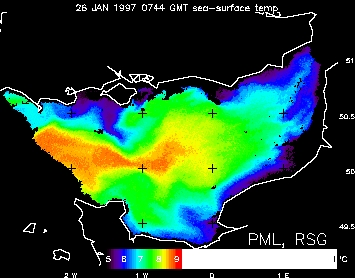
To study the atmospheric effects and the skin effect on measuring SST from space, I use marine infrared radiometers to measure SST at the same time as the satellites pass overhead, thereby getting simultaneous SST measurements. The ship I use is a ferry vessel, the MV Val de Loire (Figure 1) which sails regularly across the English Channel. Figure 2 shows a thermal infrared satellite image of the English Channel for January 1997 at which time the MV Val de Loire was approaching the French coast. The ship's radiometer and meteorological data are currently being used to evaluate the effect of the cool ocean skin on remotely sensed SST under a wide range of environmental conditions.

Figure 1. MV Val de Loire Ferry European Space Agency
Figure 2. Infrared Satellite Image of English Channel European Space Agency
Using IDL under Linux I have found I can process all my data simultaneously rather than running batch jobs that eat up the whole DOS machine. One of the future ideas for this project is to have the ship data telemetered back to base here in Southampton, so that it can be processed and archived in real time rather than collected by hand. However, we have to await further funding for that to happen.
Synthetic Aperture Radar (SAR) imaging of the Earth is becoming increasingly popular due to the fact that these radars can be used regardless of the atmospheric conditions—they easily penetrate clouds, whereas clouds absorb almost all the sea surface infrared signals of infrared imaging instruments. The SAR gathers global information by emitting a beam of microwave radiation towards the sea surface of the world's oceans.
Figure 3. SAR Imaging European Space Agency
If the sea surface is smooth, i.e., calm conditions, the surface acts like a mirror reflecting the incident beam in a direction away from the satellite. If the sea surface is roughened by wind or currents, then some of this incident beam is reflected back to the satellite and is received by the SAR. Thus, the stronger the backscattered signal, the rougher the sea surface.
Marine surface pollution is something we see all too often on television and in the news. The enduring images of stricken sea birds and baby seals on oil-soaked beaches put a lot of public pressure on environmental agencies to monitor marine pollution and catch the culprits who may be illegally dumping oil/waste off our shores. There is work going on in our group related to the observation of sea surface slicks, both man-made and natural. This type of work is suited to “SAR” studies.
The SAR on board the ERS-2 satellite sends images of the ocean surface back to Earth receiving stations on a regular basis. The SAR images reveal a surprising amount of structure on the sea surface reflecting just how rough the sea actually is at the time the image is acquired. Where the sea surface is rough, the radar beam is strongly scattered back to the satellite antenna; and where it is smooth, the beam is strongly reflected from the sea surface away from the antenna.
Slicks have the effect of calming the sea surface and damping wave motion thereby resulting in most of the radar beam being reflected away from the antenna. On a SAR image, slicks typically appear as dark patches on the sea surface corresponding to calm conditions. Using IDL under Linux, sophisticated processing routines have been developed that reveal slick-like features on the sea surface and provide information about their position. Wind speeds can also be determined from the radar backscatter which helps to predict where the surface wind-driven currents may move the slick. The main problem with processing this data is the image sizes. The raw SAR images are 130MB in size and take a long time to process before they can be displayed on the screen. Linux has proved to be much more reliable at handling SAR data than MS Windows, and it is much faster too.
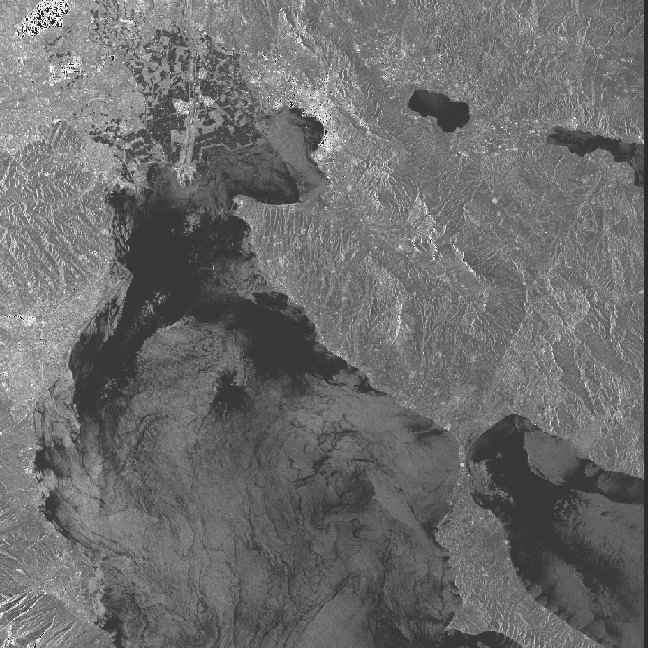
Figure 4. ERS SAR Coast of Greece, 1996 European Space Agency
The scene in Figure 4 is a good SAR image of the Gulf of Thermaikos in the Aegean Sea, just off the coast of Greece. The image was taken by the ERS-2 SAR on 25 May 1996 at 20:43 GMT. A number of oceanographic features evident in this image which are of general interest. The numerous black swirls and bands across the water surface correspond to surface slicks. Much of the slick material comes from a river outflow at the edge of the city of Thessaloniki, seen at the top left in the image. This reverine material is concentrated around the top of the bay and is then distributed throughout the gulf by eddies, tides and wind-driven currents. Incidently, the dark square patches around the town are probably rice fields which give very little radar return signal. In the bottom right of the image is the edge of Mount Olympus, mythical home of the Greek gods.
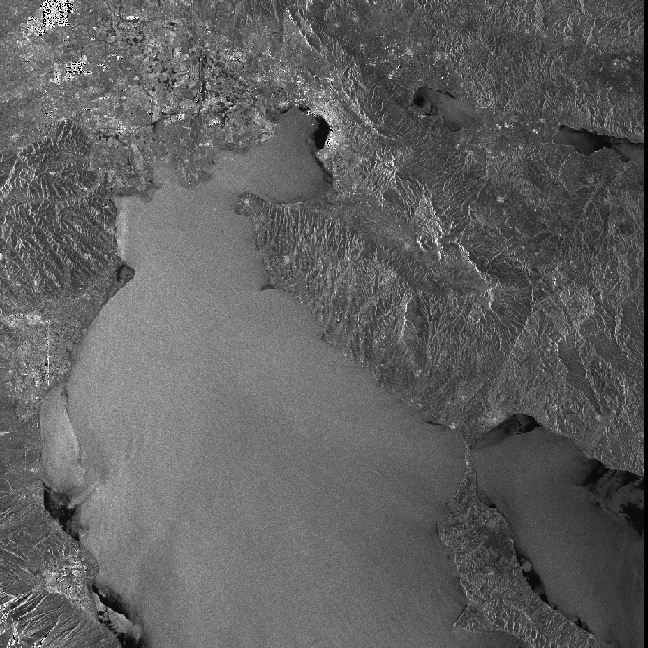
Figure 5. ERS SAR Coast of Greece, 1995 European Space Agency
Figure 5 shows the same area one year earlier, but this time there is very little of oceanographic interest in the image. The sea appears to be bright, which implies that most of the radar signal had been backscattered towards the SAR. This suggests that the sea surface is very rough (wind speeds greater than 10 meters per second), rough enough to break up any slick material and destroy the surface signatures of eddies and weak currents. Around some of the Eastern coastline are dark patches which correspond to areas of water which are sheltered from the effects of the wind by the mountains and are therefore calm, backscattering very little of the radar beam towards the SAR.
The full potential of SAR is yet to be realised, and the European Space Agency is keen to see the SAR data it produces fully used. Military applications include looking for surface vessels and the surface signatures of submarines, although here at SUDO we deal strictly with the oceanographic science.
Modeling of phytoplankton blooms and the subsequent chlorophyll concentrations is also done here at the University in conjunction with satellite ocean colour data. This data reveals information about pigment concentration that is a measure of the biological activity in the water. The pigments are part of the phytoplanktons' biological strategy for getting energy from sunlight (photosynthesis) so they can live. The study of phytoplankton blooms is very important for the study of the carbon cycle and its global warming implications.
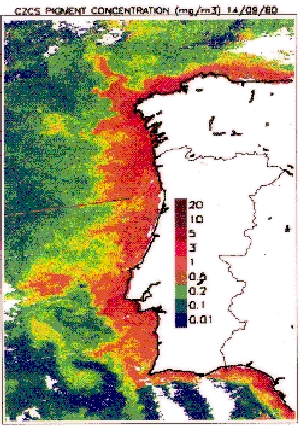
Figure 6. Ocean Colour Image/Airborne or CZCS
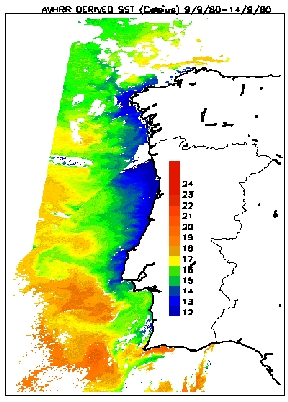
Figure 7. Thermal Image from AVHRR Satellite
Figure 6 shows an interesting image from the Coastal Zone Colour Scanner (CZCS) which is an instrument which flew on the Nimbus 7 satellite. The instrument is no longer functional but worked well between 1978 and 1985. The image data were acquired on 14/9/80 and show the Western coast of the Iberian Peninsula. The image shows pigment concentration during a strong upwelling event. (Equatorward winds push the water away from the coast, and cool water from beneath the surface is drawn upwards near the coast.) The pigments are produced by phytoplankton.
The subsurface waters are generally cooler in the coast than the surface and in Figure 7 this is shown on a coincident thermal image from the AVHRR satellite as the blue, cool area. So the high pigment concentrations in the CZCS image can be explained by the fact that the upwelling event observed in the thermal image has led to the pigments being brought closer to the surface where they are more visible to the CZCS satellite instrument. Also, nutrients upwell with the phytoplankon and as they are closer to the surface, where there is more light, they are able to photosynthesise more effectively and thus form large blooms. This multi-sensor approach to oceanography (using complementary data from different sources, e.g., WAR, thermal and visible imagery) provides a more comprehensive view of a region than would be obtained using only one source of data.
For serious image processing you need a fast machine with good graphics support. For satellite images you also need vast amounts of storage. So I will talk about these in turn, bearing in mind that cost is always a factor.
At the moment Intel P200 and AMD K6 processors are very fashionable although price-wise a P166 will give comparable performance for much less money. It's difficult to make price comparisons though because here in the UK electronic components are generally more expensive than in most other countries. The Intel 430TX motherboard is generally the one I would choose at the moment, USB and Ultra DMA support being standard.
Depending on the amount of time you spend using your machine for graphics I would recommend at least a 17-inch colour monitor. We do have some Illyama 21-inch monitors, but at the moment those extra few inches double the price of the monitor. A fast graphics card with lots of on-board RAM will make your machine update the display much faster, especially if you are using large images. Any S3 card (e.g., S3 trio v64+) with 2MB+ on board should give you enough to cope with most demands, although a 4MB card should give plenty of scope for dealing with vast displays, especially when using the monitor at its highest resolution.
Our group has about 10GB of storage space allocated on the network server, which is almost enough. If you need speed, you need a lot of disk space local to the machine. The local hard disks of workstations are rarely backed up, so beware of depending on it too much. About 3GB of hard disk space is sufficient, and these days E-IDE is about as quick as SCSI and certainly cheaper. New IDE disks have Ultra DMA which allows a 33MB/s transfer rate, double that of the old IDE, although you will need at least the 430 TX motherboard to take advantage of this rate.
Many images are now distributed on CD-ROM because it is such a cheap way to distribute large quantities of data. A 12-speed CD with ATAPI controller will suffice for most requirements, although the speed of CD-ROM drives is getting faster by the month.
As I have mentioned, IDL is our favorite package for dealing with satellite images even though many are available. Most tend to be inflexible and tailor-made for doing specific types of image analysis. IDL can do most of the same operations more cheaply and flexibly while allowing you to interact with the data and merge data from several sources. However, IDL is a programming language in its own right, so there is a learning curve inherent to using it.
The choice of other system components is not as critical as choosing the video card, motherboard, processor and monitor. When it comes to backing up our data, an Exabyte drive suits us nicely for backing up anything less than 5GB in size.
Again, IDL is the main processing software for this type of work. Many users feel they are comfortable using LaTeX under Linux too, although this appears to be a point of contention. Most of us are still locked into using MS Word for want of a cheap Linux word processor that is Word compatible and can handle multiple data formats and equations. We are now looking at some alternatives like Applixware.
Linux has reduced the computing cost of the Oceanography Department's satellite remote sensing group in terms of both time and money. Its stability has been its greatest asset in converting die-hard Windows fanatics into potential Linux gurus. For many of us Linux has enabled us to embark on a voyage of discovery into the computing world. We now have a deeper understanding of how our PCs work as Linux has brought us closer to the machine. We are currently reviewing the hardware and software requirements of the group for the next couple of years. We plan to continue using Linux well into the next millennium and are quite happy with the decision.
Acknowledgements
The SAR images in this article were obtained free from the European Space Agency.