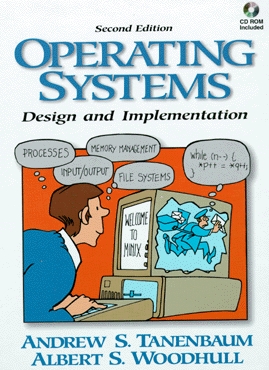
Operating Systems, Second Edition
Authors: Andrew S. Tanenbaum and Albert S. Woodhull
Publisher: Prentice Hall
http://www.prenhall.com/
Price: $66 US
ISBN: 0-13-638677-6
Reviewer: Boytcho Peytchev
Operating Systems: Design and Implementation is an introductory book designed for people who have already dealt with the basics of programming. When reading this book, a knowledge of both C and assembly language is helpful but not required. In particular, not knowing assembly will not prevent you from understanding the book, but it may slow you down.
The first chapter of the book is an overall introduction to the topic of operating systems. It starts with an explanation of what an OS is and a short historical summary on the evolution of operating systems. Then, the basic concepts of operating systems are explained and the different possible structures for an OS are introduced. The introduction ends with an overview of the remaining chapters of the book.
The style of the authors is very straightforward, making the information easy to follow and understand. The text doesn't get side-tracked into irrelevant topics, a problem found in many text books.
Another strong point of this book is that it is not only a theoretical introduction to operating systems programming but a practical one as well. The included CD-ROM contains MINIX 2.0 complete with source code and several simulators for non-Intel machines. The code is meant to be backward compatible with processors as old as the 8088, so if there's an old machine gathering dust in the basement, it can still be put to use for experimenting with the concepts covered in the book. The theoretical and practical parts of the book are well-balanced and easy to separate, so that one may use the book only for the theoretical parts or only for the practical parts.
Installing MINIX from the CD-ROM is not too hard, but if you have done installations before, the experience will help. The installation instructions have some minor inaccuracies, but a log file from an installation done by Andrew Tanenbaum is also provided, which clarifies the situation.
The chapters following the introduction each deal with a specific concept of OS programming. Chapter 2 is dedicated to processes, Chapter 3 to I/O, Chapter 4 to memory management and Chapter 5 to file systems. Each of these chapters starts with a description of the concept and the theory behind it. The chapter then continues to detail how the concept is realized in MINIX. This part of the chapter follows the source code line-by-line explaining what is being done by the corresponding piece of code.
Another practical side of the book is that all the code explained is contained in Appendix A, which means that there is no need for piles of printouts or a screen when one is trying to follow the description in the book.
Every chapter is followed by exercises that provide for good, practical implementation of the topics discussed.
The book ends with a suggested reading list ordered according to the concepts described in the book.

Realizing the promise of Apache® Hadoop® requires the effective deployment of compute, memory, storage and networking to achieve optimal results. With its flexibility and multitude of options, it is easy to over or under provision the server infrastructure, resulting in poor performance and high TCO. Join us for an in depth, technical discussion with industry experts from leading Hadoop and server companies who will provide insights into the key considerations for designing and deploying an optimal Hadoop cluster.
Sponsored by AMD
Built-in forensics, incident response, and security with Red Hat Enterprise Linux 6
Every security policy provides guidance and requirements for ensuring adequate protection of information and data, as well as high-level technical and administrative security requirements for a system in a given environment. Traditionally, providing security for a system focuses on the confidentiality of the information on it. However, protecting the data integrity and system and data availability is just as important. For example, when processing United States intelligence information, there are three attributes that require protection: confidentiality, integrity, and availability.
Learn more about catching the bad guy in this free white paper.
Sponsored by DLT Solutions
| Dynamic DNS—an Object Lesson in Problem Solving | May 21, 2013 |
| Using Salt Stack and Vagrant for Drupal Development | May 20, 2013 |
| Making Linux and Android Get Along (It's Not as Hard as It Sounds) | May 16, 2013 |
| Drupal Is a Framework: Why Everyone Needs to Understand This | May 15, 2013 |
| Home, My Backup Data Center | May 13, 2013 |
| Non-Linux FOSS: Seashore | May 10, 2013 |
- Dynamic DNS—an Object Lesson in Problem Solving
- Making Linux and Android Get Along (It's Not as Hard as It Sounds)
- Using Salt Stack and Vagrant for Drupal Development
- New Products
- Drupal Is a Framework: Why Everyone Needs to Understand This
- Download the Free Red Hat White Paper "Using an Open Source Framework to Catch the Bad Guy"
- Validate an E-Mail Address with PHP, the Right Way
- A Topic for Discussion - Open Source Feature-Richness?
- New Products
- Dart: a New Web Programming Experience
Enter to Win an Adafruit Pi Cobbler Breakout Kit for Raspberry Pi

It's Raspberry Pi month at Linux Journal. Each week in May, Adafruit will be giving away a Pi-related prize to a lucky, randomly drawn LJ reader. Winners will be announced weekly.
Fill out the fields below to enter to win this week's prize-- a Pi Cobbler Breakout Kit for Raspberry Pi.
Congratulations to our winners so far:
- 5-8-13, Pi Starter Pack: Jack Davis
- 5-15-13, Pi Model B 512MB RAM: Patrick Dunn
- 5-21-13, Prototyping Pi Plate Kit: Philip Kirby
- Next winner announced on 5-27-13!
Free Webinar: Hadoop
How to Build an Optimal Hadoop Cluster to Store and Maintain Unlimited Amounts of Data Using Microservers
Realizing the promise of Apache® Hadoop® requires the effective deployment of compute, memory, storage and networking to achieve optimal results. With its flexibility and multitude of options, it is easy to over or under provision the server infrastructure, resulting in poor performance and high TCO. Join us for an in depth, technical discussion with industry experts from leading Hadoop and server companies who will provide insights into the key considerations for designing and deploying an optimal Hadoop cluster.
Some of key questions to be discussed are:
- What is the “typical” Hadoop cluster and what should be installed on the different machine types?
- Why should you consider the typical workload patterns when making your hardware decisions?
- Are all microservers created equal for Hadoop deployments?
- How do I plan for expansion if I require more compute, memory, storage or networking?


2 hours 15 min ago
4 hours 6 min ago
9 hours 19 min ago
12 hours 31 min ago
14 hours 46 min ago
15 hours 14 min ago
16 hours 13 min ago
17 hours 41 min ago
18 hours 50 min ago
19 hours 36 min ago