
Book Reviews: Active Java and Exploring Java
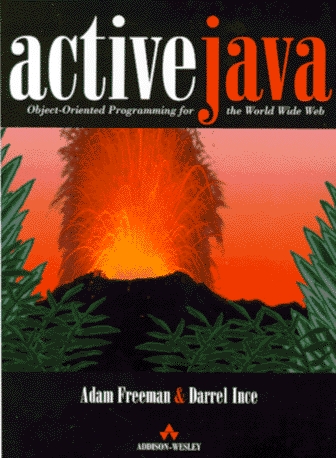
Title: Active Java: Object-Oriented Programming for the World Wide Web
Author: Adam Freeman & Darrel Ince
Publisher: Addison-Wesley
Price: US$25.95
ISBN: 0-201-40370-6
Title: Exploring Java
Author: Patrick Niemeyer & Joshua Peck
Publisher: O'Reilly & Associates
Price: US$24.95
ISBN: 1-56592-184-4
Reviewer: Danny Yee
Somewhat bemused by the marketing frenzy and in no particular hurry to learn yet another programming language, I have refrained from asking for review copies of any books on Java. Nevertheless, a few turned up on my doorstep anyway, and I found it hard to resist finding out what all the fuss is about.
The first book to arrive, and the only one I read right through, was Active Java. This is an introduction to Java aimed at those having basic programming competence but no experience with an object-oriented language. The book works its way through the elements of the language, explains how to use the awt and net libraries, introduces the Java Development Kit and the basics of writing applets and applications—and then concludes with a chapter on Java internals. The emphasis is on covering important ideas and concepts rather than on providing details. Active Java is easy to follow and clearly laid out, and I recommend it for anyone wanting a broad overview of Java. I think it would also make a good textbook for an undergraduate course, though it lacks exercises and is perhaps not repetitive enough.
As a supplement to Active Java, and a source of more detailed information, I used Exploring Java. This begins with a brief look at internals and security issues and then launches into a basic “Hello Web!” applet. This book contains detailed descriptions of the basic classes and standard libraries and is clearly aimed at experienced programmers who want to learn Java in order to write serious applications.
I have only glanced at the three other books on Java that arrived; Java in a Nutshell (O'Reilly) looks like a reference for the serious Java programmer; On To Java (Addison-Wesley) is a textbook with an unusual layout, using paragraphs numbered sequentially throughout; and Learn Java on the Macintosh (Addison-Wesley) comes with a Mac version of the Java Development Kit on CD-ROM. Anyone looking for a book on Java should search carefully: as even this small sample illustrates, there are books on Java for all sorts of niche markets. I wouldn't be at all surprised to see titles like From Common Lisp To Java For Amiga Users and 101 Implementations of Tetris In Java appearing!
Danny Yee received review copies of the books mentioned from Addison-Wesley and O'Reilly & Associates, but has no stake, financial or otherwise, in their success. He can be reached at danny@cs.su.oz.au.
