Applixware
Product: Applixware 4.2 For Linux
Publisher: Red Hat Software, Inc.
Phone: 800 454-5502
Fax: 203 454-2582
WWW: http://www.redhat.com/
Price: USD $495, student price USD $79.95
Reviewer: Gary Moore
Applixware is is an excellent “office suite” that may open doors to wider use of Linux.
Applixware features a word processor, a spreadsheet, a presentation graphics tool, a drawing tool, an e-mail client, database connectivity and an object-oriented application builder. For some time, this professional set of programs has been available for other Unix platforms, including HP-UX, Solaris, AIX and Digital Unix, and now Applixware is available for Intel-compatible Linux machines and Microsoft Windows; at the time of this writing, the NT version is out and the 95 version is in beta testing.
If you install Applixware on your system, you'll notice an impact on system resources. A complete installation with the included Red Hat RPM files requires 210MB—if that's more than you have available, you can make a partial installation from a live, “unpacked” directory on the CD-ROM. In fact, Applixware can be launched and used directly from the CD-ROM, though this makes program operation a little leisurely. I was using Red Hat Linux 4.0 when I reviewed Applixware, but the software should work fine on other distributions, and installation instructions are included.
The CD speed may not seem bad if you're using a 486DX25, on which Applixware is fast enough to be usable, but probably too slow for a production environment; I found my meager CPU power to be a real problem only when I started using the graphics tools.
This is not an application for low-memory systems. As cheap as RAM is today, this shouldn't be too painful a state to rectify. With 16MB of RAM, the word processor was snappy enough with X and the Afterstep window manager running, but having much else loaded caused so much paging of virtual memory I needed something to read while waiting.
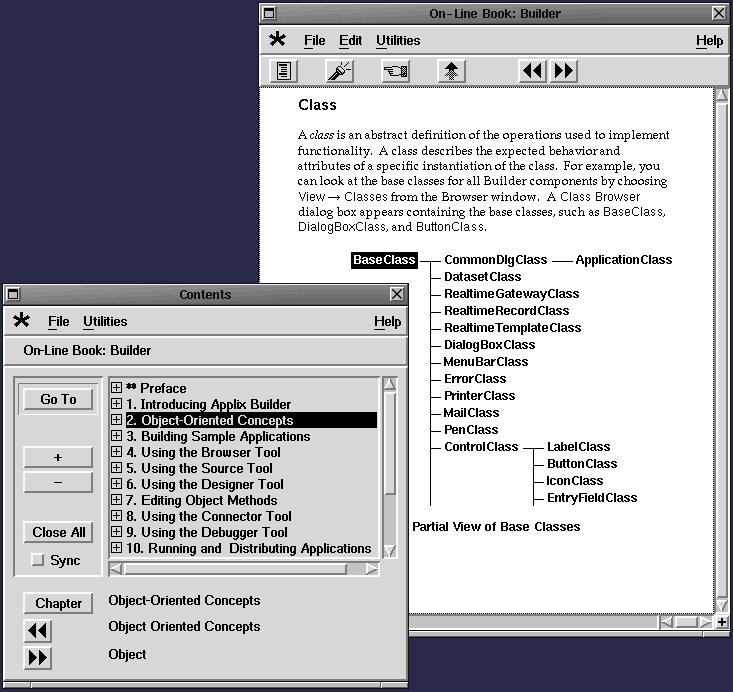
Not much reading material comes with Applix—at least, not on paper. Back when it was known as Asterix and also in version 3.x of Applix, there was a manual for each module, but either with the Linux version or with the later releases, virtually all documentation is in the “On-Line Books”. Use the on-line tutorials if you're new to the system, or the on-line help if you just need a reference.
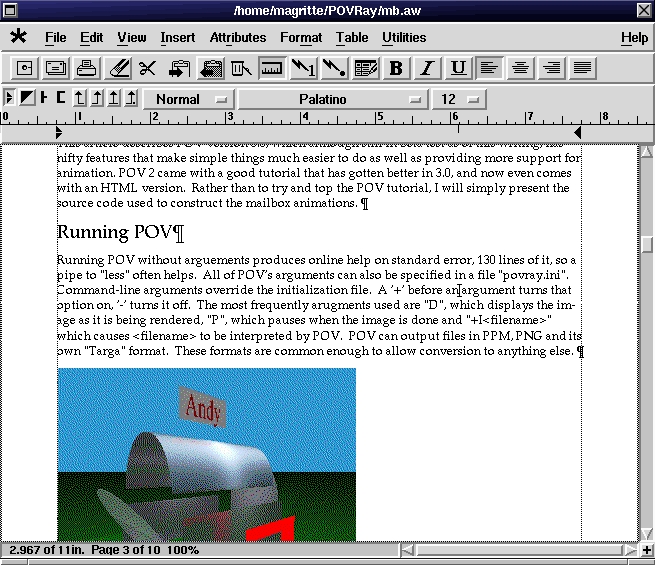
Applix Words is a full-featured word processor with everything you'd expect to find in a modern product. That is, unless you're looking to do something which really should be done using desktop publishing software. By the way, one thing you never want to do with it is embed, oh, 80 or so large, 256-color GIFs in a single document—at somewhere around 8MB, application behavior gets a bit wacky. Linking is much, much better.
Words gives you tables, borders, shading, embedded equations and calculations, conditional text and cross-referencing, international dictionaries, thesauri and a multi-font, multi-size WYSIWYG display. You can rely on multiple undo and redo, and when you're done, you can save PostScript and PCL printer files or send them directly to a networked printer.
HTML is easy with the Applix HTML authoring tool. Documents can be imported from Applix or another popular word processor using one of the format filters or created from scratch with the same ease as a word processing document. Clip art, GIFs and linked or embedded Applix Graphics images are converted seamlessly. Applix Spreadsheets documents and queries from the database interface application, Data, can be included, too. Tables, colors, and more than 25 standard HTML styles are all under your control.
Applix Graphics is a terrific drawing and presentation graphics tool. At your disposal are user-definable fill patterns, various brush styles, shearing, drop shadows, incremental zoom, rotating, scaling, color pixel editing and text wrapping, to name a few. Grid snap, guide lines, rulers, and coordinates help create precise and complex drawings quickly. I found graphics as easy to produce with Graphics as with Powerpoint.
The good news continues with Applix Spreadsheets with calculation-based attributes, 3D charts, named views and dynamic links to objects in other Applixware applications. When your linked data from elsewhere changes, it is automatically updated in your spreadsheet. There are live links to a relational database through Applix Data, goal seeking, drag-and-drop, projection tables and background recalculation. You can import those old Lotus 1-2-3 and Excel spreadsheets, too.
You might not think you need another mail client, but check out Applix Mail. When you receive mail, a dialog box pops up with the sender name and subject, giving you the options “Read Now”, “Read Later”, and “Help”. You can attach Applix files to your mail messages and upon receipt, launch the appropriate Applix tool for viewing. Mail can be marked “Urgent”, marked with a “Reply by” date, and also sent by “certified” mail, giving you a receipt when the recipient has read the mail. Of course you can “Cc” and “Bcc” people. You also get shared mail folders, automatic conversion of messages and documents to your preferences, encryption, and mail filtering based on rules you specify.
Applix Data connects Applixware applications to SQL databases like Informix, Oracle, Ingres, and Sybase, seamlessly querying data from one or more tables, selecting information with query conditions, and performing advanced queries and joins. Rows can be edited, inserted, and deleted. A live link in your document to the database means up-to-date data. Data provides a lot of capability when teamed with ELF and Builder.
The Extension Language Facility (ELF) is an interpreted language with which users can build and deploy applications, front-ends to applications, automate tasks and connect to databases and other external sources of data. The Applix user interfaces are built with ELF and ELF macros can be used to automate tasks in any of the Applixware applications. Some capabilities include: TCP/IP socket interfacing, remote procedure calls, interactive debugging, many built-in macros, string manipulation, and arithmetic and Boolean operators.
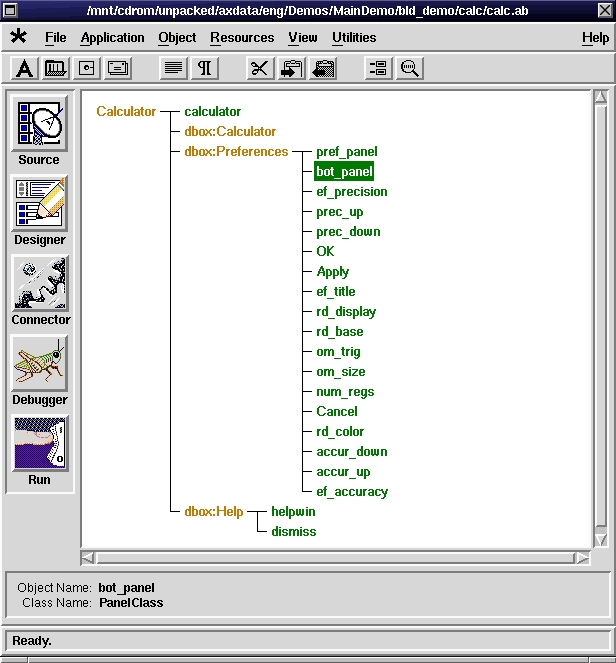
Builder is object oriented and gives you access to external data sources as well as the capabilities of the Applixware application suite for use in your custom applications. Also, full access to ELF macros and functions, external objects, shared classes, RPC and shared library support. Plus, the applications you develop in Builder on one platform are portable to Applixware on other platforms without modification.
Applixware is a terrific package. When I heard it was available for Linux, I knew I could let go of Microsoft Office (and MS Windows) forever.
Gary Moore is the Editor of Linux Journal.