
EOF - Adventures in Re-provisioning
You can model the San Francisco Bay Area with your right hand. Bring the tip of your thumb and index finger together, then part them slightly. The gap between them is the Golden Gate, with its famous bridge. Going clockwise from there, the end of your bent index finger is Marin County. Berkeley and Oakland are at the base of your index finger. San Jose is at the base of your thumb. The rest of your thumb is the Peninsula. San Francisco is the whole tip of your thumb. The knuckle below your thumb's nail is San Bruno Mountain. That's where our story starts.
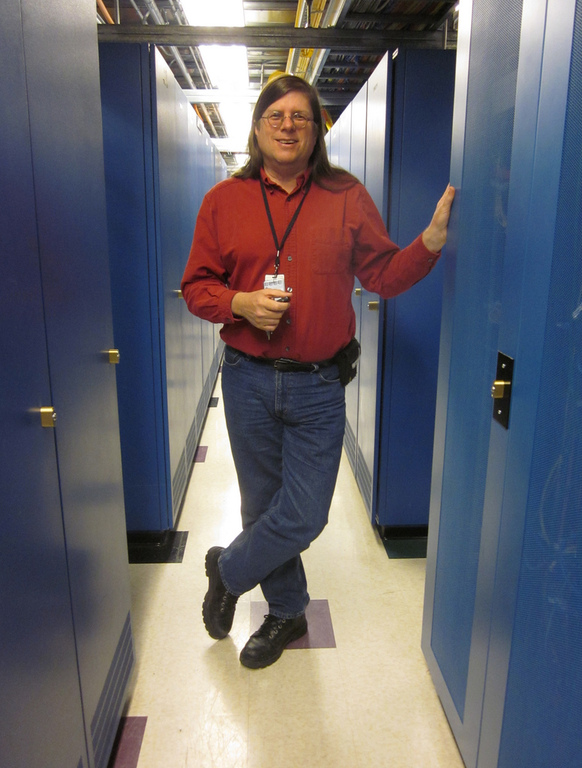
Tim Pozar in one of his natural habitats.
In the 1940s, San Bruno Mountain's long ridge began to bristle with towers for TV and FM stations. Since then, most of those stations have moved to Sutro Tower in the midst of the City—a landmark locals call “the world's largest roach clip”. One of the few remaining TV transmitters on San Bruno is KTSF, also known as Channel 26—that was its old analog channel. Now digital, it actually radiates on Channel 27, even if TV tuners still say “26”. In fact, the displayed channels for most TV stations in the US are now other than those they transmit on. Being digital, they can transmit data that tells the receiver what channel to display, regardless of the actual channel used. But that stuff hardly matters, because the percentage of Americans still watching over-the-air TV is down to single digits. Instead, they watch cable or satellite or bypass TV altogether and watch on a computer or a handheld mobile device. Still, KTSF puts out a signal with a listed power of a half-million watts. Thus, TV's mainframe age persists.
Inside the base of KTSF's tower is a small yellow shack with a leaky roof. It was here that I stood with Tim Pozar last May as he showed me how gear in a rack inside the shack was relaying many megabits' worth of Internet bandwidth from one point to another, each transmitter emitting signals measured in thousandths of a single watt. He and a colleague were busy shaking down a link to the Maker Faire that would happen down on the Peninsula a few days later. (It worked fine.)
Tim's long résumé includes decades spent both as an Internet pioneer and a broadcast engineer. Of the two tracks' convergence, he explained, “I do work for Univision in San Francisco building out video servers for them. I was talking to Don Ready over there, who is the Assistant Chief Engineer. He told me with some regret that he is doing very little 'broadcast engineering' now. Most of the time he is doing IT. Fiber, twisted pair, Ethernet, IP, switches, routers and Linux servers are the new technology for distribution of broadcast.”
But the shift isn't a matter just of swapping one tech for another. It involves clever and resourceful re-provisioning. In both principle and practice, re-provisioning is central to the means and missions of openness in general and Linux in particular. Old purpose-built structures host new stuff made for new purposes—or (as with the case of Linux) better ways of serving the old purposes. In many cases, the old and the new coexist and cooperate. KTSF and its high-wattage structures still operate within a broadcast regime that's leveraging its original infrastructure about as far as it will go, while new infrastructure gets built within the old. Credit goes to old systems welcoming the new and to resourceful pioneers, such as Tim and his colleagues with the Bay Area Wireless Users Group (and other groups with similar names).
In that latter category is the work Tim and his buddy Matt Peterson are doing on the Farallons Broadband Project, which is organized by the California Academy of Sciences, the City of San Francisco, the Internet Archive and the US Fish & Wildlife Service. The Farallons, or Farallones, are a collection of small rocky islands 27 miles from San Francisco. There is no hard electrical infrastructure connecting the Farallons to land. Electricity is made there mostly by generators. The Internet is provided by a few milliwatts of wireless from San Bruno Mountain.
The wireless project is an exercise in minimized cost and complication. The “kit” includes Ubiquiti Bullet M2 (2.4GHz) and Rocket5 (5.2/5.5GHz) radios, a Pacific Wireless radome antenna, a Soekris net5501 comms computer and a Cisco WCX-C2950 switch. He hopes we'll forgive him using OpenBSD 4.5. (He's done plenty with Linux in other settings, but for this project he says, “pf is great. Easy syntax, handles NAT tricks well.”) You can see one result through the Farallones Cam, which shows you plenty of the island's two main features: scary surf and zillions of birds.
I also followed Tim on a visit to the giant Digital Realty Trust data center, on the south edge of San Francisco. The center occupies a former retail chain furniture warehouse, which is another example of re-provisioning at work. The place is packed with servers for some of the most familiar domains on the Web, plus hundreds more of all sizes. What struck me standing in there, between racks and racks of humming equipment, is how much the whole place resembled broadcast transmission rooms. I could see there how the Net is almost done subsuming broadcast—and yet how giant data centers are hardly an end state for the Net itself. Much re-provisioning has yet to be done. In fact, it will never stop, as long as old structures and systems learn from new technologies and uses.
A photo set of my visit with Tim is at the Linux Journal Flickr site: www.flickr.com/photos/linuxjournal
Doc Searls is Senior Editor of Linux Journal. He is also a fellow with the Berkman Center for Internet and Society at Harvard University and the Center for Information Technology and Society at UC Santa Barbara.
