
EOF - Commons Interests
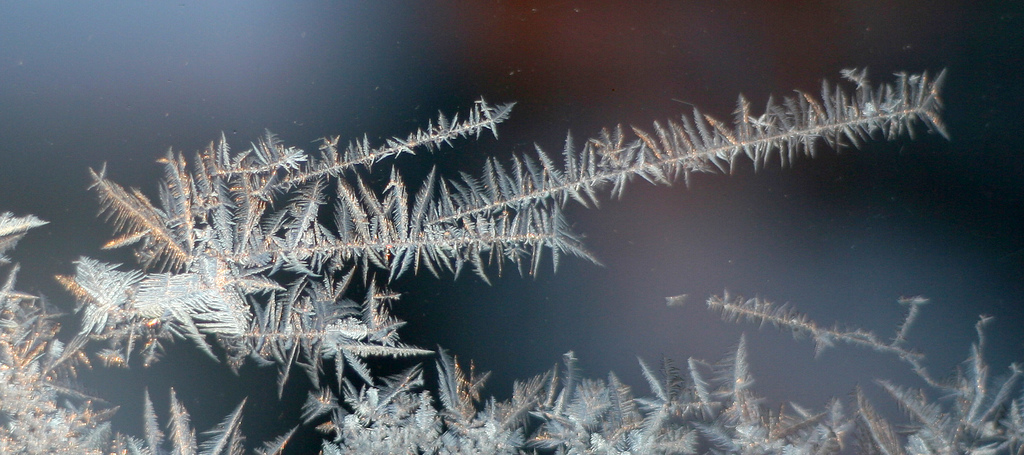
On a cold February morning in 2009, I noticed beautiful ice patterns had formed overnight inside our apartment's storm windows. Some looked like corners of snowflakes. Some looked like trees. Others looked like feathers. Naturally, I shot pictures of them. Later I put the photo set up on Flickr, tagged the images generously and gave them all a Creative Commons license meant to encourage their enjoyment and re-use. That license happened to be Attribution-Share Alike 2.0 Generic.
The decision to use that license was not a highly considered one. It's a default I chose back when I started uploading photos in 2005. On the whole, this has worked very well. For example, as of today, I have more than 34,000 photos on Flickr, more than 130 of which appear in Wikimedia Commons, and most of those also show up in Wikipedia. If you go to the Wikipedia pages for Boreray Island, San Gorgonio Mountain, Sarah Lacy or dozens of other topics, you'll find them illustrated by photos of mine, through no additional effort of my own.
I see this as nature taking its course. I am as generous with my photos as trees are with leaves in autumn, and I wish to exercise the same level of control over how they are used. I create them for the commons. Alas, while Creative Commons does offer public domain tools (http://creativecommons.org/publicdomain), Flickr doesn't leverage those. So instead I go with one that I hope will encourage re-use going forward, as well as credit back to myself—and to other creators, if any are involved.
Not that I mind making money. Over the years since I started posting on Flickr, about $400 has flowed my way, all in the form of voluntary payments for one use or another. Still, that's not my purpose in putting the pictures up there. My purpose is making them useful. To anybody.
In November 2009 one of those anybodies turned out to be Mark Levy, VP and Creative Director for NBC Sports, writing to say the network would like to use some of my winter ice images in graphic backgrounds for the upcoming Winter Olympics in Vancouver. Since text already would be running over those backgrounds, he asked permission to waive the license details and handle attribution by listing me in the credits as a member of NBC's design team. I said that was fine and didn't give it more thought until the Olympics started running. To my surprise, my ice photos served as framing elements for all kinds of stuff: talking heads in studios, features about athletes, titles of events and settings, and text running below the action on ski slopes and toboggan runs. It was not only fun to watch, but also to feel a sense of participation in a good cause that transcended the commercial interests involved. In other words, I felt honored, not exploited.
Some concern was raised, however, close to home—at Harvard's Berkman Center, where I have been a fellow for the last several years. Creative Commons was born at Berkman, when Lawrence Lessig was there around the turn of the millennium. One of the other fellows at Berkman, Herkko Hietanen (who wrote his doctoral thesis on Creative Commons) saw a potentially interesting problem with NBC's use of the photos. In his blog at MIT's Communications Futures Program, Herkko wrote, “...there is a legal side to the story that could have wreaked havoc. What NBC's designers may have missed was that the license Doc Searls used did not only require credit but also that the adaptations made from Searls' photos share the same license terms.” Later he added, “The exact amount of the material that would be affected with the ShareAlike term is unclear....To make the matter even more complicated, NBC does not own and can't license out many of the copyrightable elements that are shown on the screen next to the background graphics. There is no doubt that NBC never wanted its crown jewels, the Olympics, to fall to any royalty-free licensing scheme.” Herkko also noted that NBC and I were both satisfied with our agreement and added this response from Creative Commons VP Mike Linksvayer: “NBC's extensive use of Searls' photos, and Searls' happiness for that use, demonstrates the power of Creative Commons licenses as a means to signal openness to collaboration, even if the resulting collaboration does not occur under the terms of the license originally offered.”
But that didn't sit well with everybody either. On my blog, one commenter wrote, “Wow. Nice of you to give a corporation something worth a few thousand dollars for free, without even having them abide by the share-alike clause of copyleft!”
I still don't know what I should have done differently here. I believe in cultivating a culture of sharing, mixing and remixing. I also want to help Creative Commons push forward its pioneering work in copyright and reform. To be safe for now, I'm moving my photos on Flickr to a simple attribution license. But I'm also open to suggestions—for all of us.
Doc Searls is Senior Editor of Linux Journal. He is also a fellow with the Berkman Center for Internet and Society at Harvard University and the Center for Information Technology and Society at UC Santa Barbara.

